

China’s secret spaceplane comes into focus. What is it doing in orbit?
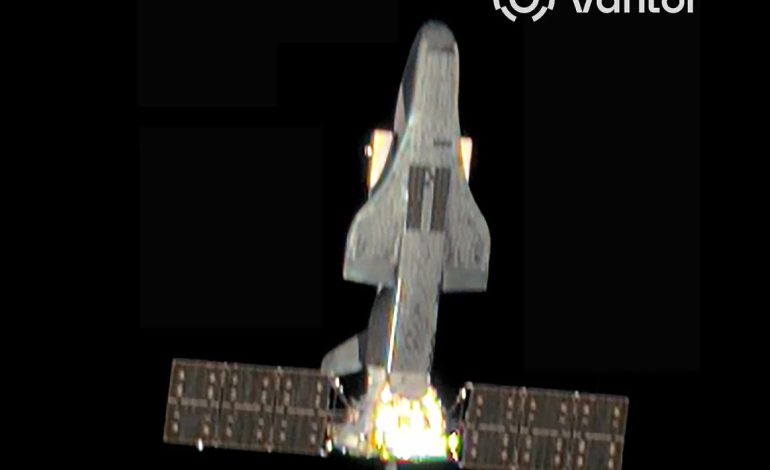
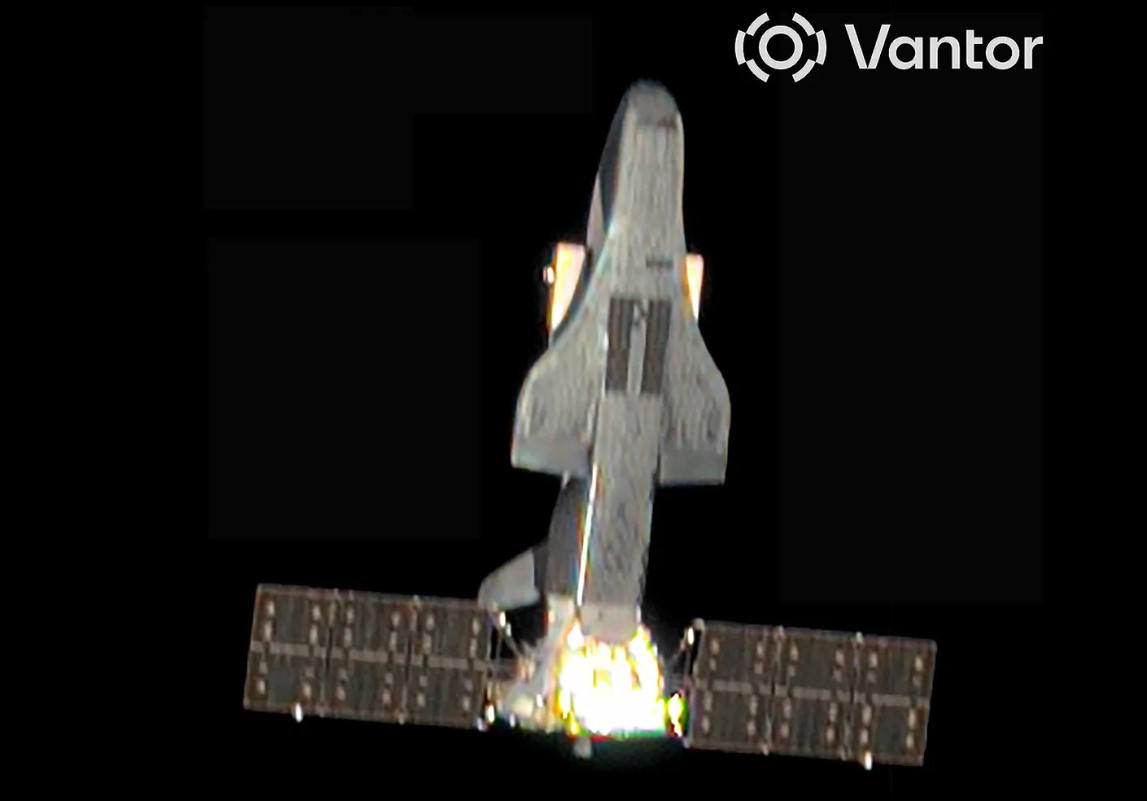
The Chinese secret spaceplane. (Image courtesy: Vantor (formerly Maxar Technologies), via DIA.)

New Delhi: A newly published US intelligence report has offered one of the clearest views yet of China’s secretive reusable spaceplane, revealing a shuttle-like spacecraft with an open payload bay and another object attached to its rear. The disclosure comes as the Chinese programme continues its fourth orbital mission, with tracking data suggesting increasingly complex experiments involving the release and possible recovery of a small satellite.
The image appears in the Defense Intelligence Agency’s (DIA) “Challenges to Security in Space” assessment, released this month. It provides unusually detailed visual evidence of a spacecraft whose existence Beijing acknowledges but whose design, equipment and precise operational objectives remain largely undisclosed.
The photograph was taken on May 28, 2024, during the programme’s third orbital flight, rather than during its current mission. Vantor, formerly Maxar, told the War Zone that its WorldView-3 satellite captured the vehicle from just under 90 kilometres away and identified a separate satellite docked at the rear, with its structure and solar arrays visible.
A less detailed version of the image had appeared in a US Space Force presentation in South Korea in 2024, although its identification attracted uncertainty at the time. Its inclusion in the DIA report now publicly establishes that the photograph depicts a Chinese spaceplane, while the higher-resolution release makes its configuration considerably easier to examine.
China announced the latest launch on February 7, saying a Long March-2F rocket had carried a reusable experimental spacecraft into orbit from the Jiuquan Satellite Launch Center. The brief official statement described the mission as a verification of reusable spacecraft technologies supporting the peaceful use of space, without specifying its duration or experimental payloads.
The latest available reporting indicates that the fourth flight remains underway, with no publicly confirmed landing identified as of October 30. Attention has increasingly shifted from how long the spacecraft can remain aloft to what it can do around other objects in orbit.
What we know about China’s reusable spaceplane
Even the spacecraft’s name requires qualification: it is widely called Shenlong, meaning “Divine Dragon”, but that designation has not been conclusively established for the operational vehicle. Chinese announcements generally describe it simply as a reusable experimental spacecraft, while the DIA’s image caption does not identify a particular model.
The programme, as RNA Media had reported in September, centres on an uncrewed vehicle launched into orbit aboard a rocket and recovered through a runway landing, combining the operating environment of a satellite with the atmospheric return of a winged aircraft. The Secure World Foundation’s assessment identifies repeated launches from Jiuquan and likely landings at Lop Nur, although China has released few details of its recovery arrangements.
Its flight record shows a substantial increase in endurance since the first mission in September 2020, which lasted about two days. A second flight, launched in August 2022, returned on May 8, 2023, after 276 days in orbit, demonstrating a capacity for much longer operations than the initial test.
The third mission began in December 2023 and ended on September 6, 2024, after 268 days in orbit. Chinese authorities presented that return as evidence of growing technological maturity and a step towards more convenient and affordable journeys between Earth and space.
The current mission has produced further evidence of satellite deployment: on June 22, the commercial tracking company, LeoLabs, detected an unfamiliar object near the spaceplane using its Tracker radar in New Zealand. In its public account of the observation, the company said subsequent measurements gave it high confidence that the object had been released from the Chinese vehicle, matching behaviour seen on earlier flights.
More recent analysis suggests the experiment may have involved recovering and releasing the same small satellite, rather than simply putting an object into an independent orbit. In the October 1 edition of Jonathan’s Space Report, the astrophysicist and spaceflight tracker, Jonathan McDowell, described orbital data consistent with possible capture, subsequent deployment and another possible recovery.
McDowell reported that the object remained well within one kilometre of the spaceplane between July 12 and August 31, before apparently separating again around September 1. From September 13, its published orbital data became indistinguishable from those of the spaceplane, suggesting another capture, although tracking data alone cannot establish whether the vehicles physically docked or how any recovery was accomplished.
These observations matter because deploying a satellite and subsequently recovering it requires more than a functioning cargo compartment. Such operations depend on controlled changes in relative position and speed, making them useful tests of the technologies needed to inspect, service or retrieve spacecraft.
The Secure World Foundation identifies rendezvous and proximity operations, docking or capture activity, and orbital manoeuvres among the programme’s demonstrated capabilities. Its assessment nevertheless distinguishes those achievements from claims that the vehicle has already been established as an operational anti-satellite weapon.
The distinction is significant because the same underlying techniques can serve different purposes: approaching and handling another spacecraft can support maintenance, inspection or experimental hardware recovery. Those capabilities also create potential military applications, but their existence does not establish that a particular mission involves interference with another country’s satellite.
In its June assessment, the Secure World Foundation said the spacecraft had not approached non-Chinese space objects and judged its feasibility as a weapon for attacking ground targets to be near zero. That assessment supports treating it principally as an experimental platform with possible dual-use applications, while leaving its undisclosed payloads and longer-term military role unresolved.
The closest operational comparison is the US Space Force’s Boeing-built X-37B, another reusable, uncrewed spacecraft used for extended orbital experiments. Boeing says its eighth mission carries demonstrations of laser communications and a quantum inertial sensor intended to support navigation when GPS is unavailable, illustrating the range of technologies a returnable spacecraft can test.
Reusability also allows experimental equipment to return for inspection, giving engineers an opportunity to examine how hardware performs after exposure to space. Boeing describes inspection and modification between missions as part of the X-37B programme, while China has repeatedly linked its own tests to reducing the difficulty and expense of round-trip spaceflight.
The photograph also demonstrates how commercial satellites can help scrutinize spacecraft that governments reveal little about. Vantor’s non-Earth imaging service uses its satellite constellation to observe objects in orbit, extending commercial imaging beyond the monitoring of activity on the ground.
Despite the clearer view, important questions remain unanswered, including the Chinese vehicle’s payload capacity, the equipment carried on its current flight and whether successive missions have used the same airframe. The available evidence establishes a reusable spacecraft conducting increasingly sophisticated orbital experiments, while leaving the full purpose of those experiments beyond public view.