In Manipur, 46 members of militant group surrender with arms as state intensifies peace push
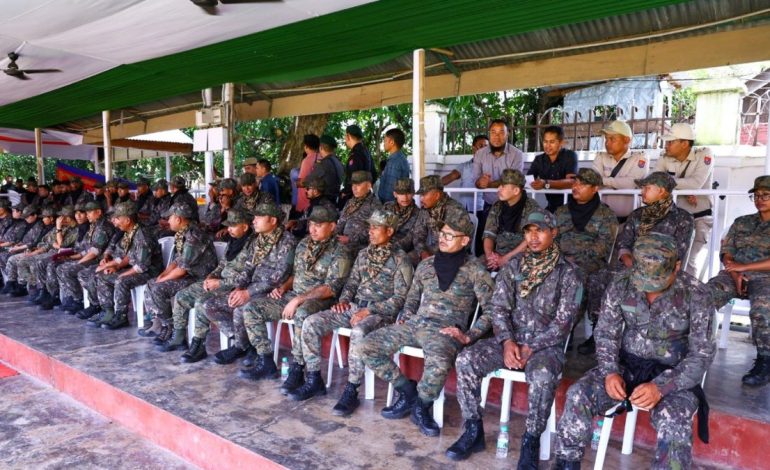
46 KCP cadres surrender with arms in Manipur. Image courtesy: X.com/@manishmedia

New Delhi: 46 cadres of the Kangleipak Communist Party (KCP) Taibanganba faction surrendered before the Manipur government in Imphal on Teusday, handing over 20 arms, 216 rounds of ammunition and three explosives. The surrender took place at a homecoming ceremony at the 1st Manipur Rifles Parade Ground.
The Hindustan Times reported that the group was led by self-styled chairman Haobijam Dilip alias Taibanganba, who had been arrested in New Delhi on May 28 by a joint team of Delhi Police Special Cell, Manipur Police and central intelligence agencies. The chief minister, Yumnam Khemchand Singh, appealed to remaining cadres to join the mainstream, saying arms would not bring peace in Manipur.
Under the Union government’s surrender-cum-rehabilitation scheme for militants in the northeast, those eligible to surrender can receive a ₹4 lakh grant kept as a fixed deposit for three years, a stipend of ₹6,000 a month for three years, vocational training and incentives for surrendered weapons and ammunition.
Another surrender in a month
The Tuesday event follows another significant surrender on July 21. Manipur Police said 42 cadres of the KCP (People’s War Group) laid down arms at Mantripukhri, handing over 28 weapons along with grenades, improvised explosive devices, detonators, ammunition and other war like stores.
The two surrenders within a month underline the government’s effort to draw armed cadres into the mainstream while maintaining pressure on groups that continue illegal activities.
How Manipur reached this point
Manipur’s present crisis erupted on May 3, 2023, amid tensions between the Meitei and Kuki-Zo communities over the Meitei demand for scheduled tribe status. The Union home minister, Amit Shah, told Parliament in April 2025 that the ethnic violence stemmed from a reservation related dispute triggered by a Manipur high court decision.
The violence caused deaths, destruction of homes and large scale displacement, leaving rehabilitation and reconciliation as central challenges even as the security situation improved. Manipur’s 2026-27 budget said there had been an improvement in law and order but identified the rehabilitation and resettlement of internally displaced persons as a primary concern. It provided ₹734 crore for their rehabilitation during the year.
An elected government returned to Manipur in February 2026, with Yumnam Khemchand Singh taking oath as chief minister on February 4 after a period of President’s Rule.
Security, rehabilitation and dialogue
The Centre’s approach combines security measures with rehabilitation, confidence building and negotiations with groups willing to renounce violence. The Union home ministry says its northeast division handles security related expenditure, surrender and rehabilitation, peace talks and implementation of agreements with insurgent groups as part of efforts to bring underground outfits into the mainstream.
During 2025-26, the Union home ministry provided ₹1,760 crore in special assistance to Manipur. This included ₹271 crore for security-related expenditure, ₹500 crore towards deployment charges for central armed police forces, ₹633 crore for prepayment of high-interest loans and ₹356 crore for rehabilitation support to internally displaced people.
The political track has also included engagement with armed groups. In November 2023, the Centre and the Manipur government signed a peace agreement with the United National Liberation Front (UNLF). The government described it as the first time a valley-based Manipuri armed group had agreed to renounce violence, honour the Constitution and return to the mainstream.