

Nipun delivered to Indian Navy: India’s new diving support vessel explained
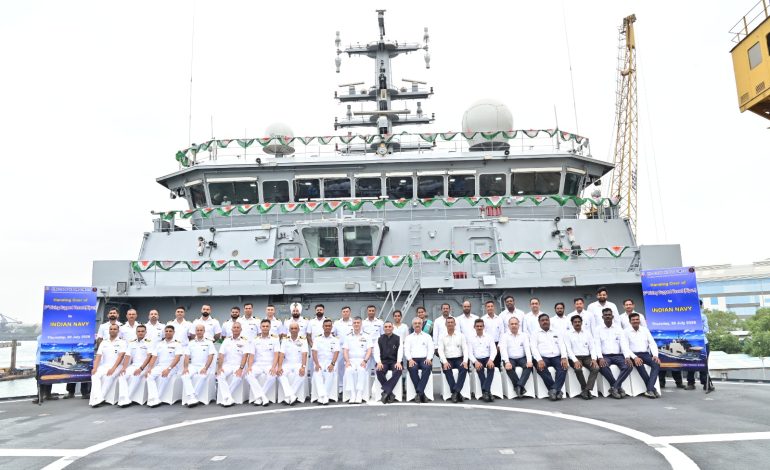
Rear Admiral Arvind Rawal from the Indian Navy and Rear Admiral Chandrasekharan Raghuram (Retd) from Hindustan Shipyard Limited (seated in centre) along with other officers, engineers, and executives from the Navy and HSL on Nipun after the diving ship’s handing over. (Photo: Indian Navy)

New Delhi: Hindustan Shipyard Limited (HSL) delivered the diving support vessel Nipun to the Indian Navy on Thursday. As RNA Media had reported, it marks the second such platform to enter the service within a year. The delivery strengthens the Navy’s underwater rescue and intervention capability at a time when India is steadily expanding its indigenous submarine fleet and deep-sea infrastructure.
The handover comes almost exactly a year after HSL delivered Nistar, the first of the two sister vessels, to the Navy in July 2025. Together, the pair gives India a dedicated diving-support and submarine-rescue capability on both its eastern and western seaboards for the first time.
The acceptance document, designated D448, was signed by Rear Admiral Arvind Rawal, chief staff officer (technical) at Western Naval Command and chairman of the D448 Committee, along with Rear Admiral Chandrasekharan Raghuram (Retd), HSL chairman and managing director. Rawal took over as chief staff officer (technical) at Western Naval Command in December 2025, having been commissioned into the Navy in July 1990.
The signing formalizes the transfer of the ship from the builder to the Navy and clears the way for sea acceptance trials ahead of formal commissioning.
Once commissioned, the vessel will be based in Mumbai and will operate as the Deep Submergence Rescue Vehicle mothership on the western seaboard, complementing Nistar, which serves the same role out of Visakhapatnam on the eastern coast.
What is a diving support vessel?
A diving support vessel, or DSV, is a specialized ship built to sustain divers and remotely operated equipment during extended operations at depth, rather than to fight or patrol like a conventional warship. It typically carries a saturation diving system, decompression chambers, cranes and remotely operated vehicles – all integrated so that crews can work safely for days at pressures that would be lethal without gradual acclimatization.
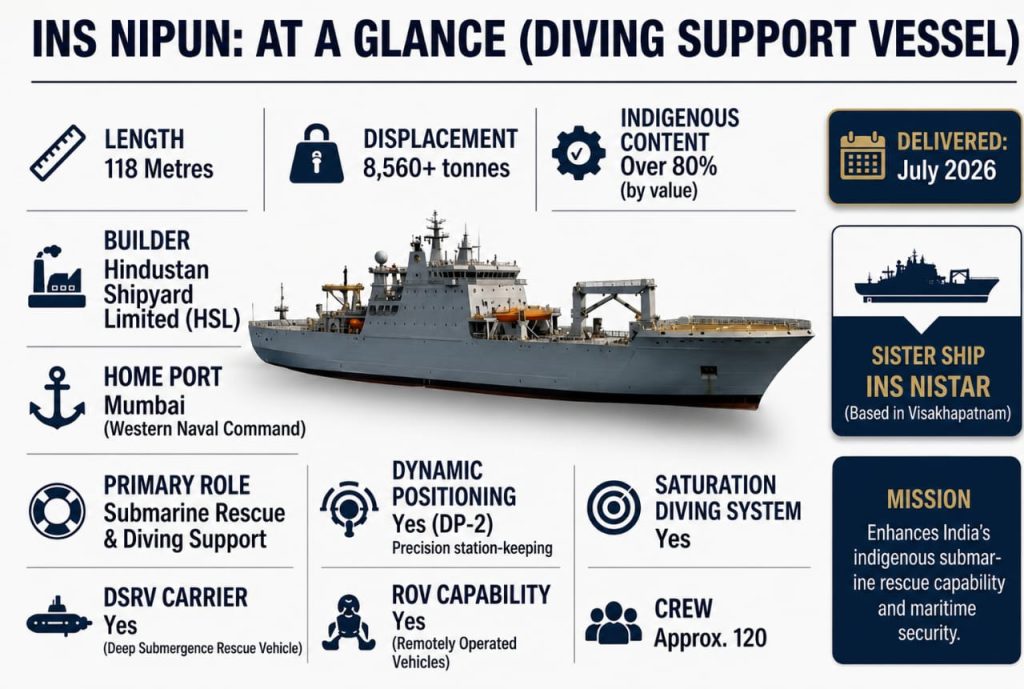
Nipun measures 118 metres in length and displaces more than 8,560 tonnes, with over 80 per cent indigenous content by value. It is fitted with dynamic positioning, which allows the ship to hold a precise location over a target on the seabed without anchoring, even in rough seas – a feature essential when divers or rescue vehicles are deployed below.
The vessel’s saturation diving system allows divers to live and work at depth for extended periods, avoiding the need for repeated, time-consuming decompression after every dive. Nipun also carries a submarine rescue system, including a deep submergence rescue vehicle capable of mating with a distressed submarine and transferring trapped crew to safety.
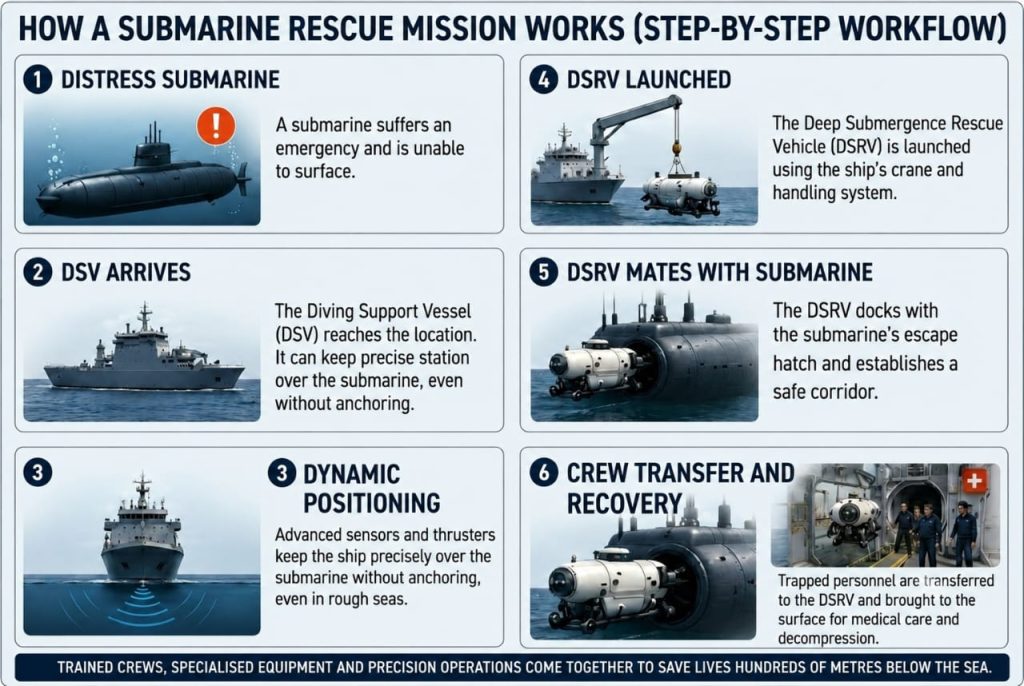
India’s existing deep-submergence rescue vehicles, procured from the British firm James Fisher & Sons in 2018 and 2019, can reach depths of around 650 metres and have already been used in international rescue exercises. One such vehicle, embarked on Nistar, achieved successful mating with foreign submarines during Exercise Pacific Reach 2025 off Singapore in September 2025. It was a rare demonstration of operational readiness in this niche field.
Beyond military rescue work, DSVs of this type also support offshore salvage, wreck location, underwater infrastructure inspection and disaster relief following maritime accidents.
Why it is a strategic asset
Submarine rescue is a capability that few navies possess, and fewer still can generate indigenously. Only a small number of countries, including the United States, the United Kingdom, Russia, China and Singapore, maintain a comparable deep-sea rescue capacity. This makes Nipun’s induction significant beyond its immediate utility to India.
For India, the strategic value lies in reducing dependence on foreign assistance during a submarine emergency, when time is the single most critical factor. Before these DSVs entered service, India’s ability to respond to a disabled submarine was constrained, and rescue support in such a scenario would often have depended on coordination with allied navies operating far from Indian waters.
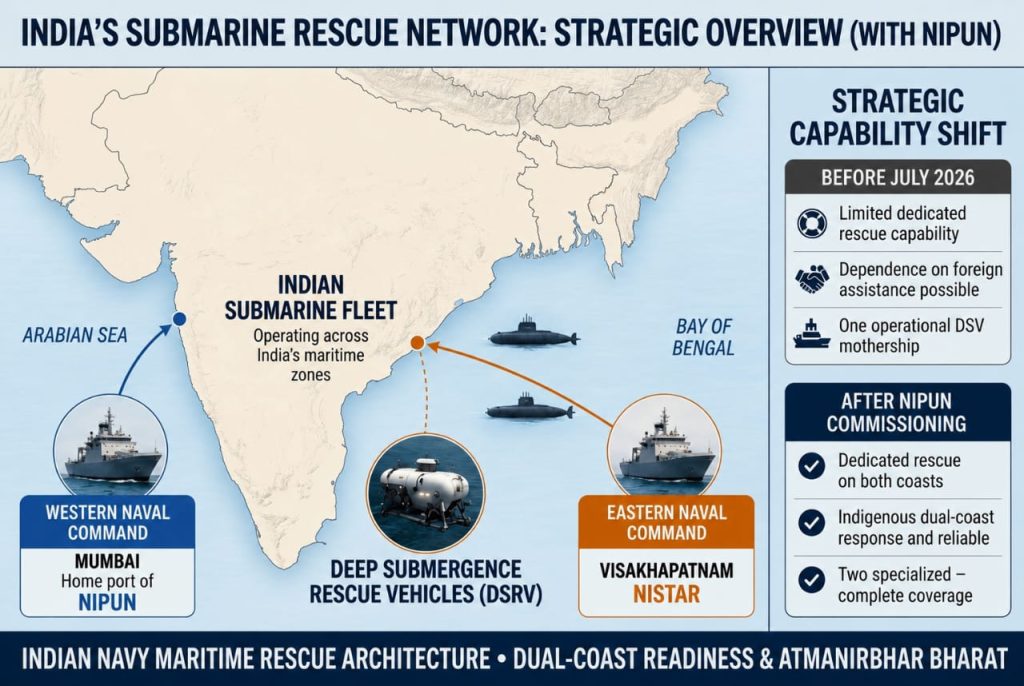
With Nistar covering the Eastern Naval Command and Nipun the Western Naval Command, the Navy now has dual-coast rescue coverage for the first time. This matters because India’s submarine fleet, comprising both conventional diesel-electric boats and nuclear submarines, is dispersed between Visakhapatnam and Mumbai.
The ships also reinforce India’s standing as what naval officials describe as a net security provider in the Indian Ocean region. India has already begun sharing this capability with partner navies through exercises, positioning itself as a country that can assist others during submarine emergencies rather than only seeking help itself.
There is a broader industrial dimension as well. Nipun was built with contributions from more than 120 MSMEs (micro, small and medium enterprises) across India, which is a reflection the government’s Atmanirbhar Bharat (self-reliant India) push in defence manufacturing. HSL’s ability to deliver two complex, technology-dense platforms of this kind within a year of each other demonstrates a shipyard capacity that extends well beyond routine naval construction.
Broader pattern
Nipun’s delivery is not an isolated event but part of a wider acceleration in indigenous naval construction that has picked up pace through 2025 and 2026. The Navy commissioned its 100th indigenous warship, INS Udaygiri, in 2025, and officials have said a new indigenously built platform or submarine is now joining the fleet roughly every 40 days.
That trend continued in June this year, when the prime minister, Narendra Modi, commissioned three more indigenously built platforms – the stealth frigate INS Dungairi, the survey vessel INS Sanshodhak, and the anti-submarine warfare craft INS Agray – at Kolkata. All three carried indigenous content of 75 per cent or higher, figures broadly consistent with the indigenization levels seen on Nipun and Nistar.
The following month, the Navy commissioned INS Malvan, a Mahe-class anti-submarine shallow-water craft with more than 80 per cent indigenous equipment, at a ceremony where a senior naval officer noted the vessel was the seventh commissioned that year, with twelve more due to follow.
Taken together, these deliveries point to a shift the Navy itself has characterized as moving from being a “buyer’s navy” to a “builder’s navy”, with 51 major warships reportedly under construction across Indian shipyards as of late 2025.
What’s next for Nipun?
Nipun is expected to undergo sea acceptance trials before formal commissioning into active service, following the pattern set by Nistar last year. Once operational, it will complete the Navy’s plan for dual-coast submarine rescue coverage, a capability gap that had persisted for decades despite India operating submarines since the 1960s.
The vessel’s entry into service also arrives against a backdrop of intensifying undersea activity in the Indian Ocean region, where several regional navies are expanding submarine fleets. A credible, indigenous rescue capability on both coasts reduces India’s reliance on external assistance and adds a layer of operational assurance for submarine crews that did not previously exist at this scale.