


US moves to make $103,265 H-1B fee permanent. What it means for Indian skilled workers with America plans
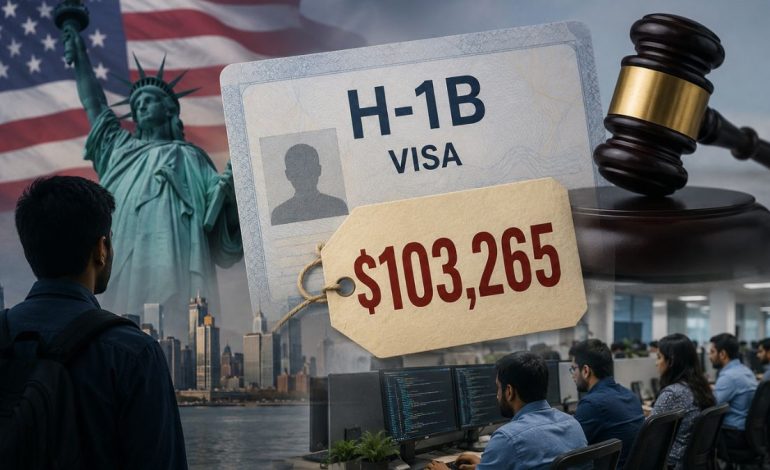
RNA illustration for representation.

New Delhi: The Trump administration has proposed a $103,265 fee on new H-1B visa petitions filed through the annual lottery. The rule was posted in the Federal Register on Monday and is due for formal publication on Tuesday, opening a 30-day public comment period.
The proposal is distinct from the $100,000 fee Donald Trump imposed by proclamation last year. A federal judge ruled in June that the earlier fee was unlawful, and the administration is appealing. That proclamation expires in September and the new rule is Washington’s attempt to place a similar charge on a firmer legal footing.
The distinction matters for scope, too. Unlike last year’s proclamation, which targeted new hires arriving from overseas, the new $103,265 fee would apply broadly to all H-1B petitions subject to the annual cap, including both the regular lottery and the master’s-degree exemption. It would not apply to cap-exempt petitions, such as many university and non-profit research positions.
The fee itself is not something Indian workers pay directly. It would fall on the employer sponsoring the petition, which could make companies more cautious about hiring from overseas rather than domestically.
Why India is particularly exposed
India’s scale within the H-1B programme is what makes this proposal significant for Indian professionals. According to USCIS data, people born in India accounted for 283,755, or 71%, of the 399,378 H-1B beneficiaries approved in fiscal 2024.
China was a distant second at 11.7%. No other country came close to either figure.
That does not mean 71% of every future visa will go to Indian applicants specifically. But it shows how tightly Indian skilled migration is bound up with this one visa category.
For an Indian engineer or technologist, a $103,265 employer cost changes the calculation their prospective employer makes. A company choosing between a domestic hire and an overseas one now has a much larger number to weigh in.
For highly specialized roles, that cost may still be worth paying. Where several qualified candidates exist locally, though, the extra expense could tip decisions away from sponsorship, particularly at entry level.
Indian IT firms are already reducing H-1B dependence
This proposal lands on a trend already under way. Data cited by Crisil Intelligence show that H-1B visas held by employees of TCS, Infosys, Wipro and HCL Technologies fell from 34,507 in 2017 to 17,997 in 2025, almost a halving.
That decline reflects a longer shift toward offshore delivery and local US hiring by these firms, one that predates the current fee fight. A steeper fee could accelerate it further.
Rather than relocating an employee, a company could keep that person in India and deliver the same work remotely. The client relationship continues either way, what changes is where the employee physically works.
This shift does not necessarily reduce American demand for Indian technical expertise. It may simply relocate where that expertise is delivered from.
H-1B rules tightening on multiple fronts
The fee proposal is one part of a broader tightening. The administration has also ordered enhanced vetting of applicants and proposed a selection process favouring higher-paid positions.
Demand for H-1B registrations has already dropped sharply. Employers registered around 344,000 H-1B applications last year, per USCIS figures cited by Reuters, down more than 25% from 2024, and less than half of the 794,000 registrations filed in 2023.
The effect is unlikely to be uniform across skill levels. A senior AI specialist or semiconductor engineer will likely remain in strong demand; employers may grow more reluctant to bear the added cost for more readily available skills.
Financial hit to Indian IT firms may be modest
For India’s largest IT services firms, the direct financial impact could be limited. Crisil Intelligence estimated that the earlier $100,000 fee would trim operating margins by only 10 to 20 basis points, with 30–70% of the added cost expected to be passed on to clients.
That suggests the more lasting consequence is likely to be structural, not financial. Fewer employees may be sent to the US, even as the volume of work performed for American clients continues to grow from India.
What it means for Indian skilled workers
The proposed fee does not ban Indian professionals from the US, nor does it apply retroactively to existing H-1B holders. Its significance lies in how it reshapes future hiring decisions, and it is still a proposal, the rule could be finalized by the end of the year, but is not yet in effect.
Employers may grow more selective about sponsorship for roles that can be filled domestically, even as demand holds for scarce specialized talent. The practical question for many Indian professionals shifts from “can I get an H-1B” to whether an employer is willing to pay a six-figure premium to bring them to the US at all.
If more employers answer no, a larger share of the work is likely to stay in India, even when the client, the company, and the job itself remain American.