

Trump hails India’s voter-ID system as he pushes SAVE America Act. What the controversial US election bill would change
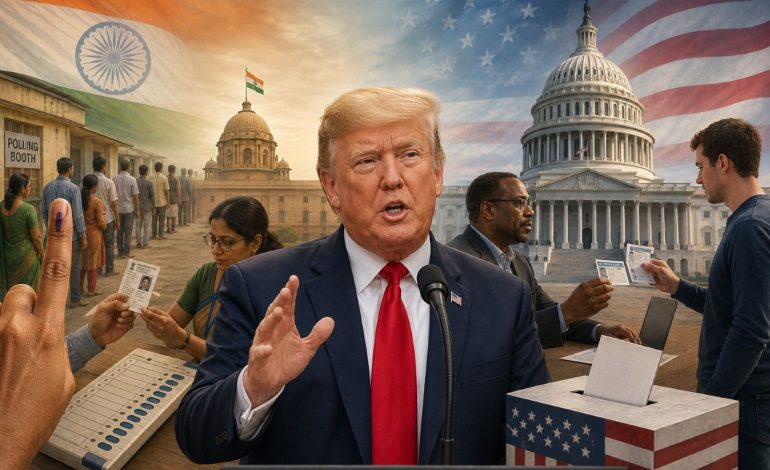
RNA Media illustration for representation.

New Delhi: The president of the United States, Donald Trump, has invoked India’s election system to intensify his campaign for the SAVE America Act, presenting the world’s largest democracy as evidence that mass elections can be conducted with stringent voter-identification requirements. In a Truth Social post on Tuesday, Trump said India’s chief election commissioner, Gyanesh Kumar, had recently asked his administration how the United States could hold elections without a uniform requirement for voters to produce valid photo identification.
Trump pointed to India’s 2024 Lok Sabha election, saying around 646 million people had voted, fewer than one per cent had done so by mail and voters were required to establish their identity. Official Election Commission of India figures broadly support the numerical comparison: 64.64 crore votes were cast, of which 42.82 lakh were postal ballots – roughly 0.66 per cent of the total.
The exact words Trump attributed to Kumar have not, so far, been independently detailed in a public Election Commission statement reviewed for this report, making the US president’s post the primary account of that exchange. The underlying point about identification, however, is grounded in Indian election rules: electors voting at polling stations are expected to establish their identity, normally through an Elector Photo Identity Card or one of 12 alternative photo-bearing documents approved by the commission.
There is an important qualification to the comparison with India, particularly when it comes to citizenship verification. Aadhaar may be used as an identity document and its linkage with electoral records remains voluntary, but the Unique Identification Authority of India explicitly states that Aadhaar is not proof of Indian citizenship or domicile.
India, therefore, offers a strong example of identity verification at the polling stage, but not an exact equivalent of the citizenship-document regime proposed under the SAVE America Act. Indian law separately requires a person to be an Indian citizen to enrol as a voter, while the documents used to establish identity at a polling booth do not necessarily serve as proof of citizenship.
Trump’s characterization also risks creating the impression that American elections operate without voter identification altogether, which is not the case because rules vary substantially across states. According to the National Conference of State Legislatures, 36 states request or require some form of identification at the polls, while 14 states and Washington, DC, use other methods of verifying a voter’s identity.
The president’s renewed intervention comes as the legislation remains caught in the US Senate after advancing through the House of Representatives. The House passed the current SAVE America Act text, carried in S.1383, by 218 votes to 213 on February 11, 2026, but a Senate cloture attempt failed 53–47 on March 26 and Republicans do not presently have the 60 votes normally required to overcome a filibuster.
What is SAVE America Act – and what is the broader issue?
SAVE stands for Safeguard American Voter Eligibility, and the legislation seeks to establish national requirements for documentary proof of US citizenship when registering for federal elections, while also introducing a federal photo-identification requirement for voting. The House-passed version would additionally require states to maintain procedures for identifying and removing confirmed non-citizens from federal voter rolls and would create new mechanisms for federal-state information sharing.
For an in-person federal ballot, a voter would generally have to produce an acceptable physical photo ID, such as a state-issued card, US passport, military identification or qualifying tribal document. Registration would be more demanding because the applicant would have to establish citizenship through specified documentation, which can include a US passport, certain citizenship-indicating identification documents or a combination of government-issued photo ID and records such as a birth certificate.
That distinction between proving identity and proving citizenship is central to the controversy because an ordinary driver’s licence, for example, may establish who a person is without establishing that the holder is an American citizen. The bill does provide an alternative procedure for eligible applicants who cannot readily produce the listed documents, allowing states to examine other evidence and make an official determination of citizenship.
Another distinction has become blurred in the political debate: the House-passed SAVE America Act does not simply prohibit ordinary mail-in voting. Its text generally requires voters casting non-in-person ballots to include a copy of acceptable photo identification, or to use a statutory fallback involving identifying information and an affidavit in specified circumstances, whereas Trump and the White House have separately advocated restricting mail ballots largely to cases involving illness, disability, military service or travel.
The legislation would not create the underlying prohibition on non-citizen voting, because federal law already bars non-citizens from voting in federal elections and US voter-registration procedures require citizenship. What the SAVE America Act would change is the evidentiary burden: instead of relying predominantly on an applicant’s attestation and state verification procedures, it would require documentary citizenship proof as part of the federal registration process.
Supporters argue that such a requirement would create a uniform safeguard, deter unlawful registration and improve public confidence at a time when trust in elections has become deeply politicized. Photo identification itself has substantial popular support – a 2025 Pew Research Center survey found 83 per cent of American adults favoured requiring voters to show government-issued photo ID – although that finding does not necessarily translate into equivalent support for the more demanding documentary-citizenship provisions.
Critics make a different argument: documented instances of non-citizens casting federal ballots are rare, while tighter citizenship-document rules could create additional obstacles for legitimate voters whose passports, birth certificates or other records are unavailable, outdated or inconsistent because of name changes and similar circumstances. Their concern is therefore less with photo identification alone than with whether preventing a relatively uncommon form of illegal voting justifies shifting a substantially greater documentation burden on millions of lawful voters.
Behind the dispute lies a structural difference that makes comparisons with India particularly difficult: American election administration is highly decentralized, with more than 10,000 election jurisdictions operating under a mixture of state and federal law. The US Constitution gives Congress substantial authority to regulate aspects of federal elections, but a national registration-and-identification regime would nevertheless standardize practices that have traditionally differed sharply from one state to another.
Those institutional boundaries are already being tested elsewhere, with federal courts having blocked parts of Trump’s executive efforts to change election administration, including measures affecting mail voting and voter-registration rules. That makes legislation passed by Congress, rather than presidential direction alone, the more consequential route for imposing durable nationwide requirements.
The wider American argument, therefore, is not simply over whether voters should identify themselves – many states already require them to do so – but over what documents should be necessary to prove citizenship, how much inconvenience is reasonable to prevent unlawful voting, and how mail ballots should be treated. Trump’s invocation of India gives his campaign a powerful international comparison, but India’s centralized election machinery, limited postal-voting system and distinction between voter identity and citizenship mean the two systems cannot be treated as interchangeable models.