

Nepal turns to India for 150MW of round-the-clock power as winter energy crunch looms
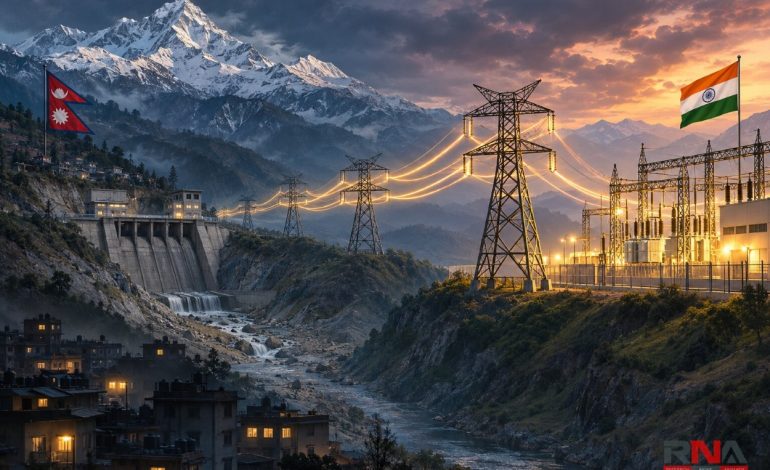
RNA Media illustration for representation.

New Delhi: Nepal has invited competitive bids from Indian electricity trading companies to procure 150 megawatts of round-the-clock power as the Himalayan country braces for a potentially severe energy shortage during the coming dry season. The move comes as Kathmandu grapples with declining seasonal hydropower generation, extensive flood damage to its power infrastructure and growing uncertainty over electricity procurement costs.
The Nepal Electricity Authority (NEA), the country’s state-owned power utility, issued a tender notice on Friday, inviting proposals from Indian companies holding Category I, II and III electricity trading licences. The authority intends to secure uninterrupted electricity supplies from January to May 2027, when domestic hydropower generation is expected to remain considerably below installed capacity.
According to Nepal’s Republica newspaper, interested Indian companies have until noon on December 28 to submit their proposals electronically through Nepal’s public procurement portal. The technical bids will be opened at the NEA’s headquarters in Kathmandu’s Darbar Marg at 1pm the same day.
Participating companies must pay a tender fee of ₹12,500 or its equivalent in Nepali currency and furnish an earnest money deposit of ₹55,000 per megawatt per month of the proposed supply. The NEA has retained the right to accept or reject any or all bids received during the procurement process.
Earlier procurement effort runs into pricing hurdle
The fresh tender follows the collapse of an earlier procurement arrangement under which an Indian electricity trading company had offered to supply power at a substantially lower rate than its competitors. The development underscores the challenges Kathmandu faces in securing affordable electricity at a time of fluctuating energy prices.
According to Nepal’s state-owned newspaper the Rising Nepal, NTPC Trading Corporation had submitted the lowest quotation of ₹6.90 per kilowatt-hour (kWh), against ₹8.50 offered by Manikaran Energy and ₹9 by SJVN. The NEA issued a letter of intent to the lowest bidder on October 2, but the company subsequently sought a revision of its quoted tariff before signing the power purchase agreement.
Among the factors cited for the proposed revision were rising fuel costs, geopolitical uncertainties, changing weather patterns and increasing electricity consumption in India. The average electricity clearing price in India’s day-ahead market reportedly reached ₹7.34 per kWh in October, highlighting Nepal’s exposure to fluctuations in the Indian wholesale electricity market.
A fixed-duration, round-the-clock supply arrangement could help Nepal reduce its exposure to short-term price volatility while ensuring greater predictability in the availability of electricity.
Flood damage compounds Nepal’s seasonal energy crisis
Nepal’s electricity system is overwhelmingly dependent on hydropower, particularly run-of-the-river projects that generate electricity according to the volume of water flowing through rivers rather than drawing from large storage reservoirs. While abundant monsoon rainfall allows Nepal to produce surplus electricity for export, declining river flows during the winter and spring considerably reduce generation.
This seasonal vulnerability has been aggravated by the devastating floods of August 2026, which damaged more than a dozen hydropower projects and associated transmission infrastructure. The disaster disrupted around 430MW of capacity across operational and under-construction projects, complicating Nepal’s efforts to maintain adequate domestic electricity supplies.
Although nearly 300MW of additional hydropower capacity is expected to be connected to Nepal’s national grid before the forthcoming dry season, these projects are projected to generate only around 90MW during the lean months. The disparity between installed capacity and actual generation highlights the limitations of relying predominantly on run-of-the-river hydropower projects.
As RNA Media reported in September, India had authorized electricity exports of up to 654MW to Nepal for 18 hours daily until December 31 to help the country overcome flood-induced shortages. The arrangement covered the Muzaffarpur-Dhalkebar and Tanakpur-Mahendranagar cross-border transmission corridors.
Earlier this month, India’s Central Electricity Authority (CEA) also authorized Nepal to procure up to 350MW through the Indian Energy Exchange (IEX) for a maximum of 17 hours daily. The authorization remains valid until July 31, 2027, providing Kathmandu with an additional mechanism to address electricity shortages.
Unlike these time-restricted arrangements, the proposed 150MW procurement is intended to secure uninterrupted supplies, including during evening hours when electricity demand typically rises. Nepal plans to supplement this contracted capacity with additional purchases from Indian power exchanges whenever necessary.
Energy cooperation acquires greater strategic significance
The tender comes just four days after the prime minister, Narendra Modi, and his Nepali counterpart, Balendra Shah, held bilateral talks in New Delhi, where energy cooperation and post-disaster reconstruction figured prominently. India subsequently announced a $1.62 billion economic assistance package for Nepal, including a $1.24 billion line of credit for energy projects.
The immediate need for Indian electricity contrasts with Nepal’s longer-term ambition of becoming a major regional hydropower exporter. Under the long-term power trade agreement signed on January 4, 2024, New Delhi and Kathmandu agreed to work towards increasing Nepal’s electricity exports to India to 10,000MW within a decade.
India has also facilitated Nepal’s entry into the wider South Asian electricity market by allowing it to export power to Bangladesh through the Indian transmission network. The inauguration of trilateral electricity trade in November 2024 marked a significant step towards greater regional energy integration.
For India, this expanding network offers access to renewable electricity during Nepal’s periods of surplus generation while creating commercial opportunities for Indian power producers and trading companies during Nepal’s dry season. It also reinforces New Delhi’s position as a central participant in South Asia’s emerging interconnected electricity market.
For Kathmandu, however, the latest procurement exercise highlights the need to diversify its electricity generation portfolio through reservoir-based hydropower, solar energy and stronger transmission infrastructure. Until such investments materialize, access to the Indian electricity market will remain a critical component of Nepal’s energy security.