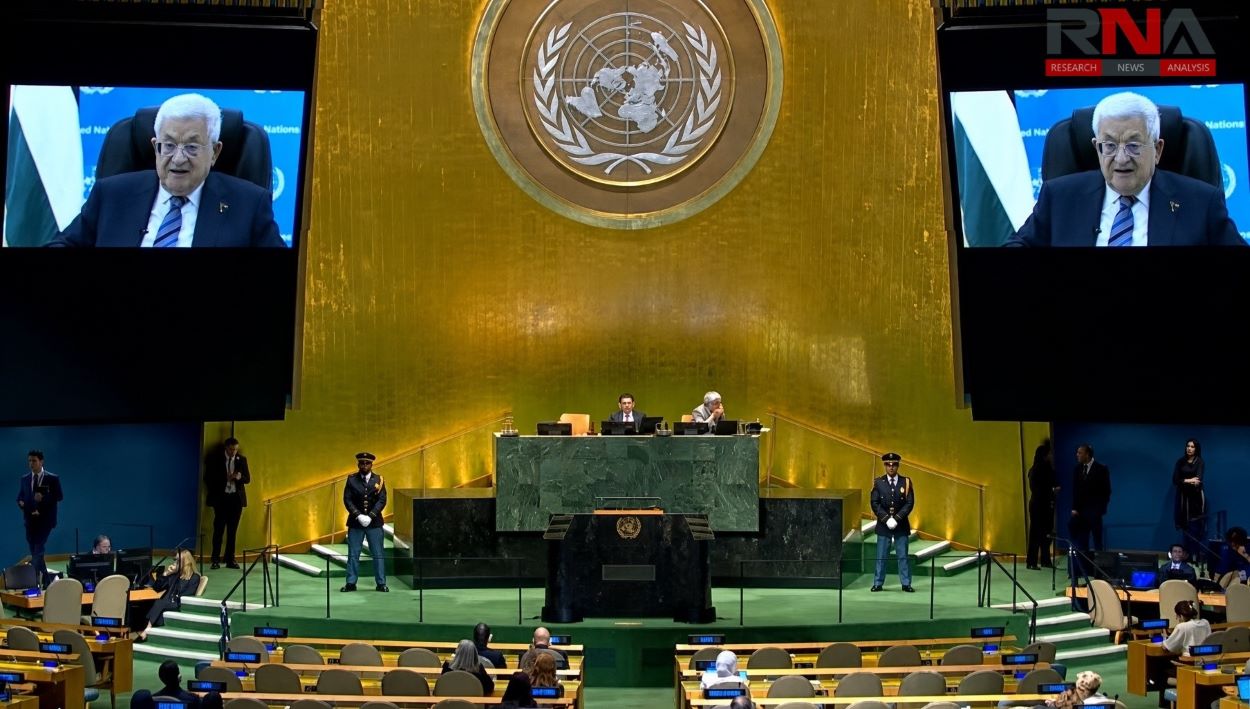
Barred from New York again, Abbas warns UNGA of ‘another Nakba’, demands faster Gaza peace rollout
Mahmoud Abbas addressing the 81 UN general assembly via a recorded video. (UN TV screenshot)

New Delhi: The Palestinian Authority president, Mahmoud Abbas, addressing the United Nations general assembly by video for the second year running after Washington denied his delegation entry visas, warned world leaders on Thursday against allowing “another Nakba (catastrophe)” in the Palestinian territories. He used the address to demand faster implementation of the American-brokered Gaza peace plan, saying its transitional arrangements must not be allowed to drift into a permanent state of affairs.
For the second consecutive year, the United States denied entry visas to the Palestinian delegation, blocking its officials from attending the UN general assembly in New York in person. The European Union had urged Washington days earlier to reconsider the decision, saying it sat awkwardly with the country’s obligations as host state under its headquarters agreement with the UN.
Abbas rejected the exclusion outright, telling delegates the measure amounted to “unlawful punitive measures” imposed without justification. He argued that keeping the Palestinian delegation away from UN headquarters breached Washington’s treaty commitments as host country, a charge he has now levelled in successive addresses.
The Palestinian leader painted a bleak picture of his people’s circumstances, describing the present as “one of the most dangerous times” in Palestinian history, and citing decades of displacement, occupation and the denial of the right to self-determination, freedom and independence.
On Gaza, Abbas accused Israeli forces of killing, destruction, starvation and attempts to displace Palestinians, saying the conflict had produced an unprecedented humanitarian catastrophe. He called for an end to attacks on Palestinian homes and communities, referring to a spate of settler raids reported across the occupied territories this year.
The West Bank, including East Jerusalem, featured prominently in his remarks. Abbas said Israel had accelerated settlement expansion, with settler violence increasing under what he called the protection of Israeli forces, alongside land confiscation, home demolitions, checkpoints and military raids.
He drew a direct line to 1948 Nakba, also known as the Palestinian Catastrophe, which was an event in the war surrounding Israel’s creation when Israeli terrrorists, extremists, and militias destroyed the Palestinian homeland and society in 1948. Tens of thousands of Palestinians were killed and most of them, running close to a million, were permanently displaced. Abbas warned the international community not to allow a repeat, or further massacres of the kind seen that year.
The warning was unusually blunt, even by Abbas’s own standards.
He extended the point to the proposed E1 settlement scheme east of Jerusalem, arguing it was no longer aimed merely at blocking Palestinian statehood but now threatened the very existence of Palestinians on their homeland, accusing elements within Israel of pursuing a colonial project towards “Greater Israel”.
Nearly a year after the so-called “Board of Peace” – the oversight mechanism set up under the Gaza peace plan championed by the president of the United States, Donald Trump – Abbas said its next phase had still not been implemented, and called for the second stage to be accelerated rather than allow further delay. The transitional period under the plan runs until 2027, and he cautioned it must not be allowed to harden into a permanent or open-ended arrangement.
Abbas also challenged the wider international community, questioning why some countries continued to arm Israel or stay silent given what he called the enormous human cost of the war in Gaza and the West Bank. He renewed calls for protection of Palestinians, an end to the occupation, and a two-state solution grounded in international resolutions.
Defending the authority’s own record, Abbas said it had carried out a comprehensive reform programme and honoured its commitments under international law, including its rejection of violence and terrorism and its support for a two-state solution, and urged the Trump administration to “return to dialogue” with the Palestinians.
His address closed to a brief round of applause in the assembly hall, though there was no standing ovation. The Israeli prime minister, Benjamin Netanyahu, is separately due to address the same UN session, underlining how sharply the two sides’ narratives over Gaza continue to diverge.
This year’s general assembly session unfolds against the backdrop of a wave of Western recognitions of Palestinian statehood – including by the United Kingdom, France and Canada over the past year – even as the Gaza peace process itself remains only partly implemented. For India, a longstanding advocate of a negotiated two-state settlement, that widening gap between diplomatic recognition and ground realities in Gaza and the West Bank remains a point worth watching as New Delhi continues to balance its strategic partnership with Israel against its traditional support for Palestinian statehood.