


7.4-magnitude earthquake strikes western Colombia; injuries, building damage reported in Choco
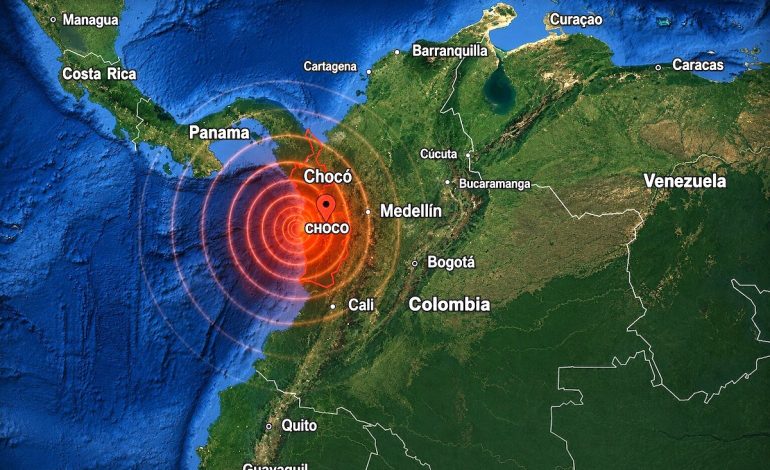
This RNA Media illustration shows the epicenter of the earthquake.

New Delhi: A powerful earthquake struck western Colombia on Monday morning, injuring people and damaging buildings in the Pacific department of Choco, while sending residents rushing out of homes and offices across several major cities. The initial US Geological Survey measured the earthquake at magnitude 7.4.
Colombian authorities issued differing preliminary estimates as emergency teams began assessing its impact.
According to reports, the earthquake struck at 7.34am local time (6.04pm IST) on Monday, with its epicentre near San Jose del Palmar in Choco, a mountainous department bordering the Pacific coast. Tremors were felt strongly in Bogota, Cali, Pereira, Armenia, Manizales and Quibdo, and were also reported in neighbouring Ecuador and Venezuela.
The governor of Choco, Nubia Carolina Cordoba Curi, said there were injuries and “significant damage” to buildings in Quibdo, the departmental capital, despite the epicentre being closer to San Jose del Palmar. Authorities were carrying out an assessment across the department, with Cordoba warning that officials were particularly concerned about the possibility of further strong tremors.
No deaths had been officially confirmed in the initial hours after the earthquake, and authorities had yet to disclose the number or condition of those injured in Choco. Reports from western Colombian cities indicated structural damage and communication difficulties, although the full scale of the destruction remained unclear as inspections continued.
There was some uncertainty over the earthquake’s magnitude and depth as seismic agencies revised their initial readings. While the USGS and an initial Colombian Geological Service assessment put the magnitude at 7.4, Colombia’s National Unit for Disaster Risk Management, or UNGRD, subsequently cited a magnitude of 6.6 and a depth of 79 kilometres, while the European-Mediterranean Seismological Centre estimated it at 6.8 and 115 kilometres deep.
The relatively deep focus appears to have helped spread the shaking across a vast area rather than concentrating its effects immediately around the epicentre. Local reports said the movement was particularly strong across Colombia’s western and central regions, with buildings swaying and residents leaving homes, offices and other structures as alarms sounded.
In Bogota, around 280 kilometres east of the initially reported epicentral area, the earthquake was strongly felt and emergency alarms were activated across buildings. The mayor, Carlos Fernando Galán, said there were no immediate reports of casualties or serious structural damage in the capital, although cracks had been detected in some buildings and authorities were carrying out inspections.
Videos and photographs circulating on Colombian social media showed residents gathered outside buildings after evacuating in Bogota and other cities, while local accounts from Choco described a considerably more serious situation around Quibdo. However, many early images and claims remained unverified, and authorities urged people to rely on official information while damage assessments continued.
Colombia’s disaster-management authorities said they were maintaining contact with municipal and departmental officials to establish the extent of damage and determine whether additional emergency assistance was required. With Choco containing remote mountainous communities where communications and road access can be difficult, a complete assessment of the earthquake’s impact could take time.
Colombia lies in one of South America’s most seismically active regions, where the Nazca, South American and Caribbean tectonic plates interact. One of the country’s deadliest modern earthquakes struck the Armenia region in 1999, killing nearly 1,000 people and causing extensive destruction across Colombia’s coffee-growing belt.
The situation remains fluid, particularly in Choco, where authorities have now confirmed injuries and substantial structural damage but have not yet released a consolidated casualty or damage figure.