
Trump warns Iran over assassination threat as Tehran alleges ceasefire breach
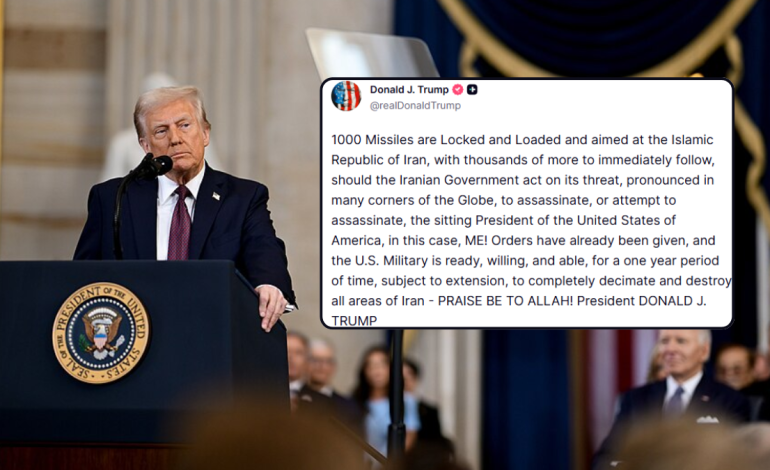
Trump warns Iran over assassination threat. (Image courtesy: Wikimedia)

New Delhi: The US president, Donald Trump warned Iran that any attempt to assassinate him would trigger an overwhelming American military response, saying he had already left instructions to strike the country “at levels they’ve never seen before.” Trump also claimed that 1,000 missiles were loaded and ready to target Iran if such an attack were carried out.
Trump’s remarks came as tensions between Washington and Tehran continued to escalate despite ongoing diplomatic contacts. Hours later, Iran accused the United States of violating the memorandum of understanding (MoU) that formalized the ceasefire reached after weeks of fighting, insisting that Tehran had upheld its commitments while Washington had failed to do the same.
Iran accuses US of breaching ceasefire
The Iranian foreign minister, Abbas Araghchi said Tehran had honoured the ceasefire agreement, while accusing Washington of violating Paragraph 9 of the MoU. In a post on X, Araghchi said Iran had kept its word and added that “there can only be mutual compliance.”
His remarks followed Trump’s declaration that the ceasefire was effectively over, even though the US has agreed to continue talks with Tehran through regional mediators.
Amid the diplomatic push, Araghchi arrived in Muscat on Saturday for talks with Omani officials, according to Iran’s semi-official Tasnim news agency. Oman, which has long acted as a mediator between Washington and Tehran, is expected to discuss regional security, shipping through the Strait of Hormuz and the future of the US-Iran memorandum of understanding.
Washington has also pressed Iran to publicly guarantee that commercial shipping through the Strait of Hormuz will remain safe and that Iranian forces will not target any vessels. According to Reuters, US officials said Iran must provide such assurances to sustain diplomatic engagement.
According to reports, officials further claimed that Iranian representatives acknowledged recent attacks on commercial ships were carried out by an errant group of hardliners acting without broader approval, describing the incident as a mistake while expressing willingness to continue negotiations.
Nuclear activity, research damage raise fresh concerns
Fresh satellite imagery analysed by CNN and the Institute for Science and International Security has reportedly shown reconstruction work at Iran’s Parchin military complex and activity near the Pickaxe Mountain facility, raising new questions about Tehran’s nuclear programme after the recent conflict. The imagery reportedly showed trucks and other vehicles moving around the damaged sites, with experts saying the activity may indicate early reconstruction efforts.
Separately, Hossein Afshin, deputy to Iranian president Masoud Pezeshkian for science, technology and the knowledge-based economy, said the conflict caused nearly $300 million in damage to Iran’s research infrastructure.
According to Iran’s state-run IRNA news agency, Afshin said facilities working on emerging technologies with no military applications had been targeted during the war. He accused Israel of attempting to weaken Iran’s scientific capabilities but said the country would rebuild its research ecosystem and continue investing in science and innovation.
Military warnings continue despite diplomacy
Iran has maintained that any fresh attack on its infrastructure would be met with retaliation. Mohammad Bagher Zolghadr, head of Iran’s top security body, warned that Israel would not be safe from Iranian retaliation if further strikes were carried out against Iranian facilities.
Foreign ministry spokesperson, Esmaeil Baqaei also said Iranian armed forces remain on high alert across the country’s coasts, islands and border regions, adding that military forces were closely monitoring what he described as enemy movements.
Meanwhile, Reuters reported, citing Iranian state media, that an explosion heard in eastern Tehran province on Saturday was caused by the controlled disposal of ammunition left over from the recent conflict. Authorities said the operation posed no threat to the public and that no casualties or other incidents were reported.
The latest exchange comes as the Strait of Hormuz remains at the centre of regional tensions. The waterway carries around one-fifth of global oil shipments, making it one of the world’s most critical maritime routes. The tensions follow the recent US strikes on around 90 military targets across Iran, including missile storage sites, air defence systems, naval assets and military infrastructure, as reported earlier by RNA.