


Amit Shah chairs first-ever conference of border district police chiefs, unveils ‘smart borders’ plan
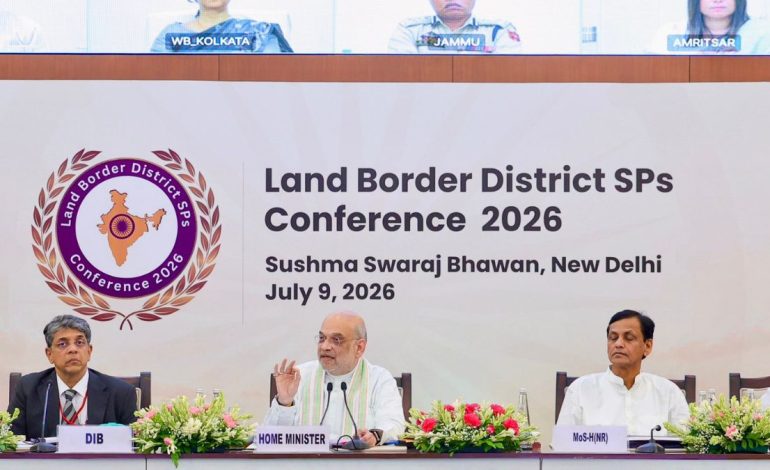
Union Home Minister Amit Shah addresses the first Land Border District SPs Conference 2026 in New Delhi. Image Credit: X/@AmitShah

New Delhi: The Union home minister, Amit Shah, on Thursday chaired the first-ever Land Border Districts’ Superintendents of Police Conference 2026 in New Delhi. The conference brought together superintendents of police from India’s border districts, along with directors general of police from 18 border states and union territories, chiefs of central armed police forces, and senior officials from the Ministry of Home Affairs and the Intelligence Bureau.
The conference aimed to build a coordinated, institutional mechanism for border security, shifting India’s approach from reactive to proactive, and to encourage state and central agencies to exchange best practices in border policing.
Discussions covered a wide range of threats facing India’s borders, including illegal infiltration, cybercrime networks, arms smuggling, narcotics trafficking, organized crime, radicalization, drone-related threats, and illegal financial transfers.
Different border states raised their own concerns. Rajasthan, which borders Pakistan, focused on stopping infiltration and encroachment through more police deployment and surveillance. Uttar Pradesh, which borders Nepal, flagged cybercrime as a growing problem, with police working alongside the Sashastra Seema Bal to trace illegal money transfers and break up cybercrime networks. Punjab, also on the Pakistan border, is most concerned about drug trafficking, with police raiding smuggling networks and registering several cases against those involved.
Addressing the conference, Shah said the government is developing a technology-driven “smart borders” system, built around a four-layer security grid involving border guarding forces, state governments, district administrations, and local communities. He said border security should not rely on armed forces alone, but on coordinated action across all agencies.
Shah said Naxalism had significantly declined, along with terrorism in Jammu & Kashmir and insurgency in the northeast. He said the government aimed to inflict serious damage on narcotics trafficking within the next three years, alongside a stronger system to prevent illegal infiltration.
Shah said investment in border infrastructure had increased by about 400% under the current government, with a more technology-driven approach now being adopted. He referred to the Vibrant Villages Programme, aimed at developing villages near international borders, and the “demography mission”, part of the government’s strategy on demographic issues in border regions.
Shah said the government considered illegal infiltration the primary reason for what he called “abnormal demographic growth” in some border areas, and said a strict approach was needed to address demographic changes linked to unnatural factors.
He also said the government was constructing a fence along the 1,610km India-Myanmar border, at an estimated cost of ₹31,000 crore, aimed at preventing infiltration, countering proxy warfare, and tackling radicalization, drone threats, cybercrime and organized crime.
Uttarakhand, whose border districts touch Nepal and Tibet, was represented by its police chief and superintendents from five border districts. The state’s police officials presented some of their border-policing initiatives, including a community-based model built on trust and local participation, and an example of reverse migration in a border village encouraged through development work.
The conference reflects the government’s push to build a permanent collaborative framework between state police, central security agencies and local communities, as it looks to strengthen border governance amid evolving security threats.