

Poland suspects sabotage at Starlink station serving Ukraine as Denmark warns of Russian escalation
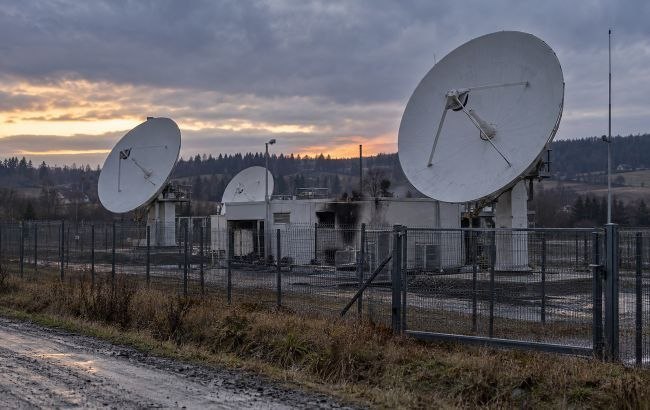
Black soot from fire can be seen on the wall of one of the buildings in the Starlink station at Grojec in central Poland’s Mazowieckie region. (Photo: X/@visegrad24)

New Delhi: Poland is investigating suspected sabotage at a Starlink ground station serving Ukraine after a fire damaged its power equipment, raising concerns over the security of communications infrastructure supporting Kyiv’s war effort. The incident came as Denmark warned on Thursday that Russia was likely to intensify attacks against western countries, although responsibility for the Polish fire remained unconfirmed.
The Polish deputy prime minister and digital affairs minister, Krzysztof Gawkowski, said the blaze appeared intended to disable the installation and disrupt internet access, including services used by the Ukrainian military. However, he acknowledged that investigators had not established who was responsible, describing Russian involvement as a possibility supported by indications rather than a proven finding.
The fire broke out on Wednesday evening at Wola Krobowska, near Grojec in central Poland’s Mazowieckie region, at a station operated by the state-owned telecommunications company Exatel. Firefighters received the alarm shortly after 9pm local time, and three crews attended the incident; nobody was injured.
Gawkowski said the damage affected the station’s power supply and backup generator, suggesting an attempt to interrupt its operation. The installation was operating normally on Thursday, while Ukraine had not publicly confirmed whether the incident had disrupted services on its side, Reuters reported.
The Polish prime minister, Donald Tusk, adopted a more cautious position than Gawkowski when questioned about the incident. He said he was reluctant to distinguish conclusively between sabotage and an accident without complete certainty, although he added that the circumstances looked troubling.
Poland’s Internal Security Agency, known by its Polish initials ABW, joined police in investigating the fire. The deputy interior minister, Maciej Duszczyk, said authorities were examining both an electrical fault and deliberate sabotage, leaving the cause formally unresolved despite Gawkowski’s assessment.
The station’s significance extends beyond Poland because it handles internet traffic passing through the country, including connections serving neighbouring Ukraine. Starlink, operated by Elon Musk’s SpaceX, became an important component of Ukraine’s communications after Russia launched its full-scale invasion in February 2022.
Ukrainian forces rely on tens of thousands of Starlink terminals for battlefield communications and some drone operations, while Poland has helped fund subscriptions. That dependence explains the concern surrounding a suspected attempt to disable supporting infrastructure, even though the fire has not been shown to have caused a significant interruption to Ukrainian operations.
The investigation coincided with a new assessment from the Danish Defence Intelligence Service warning that Russia would further escalate its hybrid campaign against Nato and the west in the coming months. The agency also identified a low but increasing risk of limited military attacks against a Nato member, even while the war in Ukraine continued.
Denmark distinguished that possibility from an outright invasion, which it continued to consider unlikely but said could no longer be excluded. Its warning therefore described a worsening risk assessment, rather than a prediction that a conventional Russian attack was imminent.
Hybrid operations typically involve sabotage, cyberattacks and disinformation intended to disrupt an adversary without an openly declared military confrontation. European governments have increasingly associated such activity with attempts to weaken support for Ukraine, although attributing individual incidents requires evidence linking those responsible to their alleged sponsors.
Earlier in September, Denmark’s domestic intelligence service, PET, accused Russia of recruiting Danish citizens through social media and gaming platforms to gather information on defence companies and infrastructure. Russia’s ambassador to Denmark rejected the allegations, saying the agency had presented no concrete evidence to substantiate them.
Germany has also blamed Russia for an attempted drone attack on Leipzig/Halle Airport, while France has ordered preparations to protect critical infrastructure and defence industry facilities. The Kremlin had not commented specifically on the Polish station fire in the BBC’s report, and Moscow has repeatedly denied conducting sabotage operations against Nato countries.
For Poland, a strong supporter of Ukraine bordering both Belarus and Russia’s Kaliningrad exclave, the incident adds to an existing concern about attacks on infrastructure away from the battlefield. The immediate question remains whether investigators can establish deliberate ignition and identify those responsible – findings needed to determine whether this fire belongs to the wider sabotage campaign Warsaw suspects.