



Nepal flood: Fresh alert after Bhote Koshi rises; death toll reaches 903, 4,247 missing
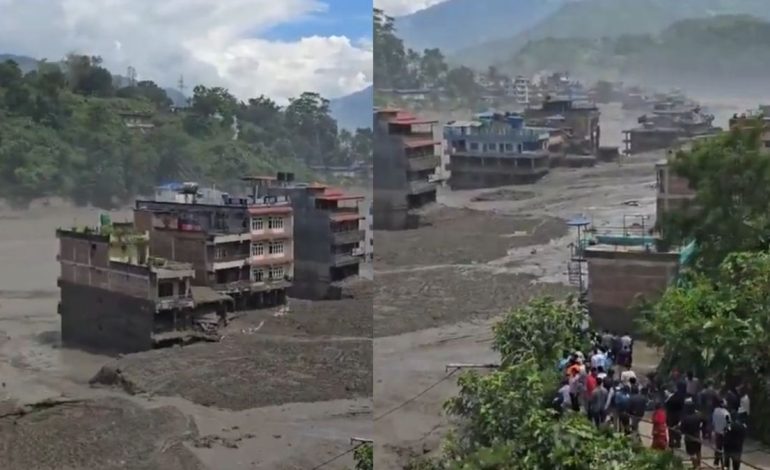
Floodwaters devastate settlements in Nepal. Image courtesy: Screen grabs via X.com

New Delhi: Nepal remained on alert after authorities warned of possible fresh flooding following another rise in the Bhote Koshi River, even as rescue teams continued searching for thousands of people missing after last week’s floods. The National Disaster Risk Reduction and Management Authority (NDRRMA) said on Monday morning that 903 people had died and 4,247 remained missing.
The fresh warning was issued after Chinese authorities informed Nepal about increased water flow upstream. Flood alerts were sent to residents’ mobile phones in Rasuwa, Nuwakot and Dhading, while people living near the Bhote Koshi and Trishuli rivers were urged to remain vigilant and move to safer locations if necessary.
The immediate threat appeared to ease later. Nepal’s flood forecasting division said water flow had risen slightly in Nuwakot but the increase was not significant. Based on information from the district police office in Rasuwa, it said there was no indication at that stage of a major flood threat along riverbank areas in Rasuwa, Nuwakot and Dhading. Monitoring was continuing.
China warns Nepal over upstream flow
Dharam Raj Uprety, chief executive of the NDRRMA, told Associated Press that the renewed warnings followed information from Chinese authorities about increased water flow upstream.
China’s water resources ministry said a barrier lake formed in the disaster zone had largely drained and water was again flowing through the river channel.
However, the ministry said an impact crater about 5.6 kilometres upstream still required close monitoring. Satellite imagery taken late Sunday morning showed the crater holding an estimated 1.4 million cubic metres of water, although its surface area had decreased during the morning and water was flowing out continuously.
Three smaller water-accumulation areas downstream of the crater also remained. Xinhua reported that another barrier lake formed by a landslide on the Nepali side had breached naturally after upstream water reached it.
Chinese authorities said the remaining water bodies continued to pose some risk and were being monitored. The warning came days after the August 26 flood swept through communities along the Nepal-China border and downstream river valleys.
Nepal toll reaches 903, 4,247 remain missing
The NDRRMA’s 9am Monday update put Nepal’s death toll at 903, with 4,247 people still missing. The missing includes residents, hydropower workers, tourists, security personnel and others who were in the affected mountain and river corridors when the flood struck.
Among those still unaccounted for are 592 foreign tourists and 127 Nepalis who were travelling with foreign visitors. The NDRRMA also listed 933 hydropower project workers among the missing.
The Tibet side figures remain separate. Chinese authorities said 16 people had died and 546 remained missing in Gyirong County as of 6pm Saturday, the latest regional government count available on Monday.
Among those missing on the Tibet side were 261 foreign nationals from 23 countries, including 104 Nepalis and 49 Indians, according to Chinese authorities.
Rescue teams search tunnels and isolated settlements
Search and rescue operations continued across flood hit districts on Monday. The NDRRMA said 20,811 security personnel had been deployed, including members of the Nepali Army, Nepal Police and Nepal Armed Police Force (APF).
The disaster authority said 10,451 people had been rescued, with helicopter operations accounting for the evacuation of thousands of Nepalis and hundreds of foreign nationals. Relief supplies were also being moved into areas where road access remained difficult.
Attention has increasingly focused on hydropower projects where workers remain trapped or unaccounted for.
AP reported that multiple foreign teams were assisting Nepali rescuers searching for workers trapped in hydropower tunnels, with officials saying at least 90 people were trapped in several tunnels.
Reuters reported that Nepali rescue teams, assisted by Indian and Chinese experts, were using earth-moving equipment to clear mud and rock debris blocking hydropower tunnels and reach workers believed to be trapped inside.
Road access also remains badly disrupted. A major section of the Pasang Lhamu Highway has been washed away along the swollen Trishuli river, cutting direct road access between parts of Rasuwa and Nuwakot. Rescue teams continued clearing debris and trying to reopen routes into isolated areas.
India updates rescue and evacuation effort
India also issued a fresh update on its nationals affected by the disaster. The External Affairs Ministry said on Sunday that 403 Indian nationals had crossed safely from China into Nepal, while another 500 Indians remained in China and were safe.
The ministry also released a list of 149 people who had been rescued. It did not issue a revised missing-person count on Sunday. Its previous update had said 275 Indian nationals and 128 people of Indian origin remained missing or uncontactable.
A 19-member Indian forensic team also began work in Kathmandu to assist with DNA analysis and identification of victims, while Indian technical teams have been supporting tunnel-rescue operations.