
Israel election 2026: Netanyahu’s survival battle and the limits of change for Palestinians
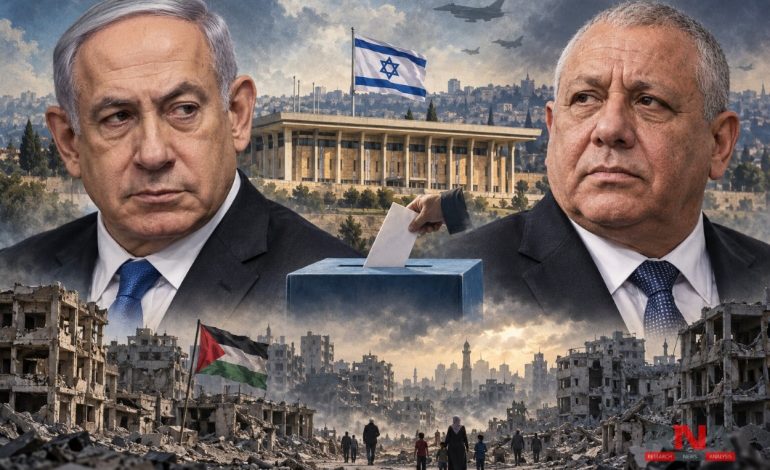
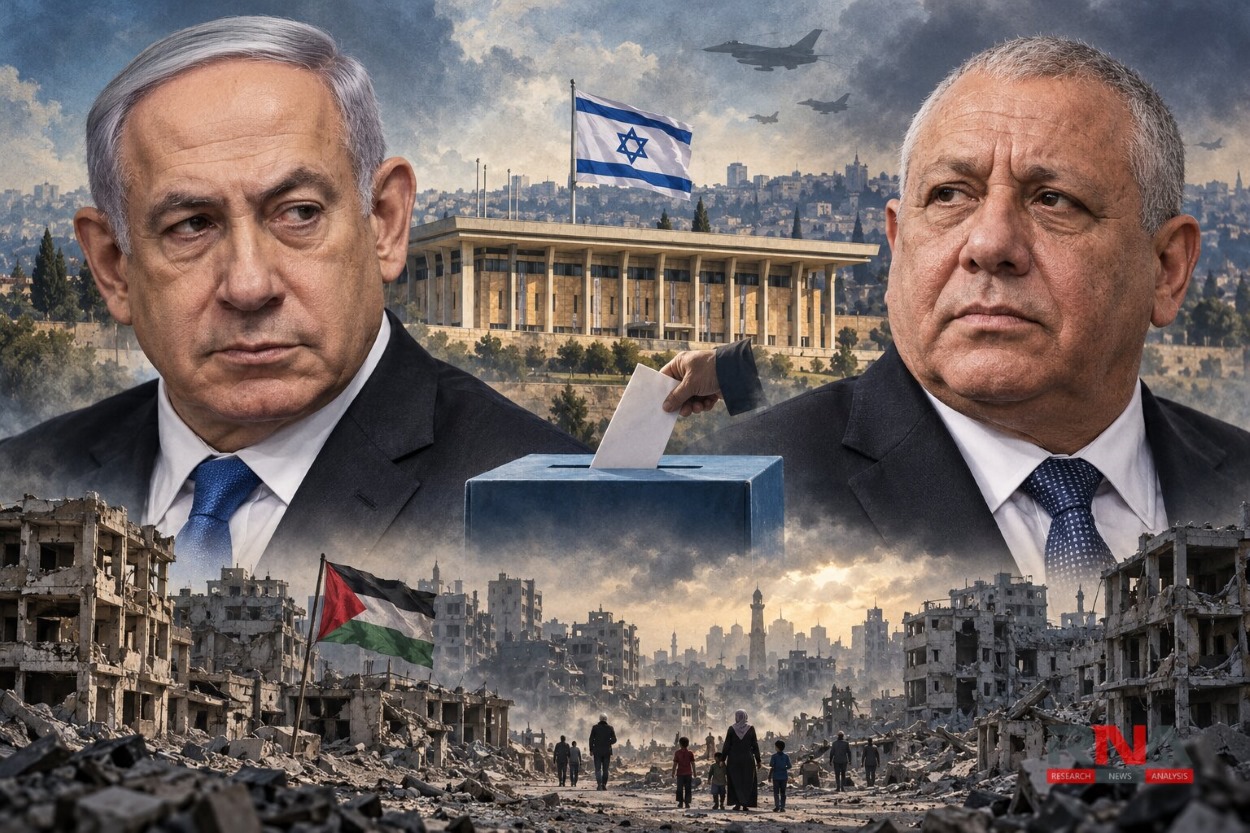
RNA Media illustration featuring Benjamin Netanyahu (L) and Gadi Eisenkot for representation.

New Delhi: Israel votes on Tuesday in an election that will test whether the prime minister, Benjamin Netanyahu, can survive the political consequences of the October 7, 2023, security failure and three years of conflict. Yet even if voters remove him, the positions of his principal challengers suggest that a change of government would bring a more limited shift in policy towards Palestinians and the wider Middle East.
The contest combines a reckoning over leadership with disputes over military service, judicial independence and Israel’s international standing. Its outcome will depend on coalition bargaining as much as votes cast, with neither Netanyahu’s allies nor the main opposition parties assured of a parliamentary majority.
The battle for 61 seats
Israelis elect the 120 members of the Knesset through nationwide proportional representation, choosing party lists rather than directly electing a prime minister. A list must secure at least 3.25 per cent of valid votes to enter parliament, making the performance of smaller parties potentially decisive.
The familiar target is a coalition commanding 61 seats, although winning the largest number of seats does not automatically confer the premiership. After consulting party leaders, the president, Isaac Herzog, assigns the task of forming a government to the lawmaker he considers best placed to succeed.
That candidate normally receives 28 days, with a possible 14-day extension, to negotiate an agreement. The government-formation process provides further opportunities if the first attempt fails, but prolonged deadlock could ultimately produce another election.
This creates a crucial distinction between Netanyahu losing support and losing office. Unless his opponents can assemble a workable alternative, an inconclusive result could leave him heading a caretaker administration while negotiations continue.
Netanyahu weakened, but competitive
For Netanyahu, the election is the first national electoral test since the Hamas-led attack on October 7, 2023. Opponents want accountability for the security collapse, while he argues that his leadership of the subsequent military campaigns has strengthened Israel’s position.
His principal vulnerability is that the attack shattered the security credentials on which he built much of his political authority. He has resisted demands for an independent inquiry, while his opponents have made an investigation part of their case for replacing him.
Recent surveys nevertheless point towards fragmentation rather than a decisive opposition victory. An Indian Express polling compilation placed Netanyahu’s bloc at 48–51 seats and the main opposition parties at 51–55 across several surveys, leaving both short of a majority.
These projections are snapshots, and small parties crossing or missing the electoral threshold could change the distribution substantially. They nevertheless explain why writing Netanyahu’s political obituary before coalition negotiations would be premature.
His leading challenger, the former military chief, Gadi Eisenkot, heads the centrist Yashar party and presents himself as a security-focused alternative. Former prime ministers Naftali Bennett and Yair Lapid have joined forces in Together, while Avigdor Lieberman and the Democrats’ leader, Yair Golan, are other significant opposition figures.
This is consequently a heterogeneous challenge to Netanyahu, bringing together politicians whose disagreements extend beyond personalities. Their shared desire to replace him does not establish agreement on the coalition partners, territorial policies or compromises needed to govern.
Arab-led parties could provide the parliamentary numbers needed to break the impasse, but several opposition leaders resist depending on them. Cooperation with ultra-Orthodox parties presents another difficulty because military-service exemptions for their constituents are among the opposition’s central targets.
A unity arrangement remains another conceivable outcome, although distrust would make it difficult to negotiate and sustain. Netanyahu’s prospects therefore depend less on recovering every lost voter than on whether his opponents can overcome their own political restrictions.
Domestic change could be substantial
The clearest differences concern the organization of the Israeli state and the distribution of wartime obligations. Netanyahu’s reliance on ultra-Orthodox allies has sharpened resentment over exemptions from compulsory military service while other families face repeated reserve deployments.
Judicial powers are another dividing line, following the confrontation over his government’s proposed overhaul. The opposition promises institutional repair and accountability for October 7, making the election consequential even if security policy retains significant continuity.
Voters can therefore reject Netanyahu’s governing methods without embracing territorial compromise. Treating the opposition as a unified peace camp would obscure the different reasons Israelis may have for supporting it.
Nor does declining support for Likud necessarily mean a retreat from hardline politics. Reuters found Itamar Ben-Gvir gaining support among younger voters for his Jewish Power party, with polls suggesting eight or more seats.
That would give an uncompromising nationalist party continuing bargaining power, particularly if Netanyahu needs every available ally. An election fought over his leadership could thus produce a weaker prime minister whose dependence on the far right remains considerable.
Would Palestinian policy soften?
A sweeping reversal appears unlikely on the candidates’ stated positions. A Reuters comparison of Netanyahu and Eisenkot found that both oppose an independent Palestinian state, demand continued Israeli security control and condition withdrawal from Gaza on Hamas’s disarmament.
The differences concern settlements, enforcement and coalition influence rather than an agreed route to Palestinian sovereignty. Eisenkot opposes unauthorized outposts and settler violence, while Netanyahu’s partners include advocates of annexation and Israeli resettlement of Gaza.
Eisenkot also opposes the E1 settlement project east of Jerusalem, which critics warn would severely damage the territorial continuity required for a viable Palestinian state. That position could restrain a particularly consequential development without amounting to acceptance of Palestinian independence.
The distinction matters because preventing additional territorial fragmentation and ending occupation are different political undertakings. A successor government could undertake the former while offering no credible timetable for the latter.
An Associated Press report from the West Bank also illustrates how difficult reversing displacement would be. Armed settler networks, established settlements and damage to Palestinian homes would remain even if a new administration enforced restrictions more seriously.
For Palestinians, stronger protection against attacks would be a meaningful improvement in daily life. It would still fall well short of restoring land, securing freedom of movement or establishing political sovereignty.
The most defensible assessment is therefore conditional: an opposition government could reduce some coercive practices and slow further entrenchment of Israeli control. Its composition and record in office would determine whether those changes extended beyond diplomatic presentation.
Iran and Israel’s neighbours
Regional security policy also offers substantial areas of agreement. In its election assessment, the Council on Foreign Relations identified a broad Israeli consensus behind tough policies towards Iran, Lebanon and Syria.
That makes an immediate strategic reversal improbable, whichever bloc governs. A successor would still face pressure to demonstrate deterrence and would inherit military commitments that could not simply be removed by changing cabinet personnel.
There could nevertheless be differences over how military power serves political objectives. A government less dependent on territorial maximalists might have greater flexibility in negotiating security arrangements, implementing agreements and coordinating with Washington.
Eisenkot has emphasized American ties, regional cooperation and normalization with Arab states. Those positions suggest an effort to combine military strength with diplomatic arrangements, although campaign commitments cannot establish how he would respond to a renewed security crisis.
Netanyahu, meanwhile, has made his relationship with the US president, Donald Trump, a central campaign argument. On the eve of voting, he suggested that the two leaders could resume action against Iran, while Trump urged Israelis to re-elect him.
Those statements demonstrate the continuing danger of escalation, but they do not establish that another attack is inevitable. Operational decisions would still depend on American choices, intelligence assessments and the costs of renewed conflict.
How region, international partners may respond
International reactions would likely distinguish between welcoming a different government and accepting its policies. European governments concerned about settlements could respond positively to credible enforcement against settler violence while maintaining pressure over occupation and annexation.
A September 8 joint statement by foreign ministers from Canada, Denmark, Finland, France, Iceland, Ireland, Norway, Poland, Portugal, Spain, Sweden and the UK set out possible trade restrictions involving settlements and demanded action against their expansion. Those concerns would survive Netanyahu’s departure unless the underlying conduct changed.
Saudi normalization would face a similar substantive obstacle. Riyadh has reaffirmed its demand for Palestinian statehood, meaning that a more accommodating Israeli diplomatic style would not, by itself, resolve the disagreement.
A successor government might reopen political space for negotiations, but normalization would require reconciling incompatible starting positions. Conversely, another Netanyahu coalition dependent on annexation advocates could make that task harder.
For India, the central question would be whether the result reduces regional instability while leaving room for Palestinian self-determination. As RNA Media had reported, New Delhi reiterated its support for a two-state solution in September, a position at odds with the rejection of statehood by Israel’s leading contenders.
Israel’s election can change who exercises power, which allies constrain them and how that power is used. Whether it changes the region’s trajectory will depend on decisions over Palestinian rights, territorial control and military escalation that the ballot alone cannot settle.