
India reiterates support for Palestinian state, starts building hospital in West Bank, moots one in Gaza; Palestine supports New Delhi’s UNSC bid
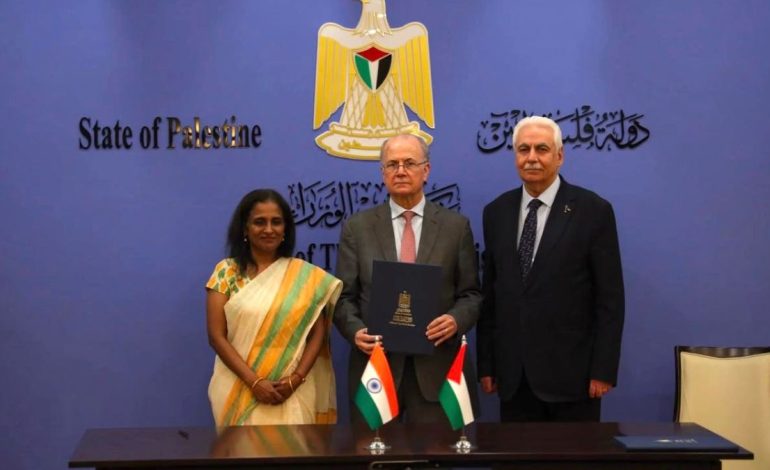
India, Palestine break ground on 200-bed super-speciality hospital. Image credit: X/@ROIRamallah

New Delhi: India’s secretary for consular, passport, visa and overseas Indian affairs, Sripriya Ranganathan, is touring Egypt, Palestine and Lebanon from August 16 to 21. During the Palestine leg of her trip, she held a series of meetings in Ramallah covering India’s development partnership with the Palestinians and the ongoing crisis in Gaza.
On Tuesday, Ranganathan met with Palestine’s foreign minister, Varsen Aghabekian Shahin. She raised India’s concern over what she called the grave humanitarian situation in Gaza, and stressed the need to address it through sustained assistance, dialogue and diplomacy. India, she said again, remains committed to a negotiated two-state solution.
The two sides also took stock of everything already running on ground, including, health, education and, capacity-building programmes.
India’s healthcare support
The visit’s most concrete moment came a day later. On Wednesday, India and Palestine held the ground-breaking ceremony for a 200-seat super-speciality hospital in Arrabeh, in the northern West Bank’s Jenin Governorate. The facility is part of India’s expanding support for Palestinian healthcare and is expected to include specialized medical services, including a trauma centre. Ranganathan attended the ceremony alongside Palestinian prime minister, Mohammad Mustafa.
The hospital project dates back to a 2017 visit to Palestine by the prime minister, Narendra Modi, when he announced India’s support for its construction. Palestine’s ambassador to India, Abdullah Mohammad Abu Shawesh, said the project has now been formally cleared, calling it “very significant” given how badly strained Palestine’s health system has become. He said India was “one of the countries” Palestine had turned to for help.
India’s representative office in Ramallah said the ceremony had “further strengthened our cooperation in healthcare, employment-oriented skills and capacity-building.”
Apart from the hospital, Ranganathan signed an agreement with Palestine’s labour ministry. This agreement will fund a vocational training centre in the printing sector.
She also met Palestine’s health minister, Majed Abu Ramadan, and handed over a fresh batch of Indian medicines, including anti-cancer drugs. India’s already running an artificial limb fitment camp there, and the two sides are now talking about sending more equipment, dialysis machines among them, some of which may come in through Jordan.
India is also weighing something bigger: a field hospital inside Gaza itself, where the healthcare system is barely holding up. Ranganathan visited an United Nations Relief and Works Agency (UNRWA) run health centre during her trip, and India’s representative office said its support to the agency “in providing health, education and other essential services to the Palestinian people remains strong.”
She also met separately with Majdi Al-Khaldi, the diplomatic adviser to Palestinian president, Mahmoud Abbas. She reaffirmed India’s continued support for Palestine, and the two discussed the wider political relationship alongside the new health, education and skills initiatives launched during the visit.
Palestine backs India’s UNSC bid
The backing wasn’t one-sided.
On Wednesday, the same day India and Palestine broke ground on the hospital, Abu Shawesh said Palestine supports India’s candidature for a non-permanent seat on the UN security council for 2028-29, as well as its longer-standing demand for a permanent seat.
“We are with India to have a permanent seat in the security council itself,” he said, arguing that India’s inclusion would also be part of wider efforts to reform the UN security council. He referred to his own experience of working on UN reform at the international body.
This is not a new position for the Palestinian envoy. At a press conference in New Delhi a last month, Abu Shawesh said “India deserves to be a permanent member of the security council. Not for just three years.” He framed it partly as solidarity among Global South nations, telling reporters, “one of our appeals as a southern country was to have India at least be one of the countries that deserves to have a permanent seat.”
Abu Shawesh has also pointed to India’s wider diplomatic reach as a reason for its importance. He said India carries significant political weight because it maintains relationships with both Israel and Palestine.
That position is relevant to another message from the Palestinian side, that India could use those relationships to support efforts to reduce tensions and advance the peace process.
India’s relationship with Palestine also has a long history. New Delhi recognized the Palestine Liberation Organization in the 1970s and recognized the State of Palestine in 1988. Since then, India has continued its development assistance and support for Palestinian institutions.
At the same time, India’s relationship with Israel has expanded considerably over the past decade. The prime minister, Narendra Modi, became the first Indian prime minister to visit Israel in 2017, the same year he announced India’s support for the hospital project in the West Bank.