
India-Sweden Establish Strategic Partnership, Modi Thanks Sweden for Condemning Pahalgam Terror
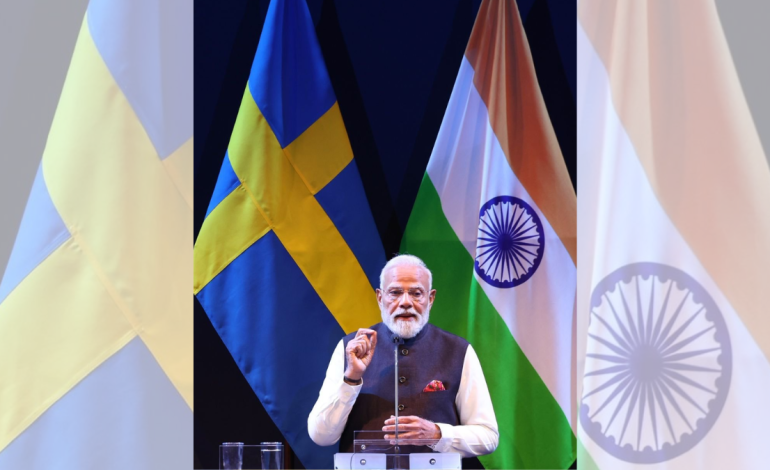
India-Sweden strategic partnership. Image courtesy: @narendramodi

India and Sweden, on Sunday (May 17, 2026), elevated their bilateral relations to a strategic partnership, pointing to the growing cooperation in Artificial Intelligence, defence, and green energy.
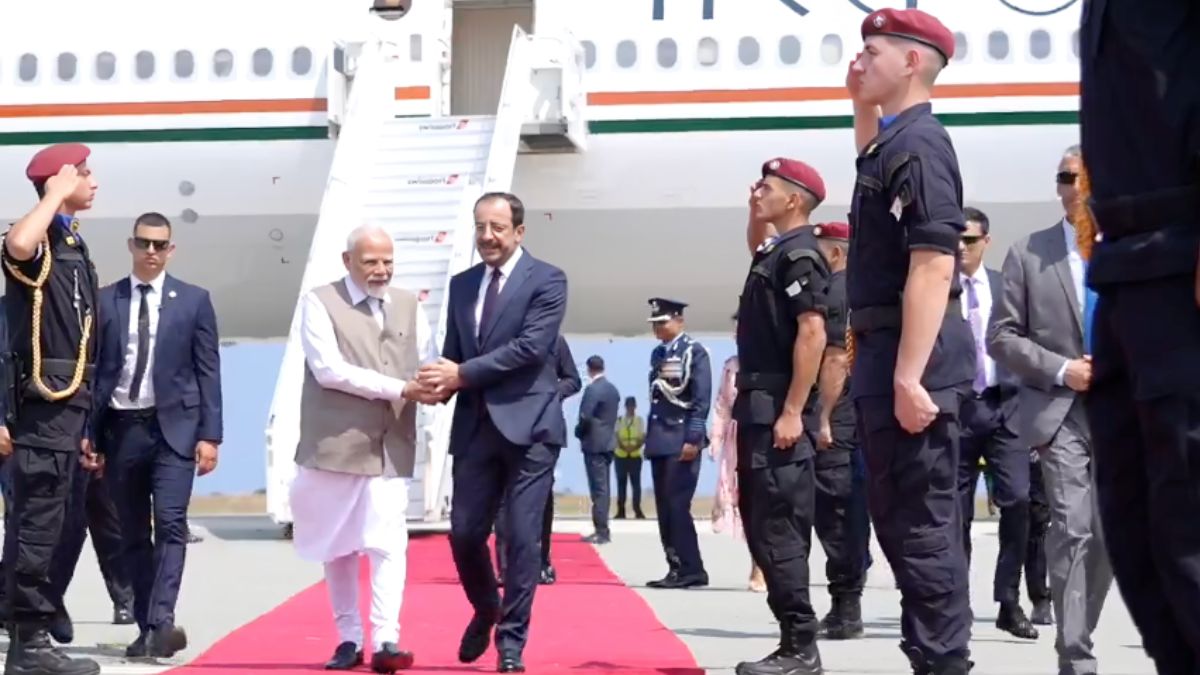
The agreement on enhancing the bilateral ties was announced during Indian Prime Minister Narendra Modi’s visit to the Scandinavian nation, when he was conferred Sweden’s highest honour, the ‘Royal Order of the Polar Star, Degree Commander Grand Cross’. The honour was conferred in recognition of his exceptional contributions to bilateral ties and his visionary leadership.
The two nations noted that their future partnership would be guided by four pillars resting on Strategic Dialogue for Stability and Security, Next-Generation Economic Partnership, Emerging Technologies and Trusted Connectivity, and Shaping Tomorrow Together for People, Planet, Health, and Resilience.
To operationalise the upgraded partnership, the two leaders adopted the India-Sweden Joint Action Plan 2026-2030, which laid out a roadmap for cooperation across political, economic, technological, security, climate, and people-to-people domains.
In Sweden, Modi held wide-ranging bilateral talks with his counterpart, Ulf Kristersson, in Gothenburg and addressed the European Round Table for Industry, underlining India’s growing strategic and economic engagement with Europe in general, and Sweden in particular.
Modi expressed India’s gratitude to the Swedish PM for the support received after the Pahalgam terror attacks in April 2025, in which 26 civilians were killed.
India and Sweden “agree that terrorism is a grave challenge for all humanity. I express my gratitude to Prime Minister Kristersson for the support we received from Sweden after the terrorist attack in Pahalgam last year. We will continue our fight against terrorism and those who support it,” he said.
Modi and Kristersson unequivocally and strongly condemned terrorism and violent extremism in all its forms and manifestations, including cross-border terrorism.
They condemned in the strongest terms recent terrorist attacks, including the terrorist attack in Pahalgam, Jammu and Kashmir, on April 22, 2025. The leaders called for the dismantling of terror infrastructure and safe havens, and for decisive and concerted international efforts to combat terrorism in a comprehensive and sustained manner and in accordance with international law.
They reiterated their commitment to strong and concerted action against terrorists and terrorist groups, including those listed in the UNSC 1267 sanctions regime and their affiliates, proxies, sponsors, backers, and financiers. They reaffirmed their strong commitment to continue taking active measures to disrupt the terror financing channels, including at the UN and FATF.
In a joint statement on the strategic partnership, the Prime Ministers agreed to strengthen dialogue at the political, diplomatic, and defence levels, including exchanges between the two National Security Advisors and their respective offices.
The Prime Ministers underlined the importance of economic security and security of supply chains and announced the shared objective of doubling the bilateral economic exchange, such as trade and investment, within five years, including through the ‘Make in India’ and ‘Made with Sweden’ initiatives.
They recognised the significant role of the India-Sweden Business Leaders Round Table (ISBLRT) and agreed that a bilateral summit, “India–Sweden: Stronger Together – towards 2047,” would be held in India in 2027.
The Swedish PM congratulated India on the success of the AI Impact Summit, while the Indian PM expressed appreciation for the participation of the Swedish Deputy Prime Minister, along with a large delegation from the Swedish AI ecosystem.
The Prime Ministers emphasised shared priorities on emerging technologies and trusted connectivity, as well as the critical role of digitalisation, and agreed to strengthen cooperation in this field, including through the Sweden–India Technology and Artificial Intelligence Corridor (SITAC).
They agreed that Sweden and India will launch an upgraded Joint Innovation Partnership 2.0 and establish an India-Sweden Joint Science and Technology Centre (ISJSTC).
The Prime Ministers expressed their commitment to pursue enhanced cooperation on space and geospatial technologies, taking note of India’s role as a leading space nation and the role of Sweden’s Esrange Space Centre.
They also welcomed the collaboration between the Indian Space Research Organisation (ISRO) and the Swedish Institute for Space Physics on the Indian Venus Orbiter Mission.
The Prime Ministers welcomed the expansion and growing engagement of the Leadership Group for Industry Transition (LeadIT) and decided to continue to advance this global movement for the acceleration of the transition of heavy industry.
To this end, the Prime Ministers called for a new four-year phase of LeadIT, LeadIT 3.0, to be announced at COP31. The Prime Ministers further recognised the importance of the bilateral Sweden-India Industry Transition Partnership (ITP).
They encouraged collaboration in advanced mining and mineral processing technologies to facilitate efficient extraction from low-grade and complex critical mineral deposits.
Simultaneously, efforts may be made to promote the co-development of refining and downstream processing capabilities to enhance domestic value addition. Such initiatives are expected to strengthen resilient supply chains, particularly for critical minerals such as rare earths.
The Prime Ministers agreed that the expanding bilateral partnership shall continue to be guided by a shared commitment to democracy, the rule of law, respect for human rights, sustainable development, and a rules-based international order.
The leaders emphasised the importance of an effective multilateral system, with the United Nations at its core. The Swedish Prime Minister reiterated Sweden’s support for India’s permanent membership in a reformed and expanded UN Security Council.