

India, Armenia move defence ties beyond arms sales with new military cooperation format
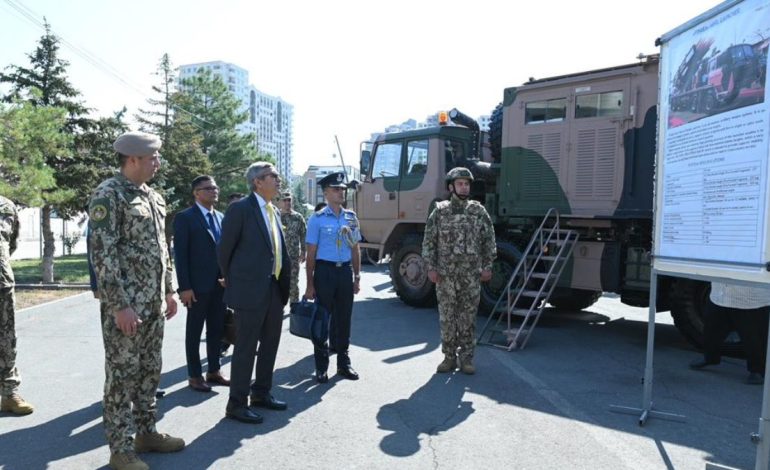
Defence secretary Shri Rajesh Kumar Singh reviews military equipment during an official visit to Armenia. Image Courtesy: X.com/@SpokespersonMoD

New Delhi: India and Armenia have moved to deepen defence cooperation with a new format for engagement between the general staffs of their armed forces, adding an institutional layer to a relationship that has expanded rapidly through arms purchases and military technical ties. The step came during India’s defence secretary Rajesh Kumar Singh’s visit to Yerevan, where he held talks with Armenian defence minister Suren Papikyan and chief of the general staff Lieutenant General Edvard Asryan.
Armenia’s defence ministry said Singh and Asryan exchanged a document defining the new format of cooperation between the general staffs of the two armed forces. In a separate engagement with Armenian high-tech industry minister Davit Tadevosyan, the Indian defence ministry said the two sides discussed cooperation in research, development, innovation and shared production in the defence industry.
From arms buyer to defence partner
The latest agreements build on a defence relationship that has widened steadily over the past few years. Armenia has become an important market for Indian-made military systems, while New Delhi has used the partnership to demonstrate the growing export potential of its domestic defence industry.
The scale of the relationship has also grown sharply. The Times of India reported that Armenia has committed nearly $2 billion to Indian military equipment, making it one of New Delhi’s most important markets for finished weapon systems, including Pinaka rocket launchers, Akash air-defence systems, Swathi weapon-locating radars and artillery systems.
In September 2022, Armenia signed a $245 million contract with India covering Pinaka multi-barrel rocket launchers, anti-tank rockets and other ammunition, according to the Indian defence ministry. The relationship has since expanded further. In January this year, defence minister Rajnath Singh flagged off the first tranche of Guided Pinaka rockets for Armenia from a manufacturing facility in Nagpur.
The institutional side has grown alongside equipment sales. India and Armenia held a Joint Working Group meeting on defence cooperation in Hyderabad in October 2025, while Asryan visited India in April 2026. The latest Yerevan talks now add a formal mechanism for closer interaction between the two countries’ military headquarters.
A strategic shift in the South Caucasus
For Armenia, the partnership with India forms part of a wider effort to diversify its security relationships as Yerevan reduces its dependence on Russia and develops closer defence ties with other partners, including France and the United States. The Armenian prime minister, Nikol Pashinyan, has publicly argued for diversification of his country’s external relationships while seeking a broader security architecture.
The regional setting has also changed. Armenia and Azerbaijan initialled the text of a peace agreement in Washington in August 2025, and both governments have since spoken of peace as established. The agreement, however, has yet to be formally signed and ratified, while work continues on border delimitation and regional connectivity.
India’s growing defence engagement with Armenia therefore carries weight beyond bilateral trade. Azerbaijan and Turkiye formalized allied relations through the 2021 Shusha Declaration, which includes defence cooperation and mutual military assistance. Azerbaijan also maintains active military ties with Pakistan, including training, exercises and military-technical cooperation.
New Delhi has not presented its partnership with Yerevan as directed against any third country. Still, closer defence industrial and military links give Armenia an additional source of equipment and expertise while widening India’s strategic footprint in the South Caucasus.
Armenia fits India’s defence export push
The Armenia partnership comes as India’s defence exports continue to rise sharply. Government figures show exports increased from ₹686 crore in 2013-14 to a record ₹38,424 crore in 2025-26, a rise of more than 5,500 per cent. India now exports defence equipment to more than 100 countries, with the government targeting ₹50,000 crore in annual defence exports by 2029.
Armenia was among India’s top three defence export destinations in 2023-24, alongside the United States and France. That makes the latest agreements significant: the relationship is moving beyond a conventional buyer-seller model towards military-to-military engagement, defence innovation and shared production, giving both countries a larger long-term stake in each other’s defence ecosystems.