

Gaza reports 16 schoolchildren killed in November as Israeli strike claims two sisters
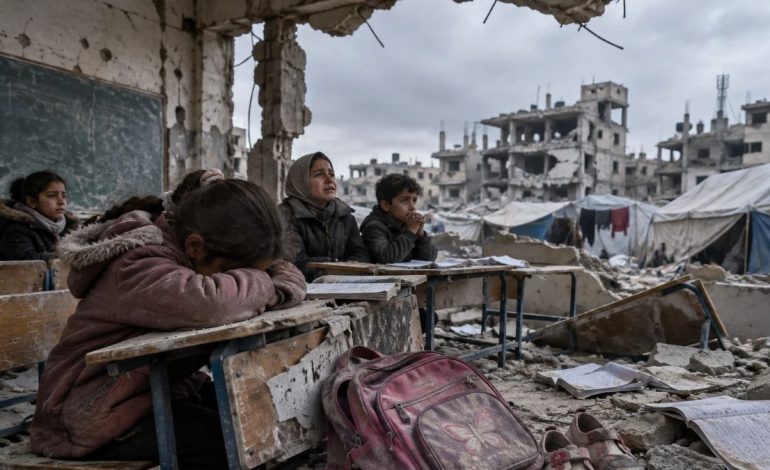
RNA Media illustration for representation.

New Delhi: At least 16 schoolchildren have been killed in Israeli attacks across Gaza since the beginning of November, including two sisters who died with their parents in a strike on an apartment in western Gaza City on Wednesday. The reported deaths come despite a ceasefire, as children face continuing violence, interrupted education, displacement and mounting public health risks.
Gaza’s education ministry announced the figure on Wednesday, saying students had come under attack for the third time in less than 24 hours. The Guardian documented several individual cases through interviews with bereaved families, although the ministry’s overall count has not been independently verified.
Yusra Mohammed Abu al-Ouf, 15, was a pupil at Kafr Qasim school, while her younger sister Jana, 13, attended al-Manar private school. Both were killed alongside their parents, Mohammed Majed Abu al-Ouf, 47, and Noura Ezzat Abu al-Ouf, 41, in the Wednesday strike. The Guardian reported that their father was a director of internal security services for Hamas in northern Gaza.
Children killed at home and near a sports pitch
Another family described the death of Mohammed Nidal Barbakh, a 15-year-old pupil at Muscat school who hoped to become a professional footballer. His father said Mohammed had gone to a sports academy in the Bir 19 area of al-Mawasi, Khan Younis, on November 6 when an Israeli tank fired towards the pitch.
According to his father, a round struck a metal object, ricocheted and hit Mohammed, who later died from his injuries. This description is the family’s account, not an independently established reconstruction of the shooting.
On November 13, artillery fire killed 12-year-old Ahmed Abu Daher, his father and a woman in Deir al-Balah. Ahmed had accompanied his father to a condolence gathering in the al-Qastal area and dreamed of becoming an Arabic-language teacher, like his grandfather.
His mother, Walaa Abu Daher, said Ahmed ran to seek help after the gathering came under fire, then rushed back towards his father before being struck by shrapnel. “I feel as though my life stopped that day,” she told the Guardian. The Israel defense forces said it lacked sufficient information to comment on Ahmed’s and Mohammed’s individual cases, but maintained that its operations on the day Ahmed died killed 10 terrorists and that precautions were taken to limit civilian harm.
Damaged schools and winter deepen humanitarian crisis
Unicef estimated in April that nearly 98 per cent of Gaza’s school buildings had been damaged, more than 93 per cent required major rehabilitation or reconstruction, and about 81 per cent had been directly hit. Approximately 700,000 children had missed formal in-person education for almost three academic years.
Unicef also estimated that around 420,000 children, or three in five, had no face-to-face learning opportunities at all. Temporary classrooms remain vulnerable, with UN humanitarian officials reporting that heavy November rain and flooding affected 201 of Gaza’s 633 operational learning spaces.
The disruption extends beyond education, with children facing severe shortages of essential medicines. RNA Media earlier reported how limited supplies of insulin and glucose testing equipment have complicated treatment for diabetic children in Gaza.
Families face winter in overcrowded shelters with limited access to clean water and essential services. Gaza’s health ministry issued a meningitis epidemic alert on Tuesday after recording 272 infections in October, as damaged infrastructure and poor sanitation compounded risks.
The health risks are compounded by extensive damage to water and sewage infrastructure. An Oxfam assessment previously covered by RNA Media warned of widespread contamination across Gaza, raising concerns about long-term exposure to polluted water and hazardous waste.
The ministry has reported at least 74,746 Palestinians killed during the war, while more than 20,000 children have been reported killed, according to the Guardian. Those cumulative figures are separate from the education ministry’s November tally of 16 schoolchildren.
Violence also continued on Thursday, when Israeli strikes and gunfire killed at least 10 Palestinians, including Khaled Abu Nada and his wife, according to medical officials cited by Reuters. Abu Nada was a Hamas appointed deputy education minister; Israel said he managed the group’s financial network and directed funds towards militant activities, an allegation Hamas did not address