
China warns of ‘consequences’ over Taiwan’s Pacific forum presence as Australia, New Zealand push back
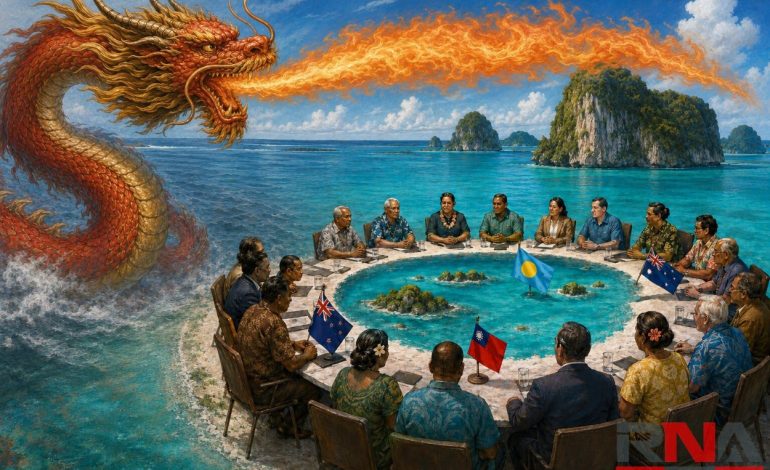
RNA Media illustration for representation.

New Delhi: China has warned of unspecified “consequences” after Taiwan’s foreign minister attended the opening ceremony of the Pacific Islands Forum in Palau, bringing the Beijing-Taipei dispute to the centre of the regional summit. Australia and New Zealand rejected any attempt by an outside power to influence the 18-member grouping’s decisions, insisting that Pacific governments alone determine who participates in its meetings.
China’s special envoy for Pacific island affairs, Qian Bo, said Beijing had “serious concerns” about Taiwan’s presence and declared that “there will always be consequences”. Qian denied that his remark was a threat but did not explain what action China might take, according to Reuters.
Qian described Taiwan’s attendance at the ceremony on August 31 as inappropriate and claimed that it was opposed by all parties. He also said China had communicated its position to Palau and enjoyed the understanding of a majority of PIF members, although the forum itself did not endorse that assertion.
The prime minister of Australia, Anthony Albanese, responded that decisions concerning the meeting belonged to the Pacific Islands Forum rather than any other country. New Zealand’s foreign minister, Winston Peters, similarly said the organization did not take instructions from governments outside its membership.
Taiwan’s foreign minister, Lin Chia-lung, attended the ceremony and is taking part in meetings and associated events during a visit to Palau from August 27 to September 3. Lin said Taiwan was honoured to remain a Pacific partner and would continue working with regional countries to promote prosperity and peace.
Taiwan’s foreign ministry said Lin would participate in the 30th Taiwan/ROC–Forum Countries Dialogue, hosted by the PIF secretariat, and attend the Pacific Prosperity Exhibit organized by Palau. His programme also includes discussions on renewable energy, climate adaptation, digital resilience, healthcare, infrastructure and investment, according to an official Taiwanese statement.
Taiwan is not a formal dialogue partner of the PIF in the same category as China but has held the status of development partner since 1993. China is among the forum’s 21 dialogue partners, alongside India, the US, the European Union, Britain, Canada and Japan.
Beijing considers democratically governed Taiwan part of China and maintains that Taipei has no right to participate independently in international organizations. Taiwan rejects Beijing’s sovereignty claim and argues that its future can be decided only by its 23 million people.
The diplomatic contest has become particularly visible in the Pacific, where China has persuaded several governments to transfer recognition from Taipei to Beijing. Palau, Tuvalu and the Marshall Islands are now the only Pacific island countries maintaining formal diplomatic relations with Taiwan.
The president of Palau, Surangel Whipps Jr, defended his country’s right to maintain its relationship with Taipei and cautioned against using the forum to intimidate participating governments. “That is our sovereign decision, not their decision,” Whipps said in remarks reported by SBS News.
The dispute follows earlier Chinese pressure on Palau, whose economy is heavily dependent on tourism and external assistance. Beijing issued a travel advisory in July describing the island country as unsafe, prompting the US embassy in Koror to accuse China of attempting to use tourism as an instrument of coercion.
The confrontation has compounded questions about regional unity at the 55th PIF leaders’ meeting, which opened with five national leaders absent. The prime ministers of Fiji, Sitiveni Rabuka; Vanuatu, Jotham Napat; Samoa, La’auli Leuatea Schmidt; and Solomon Islands, Matthew Wale, as well as the president of Kiribati, Taneti Maamau, are being represented by ministers or senior officials.
Wale travelled to Palau but returned to Solomon Islands after facing a no-confidence motion, while Kiribati cited a parliamentary sitting and limited flight connections for Maamau’s absence. There is no evidence that the non-attendance of the five leaders constitutes a coordinated boycott, as an earlier RNA Media report noted.
The absences nevertheless matter because the PIF generally reaches major decisions by consensus and relies on private exchanges among leaders to settle disagreements. Its agenda includes climate resilience, economic vulnerability, renewable energy, maritime security and transnational crime, but competition among China, Taiwan and Western powers threatens to overshadow those priorities.
That wider strategic contest was also evident in an announcement during the summit that the US and New Zealand would jointly finance the modernization of a World War II-era port on Penrhyn in the Cook Islands. Washington plans to provide $50 million and Wellington NZ$17.5 million for the project, which is intended to improve maritime access and economic links in the northern Cook Islands.
China, meanwhile, has expanded its Pacific presence through infrastructure projects, trade, diplomatic agreements and security cooperation. Australia, New Zealand and the US have responded by increasing development assistance and defence engagement, reflecting the growing strategic importance of island countries spread across vast areas of the Pacific Ocean.
Beijing’s warning leaves open whether any retaliation will be directed at Taiwan, Palau or the forum’s institutional relationship with Taipei. More broadly, the dispute has become a test of whether Pacific governments can preserve their collective autonomy while managing intensifying competition among larger powers.