

At least 132 killed, thousands missing in Colombia’s biggest earthquake in years
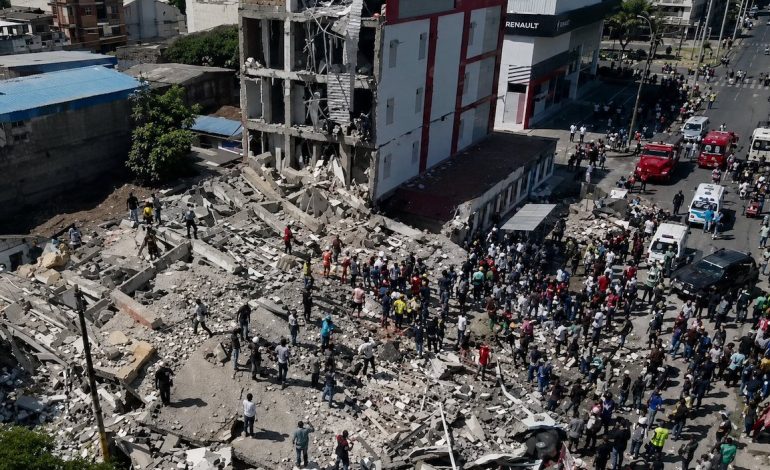
This digitally enhanced screenshot of a video shows people gathering around a collapsed building to search for survivors in Colombia

New Delhi: At least 132 people have been killed and hundreds injured after a 7.4-magnitude earthquake tore through western Colombia, with thousands more reported missing as rescue teams dig through the rubble of collapsed buildings in Cali, Pereira and Manizales. Colombia’s geological service has called it the most powerful and destructive earthquake to strike the country in years.
The earthquake, as reported by RNA Media, hit at 7.34am local time on Monday with its epicentre close to San Jose del Palmar, a small town in the Choco department roughly 240 kilometres (150 miles) west of the capital, Bogota. The US Geological Survey put the depth at 107 kilometres (66 miles), and at least 21 aftershocks followed within hours, including ones measuring 5.0 and 4.8 in magnitude.
The disaster struck barely days after Abelardo de la Espriella was sworn in as Colombia’s president, thrusting his new administration straight into its first major crisis. Addressing the nation at about 1pm local time (11.30pm IST), De la Espriella declared a national state of emergency and said the government’s first priority was rescuing people trapped under the rubble.
The death toll climbed steadily through the day as reports came in from remote and communication-starved areas. Local authorities said the count included at least 40 dead in the Risaralda region, home to Pereira; 27 in Valle del Cauca, where Cali is located, among them three children; nine in Choco; two in Caldas; and a 73-year-old man in Antioquia.
By evening, De la Espriella put the confirmed national toll at 132 dead and more than 570 injured, with the location of dozens of victims still being confirmed. More than 1,600 buildings were reported damaged nationwide, including at least 61 that had collapsed entirely.
In Cali, Colombia’s third-largest city and home to roughly two million people, the mayor, Alejandro Eder, said at least 20 buildings had collapsed and 380 more had been damaged, with people still trapped inside several of them. Rescue crews and civilian volunteers formed long human chains to clear broken concrete as they searched for survivors, and a hospital in the city partially collapsed with patients still inside.
Pereira, capital of the Risaralda region, suffered some of the heaviest losses of life anywhere in the country. A resident, Jorge Moncayo, described watching plumes of dust rise across Cali as buildings came down around him. “My entire house shook,” he told a reporter. “I’ve never lived through such a powerful earthquake.”
Thousands missing
As families struggled to reach loved ones, digital missing-persons databases – similar to those used after Venezuela’s earthquakes in June – filled rapidly through the day. One tracker had logged more than 2,000 names by Monday evening, most of them from Cali and Pereira, with the total still climbing.
In Pereira, relatives searched for a man last seen heading to the city’s transport terminal; in Cali, families posted photographs of an elderly woman whose building had collapsed. The Colombian Red Cross opened a dedicated WhatsApp line to help register the missing and reunite families.
In Manizales, capital of the coffee-growing Caldas department, one of the twin towers of the city’s neo-Gothic Metropolitan Cathedral Basilica – the tallest in Colombia – crumbled and fell onto the nave. The shaking reached Bogota, some 240 kilometres away, where residents evacuated buildings, though the city’s mayor, Carlos Fernando Galán, said only minor cracking had been reported there.
Tremors were also felt in Barranquilla on the Caribbean coast, and across the borders in Ecuador, Panama and Venezuela. Seven airports – in Armenia, Cali, Manizales, Pereira, Quibdó, Buenaventura and Cartago – suspended operations as a precaution.
Choco sits along the Pacific “ring of fire”, the seismic belt that produces most of the world’s earthquakes, and is among Colombia’s poorest and most inaccessible regions, reachable in many parts only by boat or aircraft. The Choco governor, Nubia Carolina Córdoba, said at least twelve people had died and 84 had been injured there, cautioning that communications outages were slowing the flow of information from outlying villages.
A community leader in Quibdó, the departmental capital, Luis Gregorio Moreno, told a reporter that many residents remained unaccounted for. “We are all devastated,” he said. “At this moment, there are reported deaths, dozens of wounded, but what there are most of are missing people.”
Offers of help pour in
The president of the European Commission, Ursula von der Leyen, said Europe’s “heart is with the people of Colombia” and confirmed that the bloc had activated its Copernicus satellite service to assist rescue operations. Israel’s foreign minister, Gideon Sa’ar, and its president, Isaac Herzog, separately offered condolences and pledged assistance, while the relief network run by the chef Jose Andres, World Central Kitchen, said it had activated operations in Colombia to deliver emergency food aid.
Monday’s disaster comes just two months after twin earthquakes above magnitude 7 devastated neighbouring Venezuela in June, killing more than 6,300 people and leaving the wider Andean region on edge. Colombia’s own history includes the 1999 Quindío earthquake, which killed more than a thousand people around the city of Armenia and remains the country’s deadliest tremor in living memory.
For now, officials in Bogota say the priority remains locating survivors in Cali, Pereira and the villages around San Jose del Palmar. With aftershocks continuing and communications still patchy in Choco, the true scale of the disaster – in lives lost and lives still unaccounted for – may not be known for several days.