Amidst Differences On West Asia, India’s BRICS Chair Statement Calls For Global Governance Overhaul
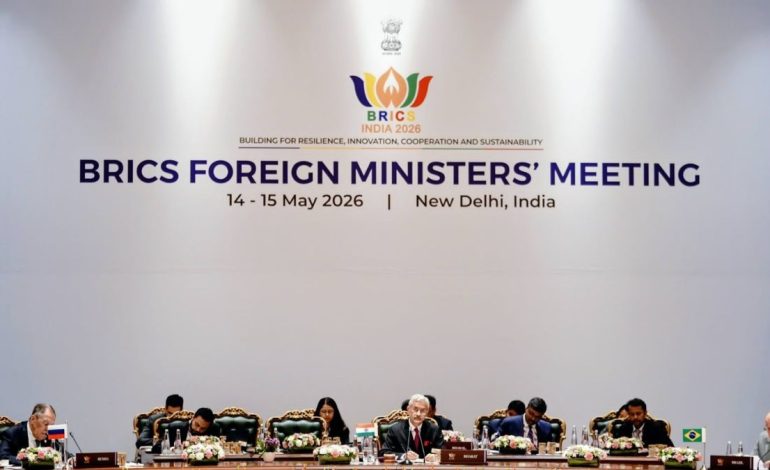
India used the BRICS Foreign Ministers’ Meeting in New Delhi to push for sweeping reforms of global governance institutions, even as differences among member nations over the West Asia conflict prevented the adoption of a joint declaration. Image courtsy: X.com/@DrSJaishankar

Amidst differences among the BRICS nations regarding the West Asia conflict, India on Friday (May 15, 2026) issued only a Chair’s Statement instead of a Joint Declaration, in which it called for “an urgent overhaul” of global governance institutions.
At the two-day BRICS Foreign Ministers’ Meeting in New Delhi, India, said the current multilateral system no longer reflected the present-day geopolitical realities, and stressed that reform was “not a matter of choice, but of necessity.”
Highlighting that institutions created in an earlier era were struggling to respond effectively to modern global challenges, India’s focus at the meeting was on a renewed demand for United Nations Security Council (UNSC) reforms.
India argued that the UN’s decision-making structures remained outdated despite expanding global responsibilities, and called for greater representation for Asia, Africa, and Latin America through the expansion of both permanent and non-permanent seats at the UNSC.
India also urged reforms in global financial and trade institutions, pointing to vulnerabilities faced by developing nations due to fragile supply chains, energy insecurity, and financing challenges.
It advocated strengthening multilateral development banks and ensuring a more inclusive, rules-based global trading system with the World Trade Organization at its core.
The BRICS meeting, however, concluded without a joint statement due to differences among member countries over the situation in West Asia.
In the Chair’s Statement issued by India, BRICS members acknowledged their differing national positions while emphasising dialogue, diplomacy, respect for sovereignty and territorial integrity, and the protection of civilian lives and infrastructure.
The statement underlined the importance of maintaining safe and unimpeded maritime commerce through international waterways and noted concerns over the global economic impact of the ongoing conflict.
The BRICS Foreign Ministers strongly condemned terrorism in all its forms and reiterated the need for zero tolerance toward terrorism, including cross-border terrorism, terror financing, and safe havens. They also condemned the terrorist attack in Jammu and Kashmir’s Pahalgam in April last year.
They reaffirmed their support for strengthening cooperation through the BRICS Counter-Terrorism Working Group and called for the early adoption of the Comprehensive Convention on International Terrorism under the United Nations framework.
The Chair’s Statement reiterated support for the Palestinian people’s right to self-determination and an independent state, emphasising the importance of unifying the West Bank and Gaza Strip under the Palestinian Authority. However, the document acknowledged that one member country held reservations regarding aspects of the Gaza-related language.
India’s Secretary (Economic Relations) Sudhakar Dalela said BRICS members had managed to find common ground on most issues despite differences over West Asia.
Taking this opportunity, India’s External Affairs Minister Dr. S. Jaishankar met with Iranian Foreign Minister Abbas Araghchi, who was in Delhi for the BRICS meeting, to discuss the West Asia situation and maritime traffic through the Strait of Hormuz.
Jaishankar said on X that he had a “detailed conversation” with Araghchi, reviewing the West Asia situation and discussing its implications, apart from bilateral issues concerning both countries.
Araghchi had also met with Indian Prime Minister Narendra Modi on Thursday (May 14), both diplomatic engagements being part of the efforts to remain in contact amidst the rising West Asia tensions and disruption in maritime cargo traffic.
At the BRICS meeting, Araghchi called for stronger collective resistance against what he described as American coercion and pressure tactics.
“To virtually everyone in this room, our resistance against US bullying is not an unfamiliar battle. So many of us encounter slight variations of the same repugnant coercion. It is high time for us to jointly step up and work towards making clear that those practices belong in the dustbin of history,” he said.
Araghchi also warned about what he described as the dangers posed by declining global powers trying to maintain dominance. “Today, our nations are closer to one another than ever before, and we cannot ignore the common and dangerous challenge we all face. History has shown that empires in decline will stop at nothing to arrest their inevitable fates. A wounded animal will desperately claw and roar on its way down,” he added.
At the BRICS session, the United Arab Emirates “categorically rejected” Iran’s justification for its attacks on its territory during the present West Asia war.
UAE Minister of State Khalifa bin Shaheen Al-Marar said his country rejected “any allegations or threats targeting its sovereignty, national security, or independent decision-making.” He said the UAE did not seek protection from others and was fully capable of deterring the unprovoked aggression.
“The UAE reserves its full sovereign, legal, diplomatic, and military rights to respond to any threat, allegation, or hostile act,” Al-Marar said, adding that since the war started on February 28, the UAE’s air defenses had intercepted around 3,000 drone and missile attacks “that deliberately and directly targeted civilian facilities and critical infrastructure.”
On the sidelines of the BRICS meet, Jaishakar also held bilateral talks with Al-Marar, apart from representatives from Nigeria, Belarus, Uzbekistan, Kazakhstan, Saudi Arabia, and Vietnam.