


DRDO’s GaN breakthrough strengthens India’s push for self-reliant radar and electronic-warfare technology
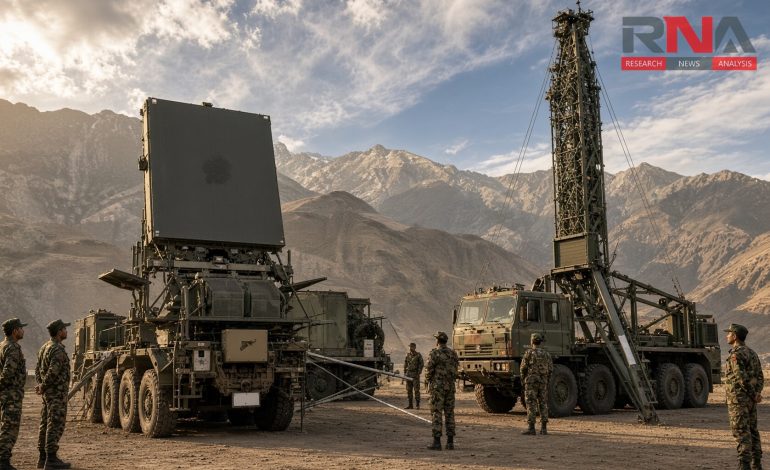
RNA Media illustration for representation,

New Delhi: India has taken another significant step towards reducing foreign dependence in a strategically sensitive area of defence electronics, with the Defence Research and Development Organisation (DRDO) demonstrating indigenous gallium nitride (GaN) technology for high-frequency systems. The development, detailed in the Ministry of Defence’s annual report for 2025-26, covers monolithic microwave integrated circuits (MMICs) intended for applications including next-generation radars, electronic warfare, communications, intelligence, surveillance and reconnaissance.
At the centre of the development is a GaN-based chip measuring only about 3.5mm by 3mm but capable of delivering up to 30 watts of power, according to the ministry. The report also says the indigenous technology has been demonstrated for applications up to the X-band, while S-band GaN high-electron-mobility transistors, power amplifiers, low-noise amplifiers and switching MMICs have also been designed and fabricated.
The significance of GaN lies less in the physical size of the component than in what it allows a system designer to achieve within a much smaller electronic architecture. Compared with conventional silicon technology, GaN is particularly suited to high-frequency and high-power applications, enabling greater efficiency and reduced size and weight – characteristics that are increasingly important in sophisticated sensing and communications systems.
The development therefore has implications well beyond a single semiconductor component. Radar systems, electronic-warfare equipment, communications systems and unmanned platforms increasingly depend on compact radio-frequency components that can handle substantial power while operating at high frequencies, making control over the underlying semiconductor technology an important element of defence-industrial capability.
The latest achievement builds on several years of work at the DRDO’s Solid State Physics Laboratory (SSPL), which has developed indigenous processes for manufacturing four-inch silicon-carbide wafers and fabricating GaN high-electron-mobility transistors with power ratings of up to 150 watts. The laboratory has also developed GaN-based MMICs rated up to 40 watts for applications extending to X-band frequencies.
The combination of GaN with silicon carbide is particularly important because it brings together a high-performance semiconductor material with a substrate capable of supporting demanding power and thermal requirements. The Ministry of Defence has previously identified the technology as an enabler for future combat systems, radars, electronic warfare, communications and other applications where lower weight, smaller form factors and improved performance are important.
India has also begun establishing limited production capability for indigenous GaN-on-silicon-carbide MMICs at the Gallium Arsenide Enabling Technology Centre (GAETEC) in Hyderabad. That transition from laboratory fabrication towards production is strategically important because developing a semiconductor process is only one part of achieving technological autonomy; the ability to manufacture reliable components repeatedly and at useful scale is the harder industrial challenge.
The effort is taking place against a wider push to build an Indian ecosystem for advanced defence semiconductors. Under the Innovations for Defence Excellence (iDEX) programme, the Defence Innovation Organisation has also backed work by domestic industry on GaN components for advanced wireless transmitters used in defence applications, reflecting an attempt to connect government research with private-sector design and manufacturing capabilities.
The strategic value of such indigenous capability is straightforward. Advanced radio-frequency semiconductor technologies have traditionally been closely controlled because they can underpin sophisticated sensing, communications and electronic systems, while access to foreign components can expose military programmes to export restrictions, supply-chain disruption and technology-denial risks.
The government had previously noted that most GaN components used in defence applications were imported and that the technology was subject to export controls in several countries. Developing the capability domestically consequently addresses not merely the cost or availability of individual components but a deeper question of technological sovereignty in critical defence electronics.
The development also fits into a broader transformation in India’s defence-electronics landscape. The country has already moved towards indigenous production of systems such as the Arudhra medium-power radar and radar warning receivers, while DRDO continues to develop electronic warfare technologies based on digital receivers, signal processing and multifunction RF chips.
The immediate achievement should nevertheless be viewed in the context of the long path from successful fabrication to widespread deployment. For India, the next challenge will be to expand production, improve manufacturing yields, qualify components for demanding service environments and create a sufficiently deep industrial base so that indigenous semiconductor capability is not confined to limited batches.
That is ultimately what will determine the strategic importance of the GaN programme. A domestically designed and fabricated high-performance semiconductor is valuable in its own right, but a sustainable ecosystem capable of repeatedly producing such components for increasingly complex defence and aerospace systems would represent a considerably more consequential shift in India’s technological autonomy.