

Trump’s foreign-shipbuilding waiver opens a narrow US Navy opportunity for Indian shipyards
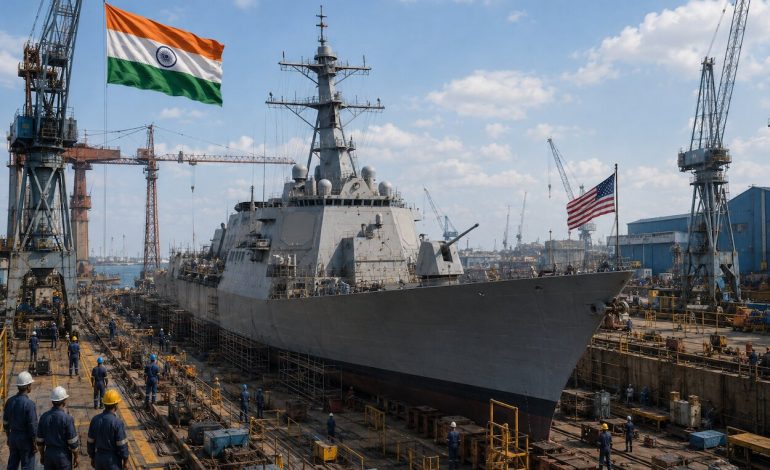
RNA Media illustration for representation.

New Delhi: The US president, Donald Trump, has opened a conditional route for foreign yards to build vessels for the United States Navy, creating a potentially valuable but tightly defined opportunity for India’s expanding maritime industry. The decision could help Indian shipbuilders progress from repairing American support ships to pursuing naval construction partnerships, although the stringent entry terms and political resistance in Washington make early contracts far from certain.
Under a national security presidential memorandum signed on August 13, qualifying foreign shipbuilders may construct as many as two initial vessels at their home yards before shifting all follow-on production to the United States. The arrangement, modelled on US-Finland cooperation on Arctic security cutters, may be applied to as many as three ship classes.
The eligible categories include surface combatants capable of anti-submarine warfare, surface warfare and convoy escort, besides consolidated cargo replenishment-at-sea tankers and roll-on/roll-off vessels. The Pentagon has been given 90 days to submit acquisition plans, timelines and resource requirements for these programmes.
The concession comes with demanding conditions: a foreign supplier must simultaneously establish a new US shipyard or acquire ownership or a majority stake in an existing one, hire and train American workers, licence proprietary shipbuilding technologies to its US operation and develop an American supply chain. The policy is therefore not an invitation to transfer long production runs overseas, but a mechanism for using a small number of foreign-built ships to draw capital, expertise and production capacity into the United States.
Trump has also not repealed the statutory restriction on overseas naval construction. Section 8679 of Title 10 of the US Code ordinarily prohibits building an armed forces vessel, or a major part of its hull or superstructure, in a foreign yard, but allows a presidential national-security waiver after Congress has been notified and given 30 days’ notice.
The move reflects the depth of Washington’s shipbuilding crisis rather than any retreat from its preference for domestic production. A US government accountability office assessment published in April found that American naval programmes were billions of dollars over budget and years behind schedule, with the last 11 lead ships costing at least $8 billion more than originally planned.
Where India could enter
India approaches this opening with stronger credentials than it possessed even a decade ago, having developed the capacity to design and construct aircraft carriers, destroyers, stealth frigates, corvettes, submarines and specialised vessels. Since 2014, Indian yards have delivered more than 40 indigenously built warships and submarines, while 51 large naval ships worth approximately ₹90,000 crore were under construction in the country by late 2025, according to a government assessment of indigenous naval production
More importantly, Indian shipbuilders already have a working institutional relationship with the US Navy. Larsen & Toubro’s Kattupalli yard, Mazagon Dock Shipbuilders and Cochin Shipyard have signed agreements qualifying them to undertake repairs on vessels operated by the US Military Sealift Command.
Kattupalli has repaired the USNS Charles Drew, USNS Matthew Perry and USNS Salvor, giving L&T experience in meeting American inspection, scheduling and logistics requirements. Its modern facilities include a heavy ship-lift and multiple dry and wet berths that permit simultaneous construction and repair work, according to the company’s account of its US Navy agreement.
These agreements, however, principally cover civilian-crewed USNS support ships rather than commissioned USS combatants, as a National Maritime Foundation analysis has noted. They are evidence of technical credibility and security vetting, but do not automatically qualify an Indian yard to construct a US warship.
The most realistic near-term opportunity may consequently lie in replenishment tankers and roll-on/roll-off vessels rather than destroyers or frigates. Bryan Clark, a senior fellow at the Hudson Institute, told Reuters that auxiliary ships were likely to precede combatants because adapting a foreign warship for American weapons, supply chains and technical standards would be considerably more complex.
India’s yards have experience constructing commercial vessels, fleet auxiliaries, offshore platforms and export ships, while their location offers operational advantages for naval forces deployed across the Indian Ocean. A successful auxiliary-vessel bid could provide Indian companies with access to American design, certification and project-management systems without immediately confronting the classified technologies associated with frontline combatants.
To qualify directly under Trump’s model, however, an Indian builder would have to make a substantial investment in the United States. That could involve acquiring a controlling interest in an American yard, establishing a new facility with a US partner or leading a consortium capable of transferring a mature vessel design and its production methods to American workers.
India currently enters this contest behind South Korea’s Hanwha and Italy’s Fincantieri, both of which already have large US shipyard footprints. Hanwha acquired Philly Shipyard in 2024 and has pledged $5 billion for its expansion, while Fincantieri has invested more than $800 million in American facilities, giving the two companies an early advantage under criteria expressly linked to US investment.
An Indian company could still participate through a partnership with an established American or allied prime contractor, providing naval design services, digital engineering, specialised equipment or project-management expertise. Such arrangements would have to be structured carefully because the memorandum requires follow-on ships constructed in America to use a US supply chain, limiting the amount of production that could remain in India.
New Delhi’s ₹69,725 crore shipbuilding package could strengthen the industry’s ability to pursue such partnerships over the longer term. The programme includes ₹24,736 crore in financial assistance, a ₹25,000 crore Maritime Development Fund and ₹19,989 crore for greenfield clusters and capacity expansion, with the government targeting annual output of 4.5 million gross tonnes, according to a July 2026 parliamentary reply.
The more immediate commercial gain may come from expanding India’s role as a maintenance, repair and overhaul hub for US vessels operating between the Gulf, the Indian Ocean and the western Pacific. Construction cooperation would deepen technical familiarity between the two sides, potentially encouraging the US Navy to place more voyage repairs, refits and logistics work at Indian yards even if the first foreign construction contracts go elsewhere.
Why building US warship will be harder
India’s experience with advanced warships establishes a credible technical foundation, but an Indian design would still require extensive work before entering the US fleet. American survivability rules, redundancy standards, communications architecture, cybersecurity requirements, weapons and combat-management systems would have to be incorporated without turning a proven parent design into another lengthy development programme.
Analysts cited by Breaking Defense have warned that even allied warships carrying Aegis systems use configurations different from those installed on American ships. Integrating US sensors, weapons, data links and logistics support into a foreign hull could erode the savings in time and money that Washington expects from adopting mature overseas designs.
The memorandum attempts to control that problem by prohibiting repeated Navy-directed alterations to an approved parent design unless senior Pentagon and White House officials authorize them. That rule could favour disciplined Indian designs, but it could also make an Indian combatant unsuitable if extensive modification is required before it meets US standards.
Capacity presents another constraint because Indian defence yards must continue delivering ships and submarines for the Indian Navy while commercial yards expand to meet domestic and export orders. Competing for American work would require additional skilled labour, predictable component supplies and production schedules that do not delay India’s own naval modernization.
There is also a serious political obstacle in Washington. House and Senate versions of the fiscal 2027 defence legislation contain restrictions on foreign construction, while the Senate committee proposal would permit certain auxiliary ships to be built only in countries that are US treaty allies – a category that does not include India, despite its status as a major defence partner.
Those provisions are not yet final and must be reconciled during the congressional process, but they could close or significantly narrow the route created by Trump’s memorandum. The US shipbuilding industry has also opposed overseas construction, arguing that federal funding should instead be used to restore domestic yards and train American workers.
Not an immediate windfall
India should therefore treat the decision as the start of a competitive process rather than as an assured order book. Its strongest approach would be to seek early consultations during the Pentagon’s 90-day planning period, clarify whether Indian companies can qualify, identify US investment partners and present mature auxiliary-ship designs supported by credible delivery and technology-transfer plans.
At the same time, New Delhi can use the policy shift to press for a broader repair relationship covering more complex work on deployed US vessels and to align American quality, security and digital-production standards with India’s new shipbuilding clusters. Even if an Indian yard does not build one of the first two ships, participation in design, maintenance, training and supply-chain partnerships could establish a durable place in the US maritime industrial network.
The immediate prize is therefore unlikely to be an American destroyer sailing out of an Indian dock. The more achievable opportunity is a progression from Military Sealift Command repairs to auxiliary construction, technology partnerships and carefully selected investment in the United States – a narrower opening, but one that could materially advance India’s shipbuilding ambitions.