India-Germany $8 billion submarine deal nears signing as Berlin’s envoy Jasper Wieck sets out vision for deeper ties
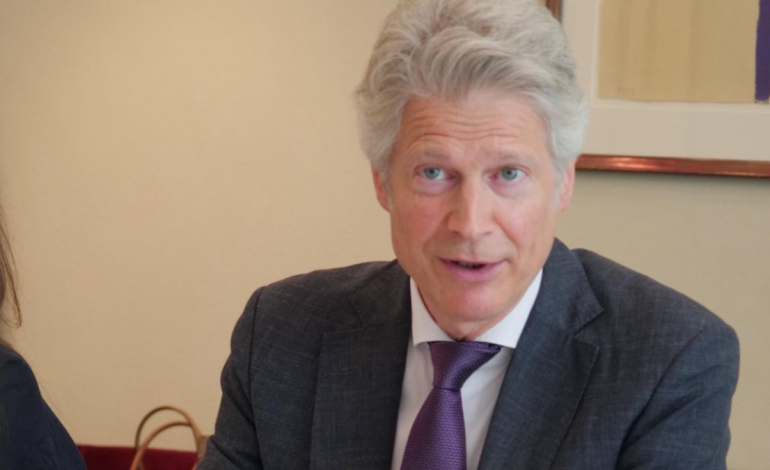
Berlin’s envoy Jasper Wieck sets out vision for deeper ties. (Image courtesy: X/@GermanAmbIndia)

New Delhi: India’s plan to build six next-generation conventional submarines with German assistance has reached the final stretch, with the proposed $8 billion programme awaiting completion of New Delhi’s internal approval process. The development comes as the Germany’s new ambassador, Jasper Wieck, seeks to give defence manufacturing a larger role in a bilateral relationship that he sees expanding across security, trade, technology and skilled mobility.
The German government has completed the documents required for the project and is prepared to sign the agreement, according to Wieck. The Indian side still has to complete its procedures, including approval by the cabinet committee on security, before the government-to-government agreement can be concluded.
The programme envisages Germany’s Thyssenkrupp Marine Systems (TKMS) working with India’s Mazagon Dock Shipbuilders (MDL) on construction in India. Technology transfer is also part of the proposed arrangement, making the project relevant to India’s effort to combine foreign expertise with domestic defence manufacturing.
For India, the significance of the programme extends beyond adding six submarines to the Indian Navy. A long-term industrial partnership with TKMS could strengthen domestic expertise in complex naval systems and create opportunities for Indian industry to participate more deeply in advanced defence production.
For Germany, the project provides an entry into a strategically important part of India’s defence ecosystem. Wieck has indicated that Berlin wants such cooperation to expand into areas including unmanned systems, cyber capabilities, missile technology and sensors, moving the relationship towards broader technology and industrial collaboration.
What’s new Wieck planning for India
Wieck, who recently assumed charge as Germany’s ambassador to India and Bhutan, has placed defence cooperation among the three priorities for his tenure. In an interview with NDTV, he pointed to growing military engagement between the two countries, including German participation in Indian exercises, naval port visits.
The two countries have also sought to create a stronger industrial foundation for defence cooperation through the defence industrial roadmap signed by their defence ministers in April. Wieck said the framework provides opportunities for technology transfer and 100 per cent foreign direct investment by German companies in India’s defence sector, potentially enabling joint production for domestic and international markets.
The security relationship is developing alongside a broader German assessment of India’s importance. Wieck described the present international environment as an “era of unpredictability” and argued that both countries need stronger economies, capable armed forces and dependable partnerships as the global balance becomes increasingly multipolar.
Wieck’s vision for the relationship is not confined to defence, with the India-EU free trade agreement forming another major priority. He told NDTV that the changing global environment had made closer economic partnerships more important and said the agreement could significantly expand commercial opportunities once implemented.
German businesses are already positioning themselves for greater engagement with India, according to Wieck, with the embassy working to connect companies on both sides. The trade push could therefore complement defence cooperation by bringing greater investment and industrial links into the bilateral relationship.
Wieck highlighted India-Germany Migration and Mobility Pact and the sharp rise in Indian students in Germany, while stressing the need to develop systems that can manage growing movement between the two countries effectively.
On Russia Ukraine war, he acknowledged the particular diplomatic position India occupies because of its established relations with both Russia and Ukraine. Wieck said New Delhi could use those channels to contribute to efforts towards a political resolution of the conflict, while Germany continues to advocate greater pressure on Moscow.