

Indian Army brings back regimental pride, scraps common uniform for top officers after three years. Why the reversal?
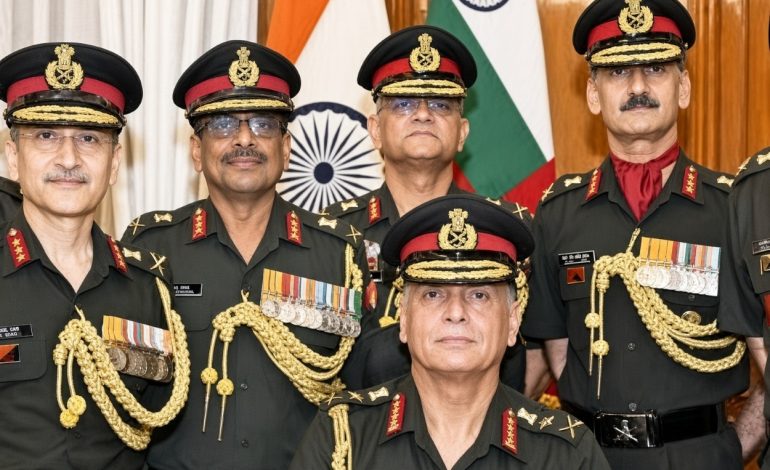
File photo of Gen Dhiraj Seth and other senior officers. Now, star-ranked officers can once again display the distinctive insignia, headgear and accessories of their parent regiments and corps in their uniforms.

New Delhi: The Indian Army has reversed its three-year-old policy of standardized uniforms for senior officers, allowing brigadiers and generals to once again display the distinctive insignia, headgear and accessories of their parent regiments and corps. The decision, effective from December 1 this year, marks a significant departure from the 2023 reform that sought to create a common professional identity among the Army’s senior leadership, irrespective of regimental affiliations.
According to media reports, in an internal Army communication dated November 13, the earlier instructions have been withdrawn following a comprehensive review of feedback received from within the service. The revised arrangement restores the provisions of the Army Uniforms Pamphlet-2018, effectively bringing back regimental distinctions that had disappeared from the uniforms of brigadiers, major generals, lieutenant generals and the Army chief.
The reversal means that senior officers of the Gorkha Rifles can again wear their distinctive slouch hats, while those associated with the Parachute Regiment Special Forces (Para SF) will return to their maroon berets. Officers from armoured regiments will regain their traditional black berets, replacing the standardized dark green headgear introduced under the previous policy.
Other traditional accessories, including regimental shoulder titles, lanyards, belt buckles and distinctive rank badges, will also return in accordance with the regulations governing individual arms and services. Officers of rifle regiments, including the Garhwal Rifles, Rajputana Rifles and Gorkha Rifles, will once again be permitted to wear their traditional black rank insignia instead of the uniform brass-coloured badges prescribed in 2023.
The changes will also be visible in the attire of the chief of the Army staff, General Dhiraj Seth, who assumed office on June 30 and belongs to the Armoured Corps. Seth will return to the black beret traditionally associated with armoured formations and brown footwear permitted under the relevant regimental dress regulations, replacing the green beret and black shoes mandated by the earlier arrangement.
Why the Army introduced a common uniform
The original uniform policy was approved during the Army Commanders’ Conference in April 2023, under the then Army chief, General Manoj Pande, and implemented on August 1 that year. Its principal objective was to reinforce the idea that officers reaching higher command positions represented the entire Army rather than the regiments or corps in which they began their military careers.
The reasoning reflected the structure of senior military leadership, where brigadiers and generals frequently command formations comprising soldiers from multiple regiments, arms and supporting services. Standardized dress was intended to symbolize institutional unity, reduce visible distinctions between different military backgrounds and reinforce a common approach to leadership and service matters.
Under that arrangement, officers of brigadier rank and above were required to abandon their traditional regimental headgear, shoulder titles, lanyards and several other distinguishing accessories. The Army introduced common dark green berets, standardized belts bearing the Army crest, brass rank insignia and black shoes, irrespective of an officer’s parent regiment or corps.
However, the reform did not extend to colonels and officers below that rank, who continued wearing their traditional regimental uniforms and accessories. The distinction reflected the Army’s recognition that regimental identity remained particularly important at the unit level, where traditions, shared history and institutional pride contribute to cohesion and morale.
Why regimental identity matters
The Indian Army’s regimental system is deeply rooted in military history, with several formations tracing their origins to the colonial period and others established after independence. Regimental colours, battle honours, distinctive headgear, insignia and ceremonial practices represent a collective inheritance built around military service, sacrifice and operational achievements.
These traditions are particularly significant because regiments function not merely as administrative organizations but also as enduring institutions through which soldiers develop professional identities and a sense of belonging. Officers often retain strong attachments to their parent units even after moving into higher appointments involving responsibility for personnel from different arms and services.
The latest decision suggests that Army headquarters has reconsidered whether removing visible regimental affiliations from senior officers was necessary to achieve institutional cohesion. By restoring traditional dress while preserving the responsibilities attached to higher command, the leadership appears to be recognizing that regimental heritage and a broader Army identity need not be mutually exclusive.
Nevertheless, the review cited in the November 13 communication does not publicly establish the extent of dissatisfaction with the common uniform or identify specific operational difficulties arising from its implementation. It would therefore be premature to interpret the reversal as evidence that the 2023 policy had weakened military effectiveness or command cohesion.
What the reversal means for the Army
The rollback is primarily a change in dress regulations and military symbolism rather than a restructuring of command arrangements or operational doctrine. It does not alter the authority of senior officers, their responsibilities in joint formations or the Army’s continuing efforts to improve coordination across different combat arms and supporting services.
The decision also comes at a time when India’s armed forces are pursuing wider organizational reforms, including greater integration and the development of joint command structures. In that context, the distinction between visual uniformity and functional integration remains important, as effective joint operations ultimately depend on command relationships, training, communications and institutional cooperation rather than identical clothing.
There has been no publicly identified official reaction from China to the uniform-policy reversal as of November 18. Nor is there evidence that the decision is linked to developments along the Line of Actual Control or to any change in India’s military posture towards its neighbours.
For the Indian Army, the immediate consequence will be the return of familiar regimental distinctions to its senior leadership after more than three years of standardized dress. The larger significance lies in the Army’s apparent conclusion that preserving its diverse military traditions is compatible with maintaining a unified command structure and a common institutional identity.