



Army eyes drone radars that can see through dense foliage to hunt terrorists
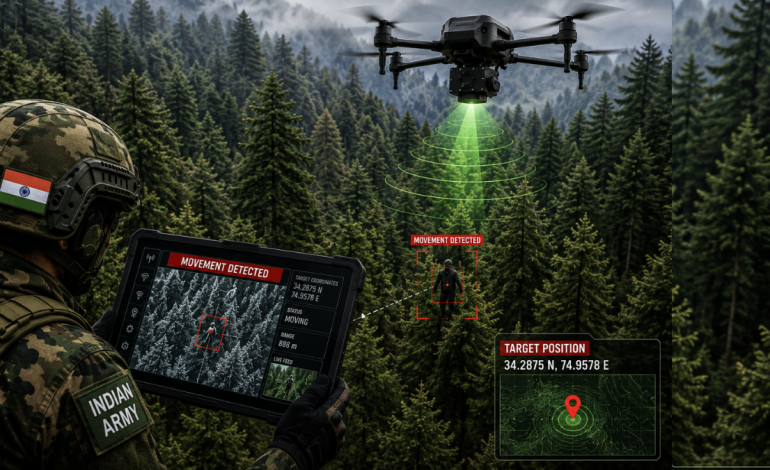
RNA Media illustration for representation.

New Delhi: The Indian Army is stepping up efforts to strengthen surveillance in forested areas by seeking indigenous drone-mounted radars capable of detecting human movement beneath dense foliage. The requirement has been driven by the challenges faced during counter-insurgency operations in Jammu & Kashmir and the northeast, where thick forests often provide terrorists with cover for movement and hideouts.
The Army has initiated the procurement proposal under the Make II category, under which Indian industry will develop the technology using its own funds. The system will be inducted if it successfully meets the Army’s specified operational and technical requirements.
The proposed radar is expected to address a significant gap in surveillance capabilities in heavily forested terrain where conventional aerial and satellite-based monitoring may be limited. The Army has noted that the absence of continuous real-time satellite coverage and the constraints of existing sensors make it difficult to maintain persistent surveillance over dense foliage.
The requirement has gained greater significance following recent counterterror operations. The search for those responsible for last year’s Pahalgam terror attack continued for months before the terrorists were eventually tracked and eliminated in the dense Dachigam forest during Operation Mahadev.
Radar to operate from lightweight drones
According to The Economic Times, Army wants the radar to be integrated with a lightweight unmanned aerial system weighing no more than 20 kilograms. The drone is expected to provide an endurance of 60 to 120 minutes, while the radar-equipped platform should have an operating range of around 5 to 10 kilometres.
A key requirement is the ability to detect human movement through thick vegetation and provide real-time information to troops deployed on the ground. This could allow units operating in difficult terrain to identify possible movement without immediately sending soldiers into heavily forested areas to physically search for suspects.
The system is also expected to support secure communications and be compatible with satellite navigation systems including Navstar, Glonass and IRNSS.
Army seeks high indigenous content
The procurement is being driven by the Infantry Directorate, with the Army looking for a substantial deployment across counter-insurgency formations in Jammu & Kashmir and the northeast. Although the exact quantity has not been disclosed, the requirement is expected to be significant given the number of units operating in such terrain.
The Army has stipulated that the final system should have at least 60 per cent indigenous content, reinforcing the push to develop the capability within the country. Several Indian defence companies are already working on foliage-penetration radar technology, while some have entered partnerships with overseas technology providers to develop the capability.