

China warns of space arms race after US confirms weapons in orbit
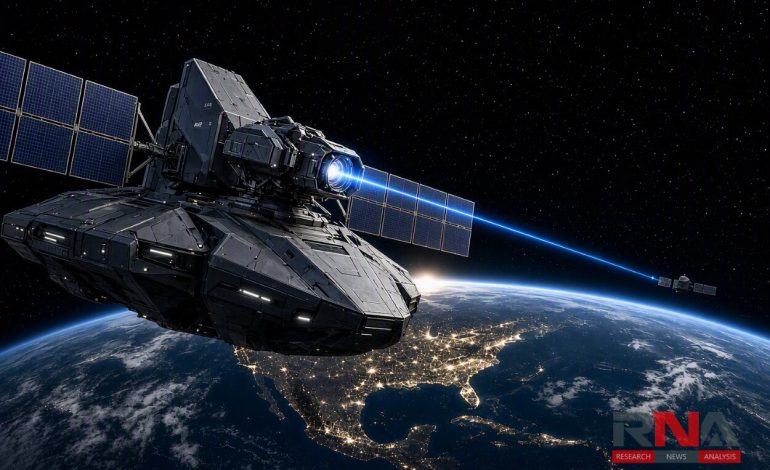

New Delhi: China has warned that the deployment of American weapons in orbit risks accelerating a space arms race, following Washington’s public acknowledgement that it possesses operational space-control weapons. The Chinese defence ministry’s response on Thursday, highlighted the widening disagreement over whether such capabilities protect vital infrastructure or make conflict beyond Earth more likely.
The ministry’s spokesperson, Jiang Bin, said attempts to weaponize space would intensify military competition and turn it into another arena for confrontation between major powers. According to Global Times’ account of his remarks, he reiterated Beijing’s stated commitment to peaceful space activities and argued that escalating military rivalry would damage interests shared by all countries.
His comments followed an announcement by the US secretary of the air force, Troy Meink, at the Air & Space Forces Association’s Air, Space & Cyber Conference in Maryland on September 14, as RNA Media had reported. Meink confirmed that the US Space Force had weapons already in orbit capable of protecting American forces against hostile action, making an unusually explicit disclosure about capabilities Washington had previously discussed in less direct terms.
The US Space Force’s official announcement described them as “on-orbit space control weapons”, but their precise nature remains undisclosed. The acknowledgement establishes that Washington says these systems are deployed; it does not establish how they operate, what they can target or under what circumstances they would be used.
According to Air & Space Forces Magazine’s reporting from the conference, Meink declined to say whether the weapons relied on physical destruction or non-kinetic effects. He said the wording of his announcement had been deliberately chosen, arguing that acknowledging the capability could strengthen deterrence while revealing technical details would undermine that purpose.
That distinction matters because the announcement should not be read as confirmation of a particular missile, laser or satellite-disabling system. Nor did Meink identify the existing orbital weapons as the planned space-based interceptors associated with the Pentagon’s Golden Dome missile-defence programme, whose development he discussed separately during the same appearance.
Washington’s stated rationale is that its military operations and economy depend on reliable access to space, and that potential adversaries must understand its ability to respond to attacks. However, the secrecy surrounding those capabilities also carries risks: the academic, Craig Albert, told Reuters that competitors lacking complete information could assume the systems threaten their satellites and accelerate their own weapons programmes.
The legal position is more specific than a blanket prohibition on weapons in space. The 1967 Outer Space Treaty expressly bans placing nuclear weapons or other weapons of mass destruction in Earth orbit, installing them on celestial bodies or stationing them elsewhere in outer space.
It also reserves the Moon and other celestial bodies for peaceful purposes and prohibits weapons testing and military installations there but does not impose an equivalent categorical ban on all conventional weapons in Earth orbit. Space activities nevertheless remain subject to international law and the UN Charter, meaning that the limited American disclosure alone is insufficient to determine whether a particular system or its use would violate those obligations.
China’s position also sits alongside its own demonstrated ability to destroy satellites. On January 11, 2007, a Chinese interceptor destroyed the country’s Fengyun-1C weather satellite, producing more than 2,500 tracked fragments, according to a Nasa study of the resulting debris cloud.
The study warned that many fragments would remain in orbit for decades because the interception occurred at a high altitude, illustrating how a single destructive event can create enduring hazards. Russia’s destructive anti-satellite test in November 2021 offered another example: Nasa said the resulting debris forced astronauts and cosmonauts aboard the International Space Station to undertake emergency safety procedures.
India, too, demonstrated an anti-satellite capability through Mission Shakti on March 27, 2019, making the debate relevant beyond the three leading space powers. The central unresolved question in the latest exchange remains what Washington has actually deployed – information needed to assess both its claim of defensive necessity and Beijing’s warning that the disclosure could intensify an arms race.