
Hegseth turns up the heat on Nato allies, orders review of US forces in Europe
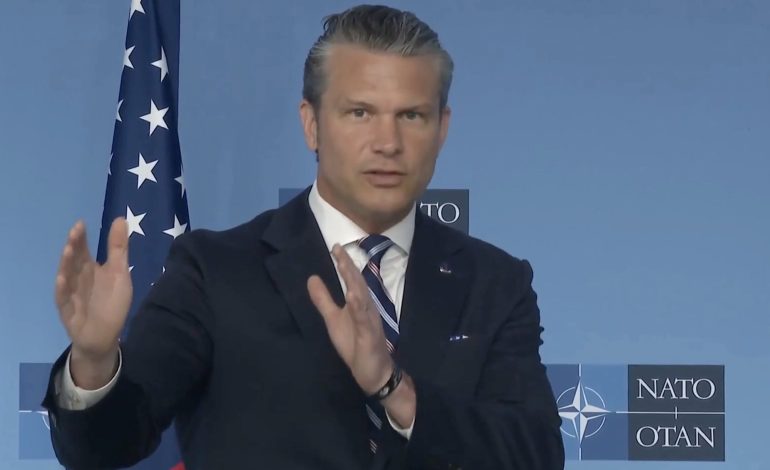
This video screenshot shows Pete Hegseth during his speech at the Nato HQ in Brussels.

New Delhi: The United States secretary of war, Pete Hegseth, arrived at Nato headquarters in Brussels on Thursday for a meeting of the alliance’s defence ministers and wasted no time making his displeasure known. Before the formal session had properly begun, he announced a six-month Pentagon review of American forces stationed in Europe – one whose conclusions, he made plain, will be shaped by how decisively European members step up to shoulder the burden of their own continental defence.
“This will be a real review,” Hegseth told his Nato counterparts. “It will be designed to ensure that Nato is moving fast and irreversibly toward Europe leading, stepping up to take primary responsibility for the defence of Europe.”
The announcement was accompanied by pointed criticism of European allies on multiple fronts. Hegseth reserved particular anger for their refusal to allow US forces access to bases on European soil during American operations against Iran, describing the denial of overflight rights and basing facilities as “shameful” and accusing the allies of putting American military personnel at unnecessary risk.
He also took a broader swipe at Europe’s domestic policy choices, arguing that the continent had allowed defence readiness to atrophy while prioritising social programmes. “Instead of tanks and fighters and air defences, the focus has been on gender equity and climate change and defence austerity. Europe’s borders flew wide open, welfare states expanded, defence budgets cratered,” he said.
These remarks that recalled the combative tone taken by the US vice-president, JD Vance, at the Munich Security Conference in February 2025.
Read also: At G7, Trump offers security assurance to India, but ties support to Modi’s leadership
The broadside, however, did not accurately reflect current European realities. European allies and Canada have launched what amounts to an unprecedented push to raise defence spending and expand their forces. Nato secretary general Mark Rutte noted at the same meeting that the alliance collectively spent $90 billion more on defence in the previous year – a 20 per cent increase over 2024.
The migration picture has similarly shifted: while large numbers of asylum seekers entered Europe over a decade ago, most governments have since sharply tightened their border regimes.
Beyond the review, Hegseth called for a fundamental restructuring of the alliance under the banner of what he termed “Nato 3.0” – a post-Cold War reset that, in his framing, would restore Nato as a hard-line military alliance with genuine warfighting capability, capable of deterring threats on the continent under European rather than American leadership.
The US would, for its part, invest $1.5 trillion in its own defence in 2027, Hegseth told reporters – a figure he cast as a signal to the world that America is building what he called an “arsenal of freedom”. He added that this capacity “first and foremost protects America and American interests” but also “backstops the strength of Nato and our allies”.
The Brussels meeting came against the backdrop of an already-fraying set of commitments. Earlier this month, on June 3, the US informed its allies that it would no longer make available an aircraft carrier and supporting vessels, aerial refuelling aircraft, and dozens of fighter jets as part of any collective defence response. European members and Canada are now scrambling to identify how to cover those gaps. Nato’s supreme allied commander – an American – is working on contingency plans to fill the voids left by Washington’s partial disengagement.
Read also: US boosts arms output after Iran conflict, plans war-ready stockpile in Australia
The Trump administration’s strategic rationale is not obscure: it wants the capacity to fight on two fronts simultaneously and insists it needs military resources held in reserve for a potential conflict with China in the Indo-Pacific. The US has no intention of withdrawing its nuclear weapons from Europe, which remain central to the alliance’s deterrence posture.
To reinforce that point, Nato’s Nuclear Planning Group issued its first formal statement in 19 years following its session at the ministers’ meeting. The statement recalled that the alliance’s strategic nuclear forces “remain the supreme guarantee of Allied security and underpin Nato’s extended deterrence architecture.” Defence ministers agreed to continue upgrading Nato’s nuclear capabilities, strengthen nuclear planning processes, and adapt them to serve the alliance’s evolving security interests.
Under Article 5 of Nato’s founding treaty, an attack on any one of the 32 members is treated as an attack on all. The provision does not, however, legally compel military assistance – though most allies would be expected to provide it. What Hegseth’s review signals is a deliberate recalibration of how far the US intends to go in meeting that expectation in conventional terms, even if the nuclear umbrella stays in place.
For India, these developments carry more than passing strategic relevance. A Nato increasingly led and funded by European members – and an America pivoting its military weight toward the Indo-Pacific – has direct implications for the balance of power in the Indian Ocean region and for the evolving dynamics of Quad-centred security cooperation. The pace and depth of European defence self-sufficiency will, to a significant degree, determine how much American strategic bandwidth is freed up – or redirected – toward Asia.