

Fourth Tri-Services Future Warfare Course to begin in New Delhi on August 3
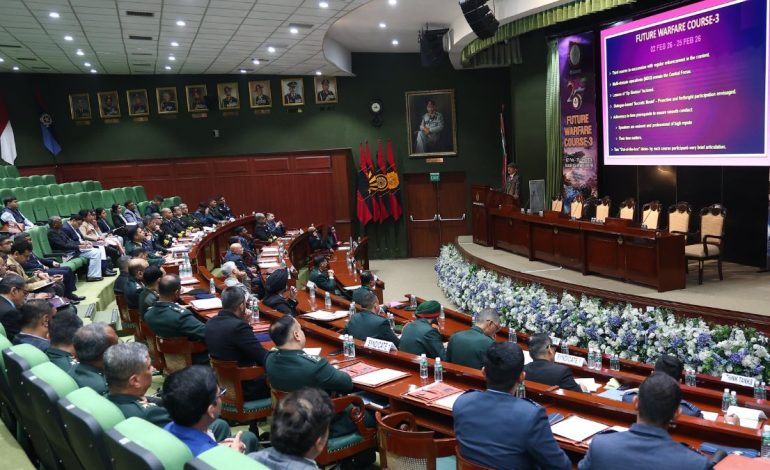
Third edition of the Tri-Services Future Warfare Course in New Delhi. Image Credit: X/@CENJOWS

New Delhi: The fourth edition of the Tri-Services Future Warfare Course will begin at the Manekshaw Centre in New Delhi on Monday. The four-week programme, scheduled to run until August 30, is part of the Indian Armed Forces’ effort to prepare military leaders for the changing character of modern warfare.
The course is being conducted under the Headquarters Integrated Defence Staff (HQ IDS) and coordinated by the Centre for Joint Warfare Studies (CENJOWS). It will bring together officers from the Indian Army, Indian Navy and Indian Air Force, along with representatives from government organizations, academia, industry and strategic think tanks.
What the course will cover
Participants will study a curriculum covering geopolitical developments, artificial intelligence, quantum technologies, and cyber and cognitive warfare. Other modules include information warfare, autonomous systems and future operations across the land, maritime, air and space domains.
The course will also examine grey-zone operations, multi-domain operations and technology-enabled warfare. Senior military commanders, policymakers, scientists, industry leaders and subject matter experts will deliver lectures throughout the programme.
The goal is to build a shared understanding of emerging operational challenges among officers and civilian experts alike. Organizers say the course is also meant to encourage discussion on the technologies, doctrines and concepts expected to shape future battlefields.
Part of push towards jointness
The future warfare course was conceived as part of the military’s push towards greater jointness and future-ready force development, under the vision of the chief of defence staff, General Anil Chauhan. It is meant to help officers understand how technological change is transforming military operations, and why conventional doctrines need to adapt to threats in domains such as cyber, space and information warfare.
The inaugural edition was held in September 2024 as a five-day pilot programme, India’s first dedicated triservices course on future warfare. It brought together officers from the three services across a range of ranks, reflecting an emphasis on pairing operational experience with technological expertise.
Following positive feedback from the pilot, the second edition ran from April 21 to May 9, 2025, expanded into a three-week course. It also widened participation beyond the armed forces to include representatives from the defence industry, startups, micro, small and medium enterprises, defence public sector undertakings and academia.
The third edition, held from February 2 to 25, 2026, broadened the curriculum further. It added specialized modules on critical and rare earth elements, supply chain vulnerabilities, and regional and global geopolitics, along with practical demonstrations of emerging technologies.
According to the defence ministry, the programme has aimed to align the operational priorities of the armed forces with the capabilities of India’s indigenous defence ecosystem, while encouraging professional debate on the changing nature of warfare.
The fourth edition extends the course to four weeks, its longest run yet, which organizers say will allow more time for participants to engage with emerging technologies and interdisciplinary discussion.
Organizers say the broader aim is to improve the Indian Armed Forces’ preparedness for the kinds of conflicts likely to define the coming years.