‘We did not bend the knee’: Iran’s Pezeshkian accuses America of terrorism at 81st UNGA, US representative walks out
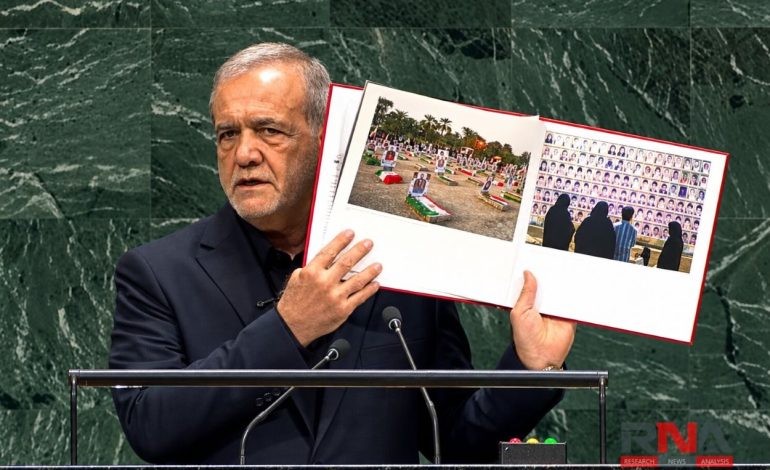
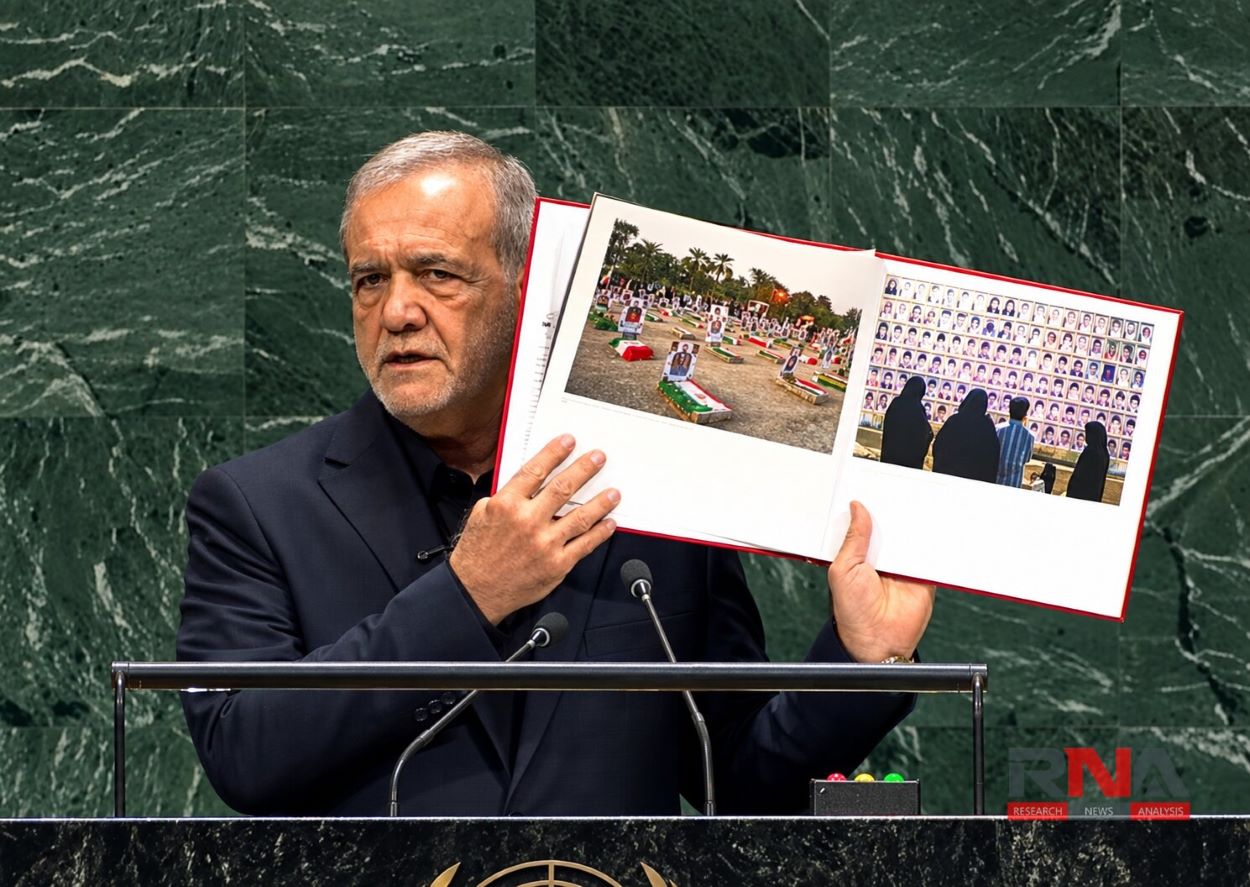
Masoud Pezeshkian holds the victims of the bombed Minab girls elementary school, in which the US killed over 150 people, including 120 children. (Digitally enhanced video screenshot.)

New Delhi: The president of Iran, Masoud Pezeshkian, accused the United States of terrorism against his country on Wednesday, confronting world leaders with photographs of children killed in the war. Answering the Tuesday’s threat by the US president, Donald Trump, to annihilate the Islamic Republic, he said Iran had suffered American and Israeli attacks but would not surrender.
Pezeshkian told the 81st UN general assembly that he had changed his prepared address after Trump branded Iran a sponsor of terrorism from the same podium a day earlier. He turned that accusation against Washington and Israel, arguing that the killing of Iranian civilians and the assassination of the country’s leadership exposed the double standards behind their claims.
“We have only defended ourselves. We are not terrorists,” Pezeshkian said, presenting Iran’s military actions as a response to aggression imposed on it. Referring to the United States, he added: “Yes they did hit us, but we did not bend the knee.”
The address combined a defence of Iranian sovereignty with repeated assertions that negotiations remained possible. Pezeshkian accused Trump of a “bullying mentality” and said threats would strengthen Iranian resistance, while maintaining that Tehran was prepared to resolve the conflict through diplomacy.
Holding up an image of the slain supreme leader, Ali Khamenei, Pezeshkian recalled his killing at the beginning of the war on February 28 this year. He also displayed photographs connected to the attacks on a school in Minab and a sports complex in Lamerd, and accused American and Israeli forces of striking universities, medical facilities and civilian infrastructure.
His emphasis on civilian casualties followed findings published on September 17, by an independent fact-finding mission established by the UN human rights council, as RNA Media had reported. The investigators said there were reasonable grounds to believe that two US attacks in southern Iran constituted war crimes, including the strike on the Shajareh Tayyebeh Primary School in Minab.
According to the mission’s findings, summarized by UN News, the Minab attack killed more than 150 people, including about 120 children, while the strike on a sports complex and residential area in Lamerd killed 22 civilians. The experts called for independent investigations, accountability and compensation for victims, alongside an immediate end to hostilities.
The White House rejected the allegations, and US Central Command denied responsibility for the Lamerd strike. The mission’s report, which is not a binding judicial ruling, also accused Iranian authorities of crimes against humanity in their repression of domestic protests.
The US representative left the general assembly chamber during Pezeshkian’s address, underlining the hostility surrounding the diplomatic exchanges. Nevertheless, the Iranian leader reiterated that his country did not seek nuclear weapons and would defend its access to peaceful nuclear technology.
Pezeshkian challenged what he described as unequal treatment of Iran and Israel over their nuclear programmes, pointing to demands for inspections in Iran while accusing Israel of possessing nuclear weapons without equivalent scrutiny. He also argued that regional security should be negotiated within the region and that relations with outside powers should not become instruments for threatening neighbouring countries.
The public confrontation came alongside renewed diplomatic contact involving the Iranian foreign minister, Abbas Araghchi, and the US envoys, Steve Witkoff and Jared Kushner. Their exchanges on September 22, 2026, took place through Qatari mediation, with Iranian officials clarifying that there had been no face-to-face meeting.
Trump said the discussions lasted about three hours and characterized them positively, offering a more conciliatory assessment than his General Assembly speech. The US secretary of state, Marco Rubio, subsequently cautioned against treating the contact as a major breakthrough, although he considered the resumption of communication significant.
The Iranian foreign ministry spokesperson, Esmail Baghaei, maintained that Tehran’s requirements remained unchanged, including an end to the US blockade of Iranian ports and the release of frozen assets. He presented the exchanges as a restatement of established demands, giving no indication that Iran had accepted new concessions.
An interim agreement reached in June had envisaged financial sanctions relief and the unfreezing of assets in exchange for negotiations on restrictions to Iran’s nuclear programme. It collapsed within weeks as the two sides disputed arrangements for shipping through the Strait of Hormuz, where Tehran wants to exercise control and collect transit fees – demands Washington rejects.
Before the war, the strait carried roughly a fifth of global oil and liquefied natural gas, making the maritime dispute central to the conflict’s international consequences. The fighting has killed thousands, disrupted energy supplies and spread instability beyond Iran, increasing the pressure for a settlement even as both governments maintain their conditions.
For Tehran, however, restarting negotiations also means confronting its distrust of the process itself. Before departing for New York, Pezeshkian said Iran had twice been attacked by the United States and Israel while negotiations were under way, explaining why another invitation to talks would not, on its own, reassure his government.