



Nepal-Tibet flash floods: Rescuers race to reach over 900 workers trapped in hydropower tunnels
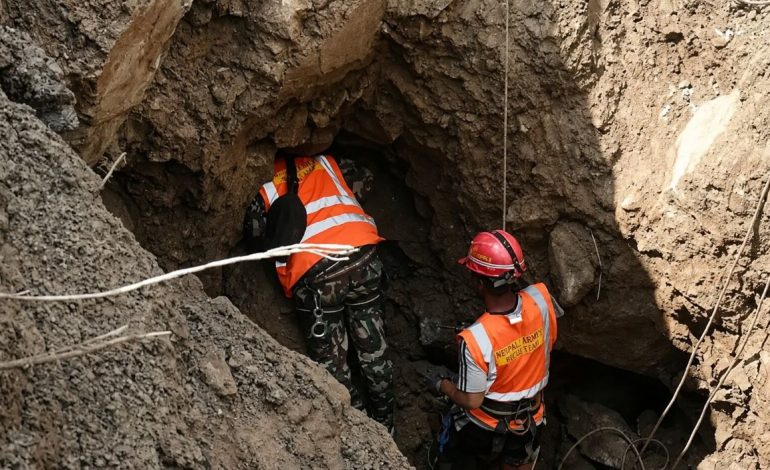
Members of Nepali Army rescue team seen at the entrance of a collapsed tunnel in Rasuwa district looking for trapped workers. (Photo via X)

New Delhi: Rescue teams supported by Indian, Chinese and South Korean specialists intensified efforts on Monday to reach hundreds of workers feared trapped inside mud-choked hydropower tunnels in Nepal. The operation has become the most urgent phase of the response to the catastrophic Himalayan flood that has killed more than 900 people across Nepal and Tibet.
Nepal’s disaster-management authority said 903 people had been confirmed dead in the country, while 4,247 remained missing, including 592 foreign nationals. Chinese authorities separately reported 16 deaths and 546 missing in Gyirong county on the Tibetan side of the border, taking the combined number of unaccounted people to nearly 4,800.
Officials said 933 workers were missing from 11 hydropower projects in the severely affected Rasuwa and Nuwakot districts, although not all were necessarily inside tunnels. The president of the Independent Power Producers’ Association, Nepal, Mohan Kumar Dangi, estimated that at least 500 of the more than 900 missing workers could be trapped underground, highlighting the uncertainty surrounding the figures.
Rescuers were deploying excavators, pumps, searchlights and controlled explosions to remove water, mud and boulders blocking tunnel entrances. Three bodies had been recovered after teams entered two tunnels, but extensive debris prevented them from reaching deeper sections where workers might have sought shelter.
The Nepali Army spokesperson, Brigadier General Raja Ram Basnet, said opening the tunnels remained the immediate priority, with teams working through deep and unstable layers of mud. Operations were continuing under the threat of further landslides, flooding and possible collapses inside structures weakened by the August 26 disaster.
Hydropower tunnels can be large enough for trucks and heavy equipment to pass through, potentially leaving pockets where workers could survive. Some missing workers reportedly contacted colleagues or relatives shortly after the flood, but rescuers warned that access to oxygen, food and drinking water would determine whether survivors could endure a prolonged isolation.
The most serious situation was reported at the under-construction 216MW Upper Trishuli-1 project in Rasuwa, where Dangi said 576 people were missing and about 300 might be inside a tunnel. The prime minister, Balendra Shah, said 250 people had been rescued from around the project site over the weekend as Chinese and South Korean teams joined the operation.
At the state-run 60MW Upper Trishuli-3A project, 42 workers were reported missing and Army engineers used controlled blasting to penetrate blocked sections. Another 122 people were feared missing at the 37MW Upper Trishuli-3B project, where Chinese tunnel specialists were assisting Nepalese rescuers.
Indian specialists conducted aerial reconnaissance and supported operations with pumps and excavators at the 22MW Chilime and 20MW Langtang Khola projects in Rasuwa. Seven workers were also missing at Mailung Khola, while 93 remained unaccounted for at the 111MW Rasuwagadhi project.
Nepal has declined offers for broad foreign search-and-rescue deployments, maintaining that its security agencies can lead the response, but has accepted specialized assistance for the tunnel operations. Nearly 21,000 Nepalese security personnel have been mobilized, while India had already delivered 47.5 tonnes of emergency supplies by air during the initial response.
The rescue effort has repeatedly been suspended because of bad weather and fears that newly formed lakes could release another surge into Nepal’s river system. Chinese monitoring teams also identified unstable glaciers and landslide deposits around the collapse zone, raising the possibility of further river blockages and sudden flooding.
Scientists examining satellite imagery believe a section of glacier and rock about 600 metres wide fell approximately 1,200 metres into the Lhende valley, temporarily blocking the river before releasing a destructive torrent. The US Geological Survey initially registered what appeared to be an earthquake but later concluded that the glacier collapse itself had produced the seismic signal.
Chinese state broadcaster CCTV attributed the event to glacier instability associated with long-term global warming, although scientists are continuing to investigate the precise sequence of the disaster. Nepali officials have also renewed calls for faster cross-border sharing of hydrological and glacier-risk data, an increasingly important requirement because several rivers enter Nepal from the Tibetan plateau.
The Red Cross estimates that more than 90,000 people have been affected, while roads, bridges, settlements and major power installations have been destroyed or damaged. Hydropower projects accounting for more than 12 per cent of Nepal’s generating capacity were affected, and the finance minister, Swarnim Wagle, has estimated that reconstruction could cost between $4 billion and $5 billion.