

Indian passport not proof of citizenship, says MEA – but what document is?
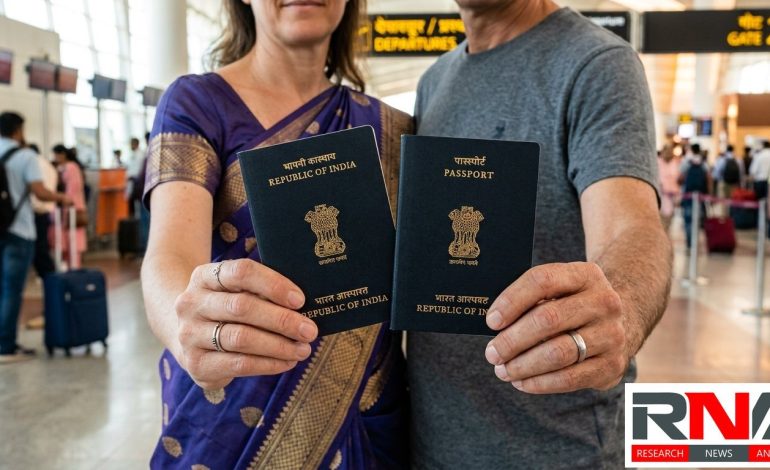
RNA illustration for representation.

New Delhi: A senior Ministry of External Affairs official, speaking at the 14th Passport Seva Divas in New Delhi on Wednesday, said that an Indian passport should be viewed primarily as a travel document and not as conclusive proof of citizenship. The official said the purpose of the Indian passport is to help Indians transit and travel through foreign ports and territories, and that it should not be compared with other documents used to establish citizenship rights.
The official noted that a passport is issued after extensive verification and scrutiny of documents, but that its primary purpose is to facilitate international travel and establish a holder’s nationality abroad. The ministry underscored that while the passport is granted only after due diligence involving inputs from multiple government agencies, it remains a travel document under the law rather than a citizenship certificate.
The occasion – the anniversary of the enactment of the Passports Act, 1967 – was otherwise meant to highlight the government’s expanding passport infrastructure. The external affairs minister, S Jaishankar, used the day to laud the rollout of the Passport Seva Programme 2.0, the introduction of chip-enabled e-passports, and the opening of new Passport Seva Kendras and Post Office Passport Seva Kendras.
A total of 14.7 million e-passports have been issued since the chip-based documents were rolled out last year. In 2025, the ministry facilitated around 1.5 crore passport-related services, including the issuance of 1.39 crore passports. Processing times have improved sharply, with most applications are now completed within six working days, and citizens spend on average less than 45 minutes at Passport Seva Kendras. The network has expanded to 545 centres across the country, up from 77 a decade ago.
None of that context, however, could contain the fallout from the citizenship remark.
The row
The statement set off an immediate wave of criticism on social media, which drew in politicians from across the opposition spectrum as well as prominent public figures.
Rajya Sabha MP Kapil Sibal, reacting on the issue, insinuated that the clarification was aimed at depriving people of their votes and helping the BJP win elections. He asked pointedly: “Which document then is proof of citizenship? BLO (booth-level officer) can doubt my citizenship. Deprive me of my vote.”
Lyricist and screenwriter Javed Akhtar called the MEA’s position “absurd”, asking whether the ministry was issuing travel documents to people without first being convinced they were Indian citizens. His frustration captured the instinctive public reaction: if a passport requires citizenship to obtain, how can it not serve as proof of it?
Shiv Sena (UBT) leader Aaditya Thackeray questioned the government’s position, arguing that passports are issued only after police verification and extensive checks, and said the statement was most likely to create confusion about the status of Indian passports internationally.
TMC MP Saket Gokhale posted a checklist on X showing that, by the Union government’s own reckoning, none of the documents most Indians carry – Aadhaar, PAN, voter ID, driving licence, bank passbook, domicile certificate, government employee ID, property papers, or birth certificate (unless the holder was born before July 1, 1987) – are being accepted as proof of citizenship. He alleged the BJP government was using this logic to advance the SIR of electoral rolls and the prospect of a nationwide National Register of Citizens.
The ruling party pushed back. The BJP’s national information & technology department head, Amit Malviya, said the MEA had not announced a new policy but had merely reiterated a settled legal position, citing the 2013 Bombay high court ruling and subsequent reaffirmations that citizenship is determined under the Citizenship Act, 1955, based on eligibility and supporting evidence. He said in a post on X that a passport is an important identity and travel document and may support a claim of citizenship, but that citizenship flows from the Constitution and the Citizenship Act, not from the mere possession of a single document.
Government sources followed up on Thursday, saying the passport had never been proof of citizenship. “It was not decided yesterday that the passport is not a proof of citizenship. It was not even decided in the last 12 years. The passport has never been a proof of citizenship,” a media report citing a source said.
The legal basis
The government’s position is rooted in statute. Section 20 of the Passports Act, 1967, states that the central government may issue a passport or travel document to a person who is not a citizen of India if it is of the opinion that it is necessary to do so in the public interest. That single provision establishes that holding an Indian passport is not, in law, conclusive proof of Indian citizenship.
The authorities also point out that a passport obtained through false information or misrepresentation can be cancelled or revoked, which is another reason the document is treated as evidence of identity and travel eligibility rather than of citizenship.
The broader judicial record backs this up. The Supreme Court, hearing the Bihar SIR case, ruled on August 12, 2025, that Aadhaar would strictly be used as proof of identity and not as evidence of Indian citizenship. The government also referred to a set of FAQs issued by the Press Information Bureau on December 20, 2019, in the context of the CAA and the proposed NRC, which stated that citizenship may be established through documents relating to a person’s date and place of birth, though it noted that a final decision on the list of acceptable documents was yet to be taken.
As of June, the Ministry of Home Affairs has not finalized any official nationwide guidelines or a definitive list of acceptable documents to prove Indian citizenship under a nationwide NRC.
So what does prove Indian citizenship?
This is the question at the heart of the public unease – and the answer is more complicated than most Indians realize.
Indian citizenship is not derived from any singular document. The Constitution of India and the Citizenship Act, 1955, together define who qualifies. Under the citizenship law, a person is an Indian citizen by birth if born in the country on or after January 26, 1950, but before July 1, 1987. A person born after July 1987 can claim citizenship if at least one parent is or was a citizen. A person born on or after December 3, 2004, can claim citizenship by birth only if both parents are Indians, or if one parent is a citizen and the other is not an illegal immigrant at the time of birth.
The Citizenship Act, 1955, defines exactly how an individual acquires or proves their status through five distinct pathways: birth, descent, registration, naturalization, or the incorporation of territory.
Currently, India does not have a single national document that automatically establishes citizenship for every citizen. Experts note that under the current framework, the most definitive proof available is a certificate of naturalization or a certificate of registration, issued directly by the Ministry of Home Affairs under Sections 5 and 6 of the Citizenship Act, 1955. For the vast majority of Indians who are citizens by birth and have never needed such a certificate, there is no equivalent single stamp of citizenship.
Voter ID, Aadhaar, and PAN cards have repeatedly been ruled by courts to hold zero legal weight regarding nationality. They are identity documents for availing services but cannot override the foundational rules of the Citizenship Act.
India, like most European countries, follows primarily the jus sanguinis (Latin for “right of blood”) principle. Since most Indians acquire citizenship automatically through birth or descent, citizenship is established through what is described as a “multiple-document approach” – a combination of records that establish a chain of facts relating to date of birth, place of birth, and parentage using official documents.
In practice, this means a birth certificate, parental records, school-leaving certificates, electoral roll entries, land records, and government service records – used in combination – are what the system falls back on. None of these is individually conclusive; the mix depends on when and how a person acquired citizenship. A passport may support a claim of citizenship, but citizenship flows from the Constitution and the Citizenship Act, not from the passport itself.
The political undercurrent
Citizenship emerged as one of the defining political issues during Prime Minister Narendra Modi’s second term, particularly following the passage of the Citizenship Amendment Act and the proposed NRC exercise. With the government’s stated commitment to identifying and removing illegal immigrants, especially in border regions such as West Bengal and the northeast, the debate over citizenship is likely to remain politically significant. Special intensive revision (SIR) exercises conducted before assembly elections in several states have also brought citizenship into focus, as electoral authorities have sought to verify voter eligibility and revise electoral rolls.
In June 2026, the Supreme Court issued notice on a petition that alleged Aadhaar was being misused to project residency or status in a way that blurs the line drawn by Section 9 of the Aadhaar Act, and sought responses from the Union government and states.
The MEA’s statement – legally accurate and nothing new in a strict sense – arrived in this charged environment. Whether it was an administrative clarification or a political signal is being debated across the country. What is beyond debate is that for hundreds of millions of Indians who have never needed to formally prove citizenship, the realization that their passport does not legally suffice has come as a shock.