
UN inquiry finds Israel deliberately targeting Palestinian children, cites genocide
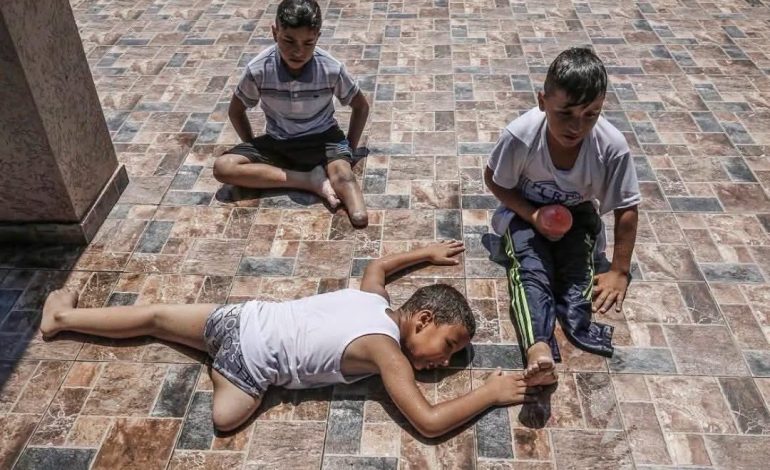
Three Gaza children who lost their limbs in Israeli bombing. (Photo: X/@mhmd_s09)

New Delhi: A UN independent commission has released its most detailed indictment yet of Israeli military conduct in Gaza and the West Bank, concluding that children have been deliberately killed as part of a strategy it characterizes as genocide. Israel has rejected the findings as a fabrication.
The UN Independent International Commission of Inquiry on the Occupied Palestinian Territory, including East Jerusalem, and Israel launched its findings at a news conference in Geneva on June 23, 2026, presenting what it described as the first specialised UN investigative report on crimes against Palestinian children. The 100-page document – formally titled “The essence of childhood has been destroyed” and bearing the reference A/HRC/62/CRP.2 – covers the period from October 7, 2023, to March 31, 2026.
The three-member commission was represented by its chair, Srinivasan Muralidhar – who retired as the chief justice of the Odisha high court, and commissioners Florence Mumba and Chris Sidoti. Muralidhar, who was a highly respected judge, is bringing significant Indian jurisprudential standing to the panel’s leadership.
Numbers and what they establish
The report documents serious physical and psychological harm caused by Israeli security forces to Palestinian children, including the death of at least 20,179 and the injury of 44,143 children. Children accounted for around 30% of those killed in the occupied Palestinian territories, and attacks on them have been described as a continuing activity. By comparison, children accounted for about 24% of conflict-related deaths during previous Gaza conflicts in 2008–2009 and 2014. Investigators said the scale of child deaths, combined with patterns of military operations, distinguished the current conflict from earlier wars.
UNICEF findings also suggest that by February 2026, the toll in Gaza had risen to 21,289 children killed and 44,500 injured.
Israeli forces continued to use high-payload munitions and weapons with wide-area effects in densely populated residential areas despite mounting child casualties. The commission said this pattern of conduct was not incidental. It concluded that the Israeli security forces treated Gaza’s civilian population as collectively associated with Hamas, and that the commission had reasonable grounds to conclude that these acts formed part of a deliberate strategy to destroy the future of Palestinians in Gaza by targeting their children.
The commission reiterates that the deliberate targeting of children is one of the key elements establishing genocidal intent of the Israeli authorities and security forces to destroy the Palestinian group, in whole or in part, in Gaza. This finding builds on the body’s earlier September 2025 determination, in which it concluded that there were reasonable grounds to determine that Israel had committed genocide against Palestinians in Gaza, carrying out four of the five prohibited acts defining genocide under the 1948 Genocide Convention.
Ceasefire did not end killings
A particularly sharp finding concerns the period after the October 2025 ceasefire, which was expected to bring the worst of the violence to a halt. Even after that ceasefire, children continued to be killed and seriously injured, with Israel allegedly showing continued disregard for the ceasefire and for the protection owed to Palestinian children under international law.
Muralidhar was unsparing in his assessment of the long-term damage. “Even if the bombs and guns fall silent in Gaza and West Bank, Palestinian children will not simply recover overnight,” he said. “The destruction of their health, education and development is irreversible.”
Palestinian children have suffered immense psychological harm, having been stripped of any sense of safety and future. Mental harm is an intergenerational condition, producing a distinctive “occupied psyche” in which the freedom to play, imagine, hope, and develop an identity has been eroded.
Infrastructure of childhood destroyed
The report examines the destruction not merely of individual lives but of the institutional and physical environment that sustains childhood. In Gaza, 22 out of 38 universities have been completely destroyed. There has been a systematic disruption of children’s ability to learn, sabotaging the intellectual and social foundations of Palestinian society.
The commission found the use of starvation and the imposition of conditions obstructing children’s survival. As of October 1, 2025, there had been 151 children’s deaths on account of malnutrition. Between October and December 2023, at least more than 1,000 children underwent amputation of one or more limbs.
Israel’s targeting of neonatal and maternity care centres directly endangered Palestinians’ reproductive future and the survival of newborns, driving a rise in miscarriages and birth complications. Birth rates in Gaza in the first half of 2025 were 41% lower than in the same period in 2022.
Detention, torture, sexual violence
The commission’s findings extend beyond combat casualties to documented patterns of abuse in detention. In the West Bank, including East Jerusalem, the commission found a sharp increase in violence by Israeli settlers against Palestinian children and documented evidence of torture, including sexual and gender-based violence, during mass arrests and detention. Palestinian children, particularly boys, were subjected to systematic mistreatment in detention, including forced stripping, beatings, and food deprivation. The commission concluded that this treatment constituted crimes against humanity.
The commission documented alleged cases of children being deliberately shot in vital organs by precise weapons. Commissioner Sidoti illustrated this with a specific case: a 14-year-old boy was shot by an Israeli military patrol as he left his house, at a moment when no fighting was taking place. The boy lay badly injured and surrounded by soldiers for around 45 minutes while he bled to death. Sidoti added that when the boy’s mother attempted to go to him, she too was shot at by the patrol. He told journalists that every international legal norm had been violated in the treatment of Palestinian children.
Self-determination at stake
The commission frames the assault on children not merely as a humanitarian catastrophe but as an attack on Palestinian nationhood itself. By targeting children, Israel is eroding the foundational structure of Palestinian society, weakening the demographic vitality and overall capacity of the Palestinian people to sustain and exercise its right to determine its future.
“The protection, care and survival of Palestinian children are inseparable from the Palestinian people’s right to self-determination,” Muralidhar said. “By targeting children, Israel is attacking the very capacity of the Palestinian people to exist and to determine their future.”
Commission’s demands
The panel called on Israel to immediately cease all violations against Palestinian children, and to end its occupation of the West Bank and East Jerusalem in accordance with the 2024 International Court of Justice advisory opinion. It urged the UN security council, member states, and the International Criminal Court prosecutor to enforce accountability, including through targeted sanctions. The commission identified specific military units responsible for killing and injuring children and referred recommendations to the ICC prosecutor.
Notably, the commission previously found that Hamas and other Palestinian armed groups committed war crimes and crimes against humanity on October 7, 2023, when 40 children were among those killed in Israel. The October 7 Hamas attack, which triggered the subsequent Israeli military campaign, resulted in 1,200 deaths and 250 hostages taken into Gaza.
Limits of commission’s mandate
Israel’s mission in Geneva rejected the report, calling it a “libelous sham” and the commission’s “second defamatory advocacy report”. It accused the commission of ignoring the brutal tactics of Hamas. Israel’s rebuttal said its military consistently strives to minimize harm to children, and pointed to its facilitation of vaccinations, the entry of medical staff, and the establishment of field hospitals.
It also accused Hamas of diverting humanitarian aid and fuel intended for civilian use, a charge the group has consistently denied. On the West Bank findings, Israel said the report omitted the context of a constant terrorist threat. The report itself notes that the commission sent 13 requests for information to the government of Israel and received no response.
Notably, a sharp internal Israeli voice also entered the debate just days before the report’s release. Former Israeli prime minister Ehud Olmert published a column on June 18 sharply criticizing Israeli policies in the West Bank, accusing the government of enabling organized settler violence against Palestinians and asserting that the state of Israel was conducting an organised, systematic, state-funded campaign of ethnic cleansing and crimes against humanity in areas under its exclusive security control.
The commission is an investigative body, and its conclusions are formal findings rather than a court ruling; the allegations would still need to be tested before a competent tribunal. Critics, including the NGO UN Watch, have questioned the commission’s methodology and its characterization of targeting as deliberate rather than as collateral damage in the context of urban warfare, arguing the body has a structural bias against Israel. The commission was established by the UN human rights council on May 27, 2021 – a body that has itself been criticized for its composition and voting dynamics.
The report is available in full on the OHCHR and UN websites. The full video of the news conference held by the three-member commission.