

How Gaza’s war split the world’s loyalties in the Spain-Argentina World Cup final
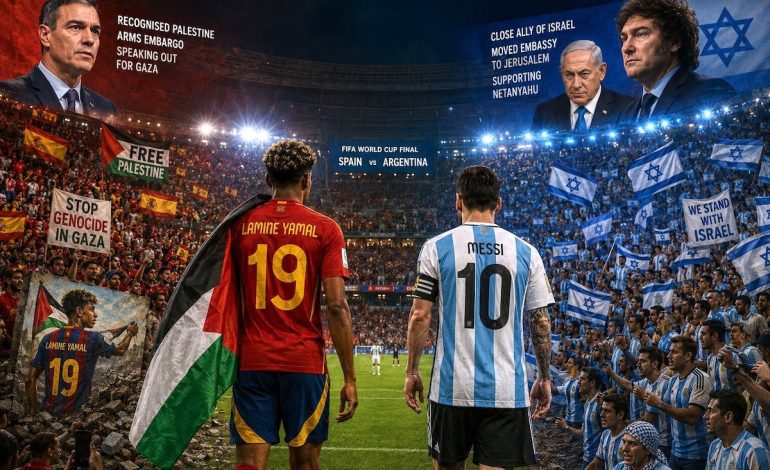
RNA Media illustration for representation.

Spain won its second Fifa World Cup on Sunday, beating Argentina 1–0 after extra time at the New York/New Jersey Stadium in East Rutherford. Ferran Torres settled the contest in the 106th minute, with Argentina having played the entire additional half hour a man short after Enzo Fernandez was sent off in second-half stoppage time.
The match itself carried real footballing weight – it was the first final ever contested between the reigning champions of Europe and South America, and only Spain’s second appearance in a final since it first won the trophy in 2010. For Lionel Messi, who has said this was his last World Cup and will be 43 by the time the next one is held in 2030, it was also a farewell that ended in defeat.
But the story that had consumed much of the world for weeks before kickoff had comparatively little to do with any of that. Long before Messi and Lamine Yamal walked out under the lights, the final had been recast online and in ministerial statements as a proxy contest over the war in Gaza, with two national teams pressed into service as stand-ins for Israel and Palestine.
Two leaders, two positions on Gaza
The framing did not come from nowhere. Argentina’s president, Javier Milei, a self-described anarcho-capitalist who took office in December 2023, has rebuilt his country’s foreign policy around a close alliance with Israel. He has visited the country repeatedly, announced in June 2025 that Argentina would move its embassy to Jerusalem, and that same month became the first sitting head of state, and the first non-Jew, to receive the Genesis Prize for his support of Israel – he has even said he is considering converting to Judaism once he leaves office.
He redirected the prize’s $1 million award into the Isaac Accords, an initiative of his own conception to draw Latin American governments closer to Israel on the model of the Abraham Accords, which he signed with the Israeli prime minister, Benjamin Netanyahu, in Jerusalem in April this year.
Spain’s prime minister, Pedro Sanchez, a socialist, took the opposite path, building a reputation as one of Europe’s most vocal critics of Israel’s campaign in Gaza. His government recognized the state of Palestine in 2024 alongside Ireland and Norway, later imposed an arms embargo, and has repeatedly described the Gaza campaign as a genocide – a characterization Israel and the United States both reject.
On the eve of the final, Netanyahu met Argentina’s ambassador to Israel, Rabbi Shimon Axel Wahnish, who relayed an audio message from Milei calling him a friend. “Javier, you are a friend. A true friend,” Netanyahu replied in a message his office posted online, before signing off with a chant of support for Argentina.
Also read: From Empire to Extra Time – How the 2026 Fifa World Cup told the story of migration
The flags that framed the final
The teams’ biggest stars became convenient symbols of the same split. Messi’s occasional visits to Israel, including a 2013 photograph of him in a kippah at the Western Wall, have long made him a target of criticism in parts of the Arab world. Yamal, Barcelona and Spain’s 18-year-old forward, became the mirror image of that in May, when he waved a Palestinian flag from an open-top bus during Barcelona’s La Liga title parade in front of roughly 750,000 people.
Israel’s defence minister, Israel Katz, said the gesture “incites hate”. Barcelona itself distanced the club from the moment in a message to its Israeli supporters’ association, even as Sanchez defended the player, saying he had “merely expressed the solidarity with Palestine that millions of Spaniards feel.” Palestinian artists in Gaza City’s Al-Shati refugee camp later painted a mural of Yamal and his flag on the rubble of a bombed building.
When Argentina’s own fan base flinched
The clearest sign of how far this had travelled beyond diplomacy was the reaction among people who would ordinarily support Argentina without a second thought. The country carries an outsized following well beyond South America, from Bangladesh to India, built almost entirely on Messi’s individual appeal rather than any political alignment. In Kolkata – where Argentina’s colours are painted on walls and children are named after its players – fans queued for hours through this tournament simply to watch Messi from close range one last time.
This time, though, a section of Argentina’s global following said openly that Milei’s embrace of Netanyahu made cheering for the team feel wrong. Posts describing the final as “pro-Palestine versus pro-Israel” circulated widely in the days before kickoff. The mixed martial artist Khabib Nurmagomedov, a prominent pro-Palestinian voice, wrote simply, “I know who I’m supporting.”
A streamer with a history of antisemitic remarks compared Argentina to Israel, prompting the Israeli nonprofit CyberWell to warn that the final’s global stage was being exploited to spread conspiracy theories. Even old regional rivalries bent to the mood: fans across Mexico, Brazil, Chile and Colombia, who would normally back a fellow Latin American finalist, flooded social media backing Spain instead, treating Argentina as the odd one out for once.
The picture was not one-sided, though. Argentina drew its own watch parties in Gaza, and a poll cited by Jewish media found it to be the clear favourite among Israeli viewers, chosen by 38 per cent of respondents. Messi also retains real popularity across the Middle East and North Africa. Commentators noted celebrations in Hezbollah’s Beirut stronghold, Dahiyeh, after Argentina’s semi-final win.
Europe’s politicians and activists weigh in
The politics went beyond the two teams’ own governments. The American president, Donald Trump, and Sanchez met at the final after nearly two years of strained relations, driven partly by Spain’s refusal to commit to Nato’s target of spending 5 per cent of GDP on defence and partly by Madrid’s description of the Gaza campaign as a genocide.
Milei and Sanchez had their own quarrel running well before the tournament. Spain recalled its ambassador from Buenos Aires and demanded an apology in 2025 after Milei made derogatory remarks about Sanchez’s wife at a Madrid rally organized by the far-right party Vox. It was an episode that gave the football rivalry a distinctly personal edge.
Elsewhere in Europe, activists leaned on culture rather than diplomacy – the Spanish actor Javier Bardem, a fixture at Spain’s matches, carried a Palestinian flag through the tournament and described Palestinian survival itself as an act of resistance.
After the final whistle
Even though Israel itself had not qualified for this World Cup, the war shaped the tournament from the group stage onward, and Spain’s win was celebrated in Gaza and the occupied West Bank as much as in Madrid. “I’m completely behind Spain because they stood up for Palestine,” a Gaza City resident, Ahmed al-Bozm, had said before kickoff, a sentiment echoed across the strip’s makeshift screening points.
Iran’s embassy in Kenya had already congratulated Spain after its semi-final win, saying the team would “never be forgotten for standing on the right side of history.” Weeks earlier, Egypt’s coach, Hossam Hassan, had carried a Palestinian flag onto the pitch after his team’s first-ever World Cup knockout win, saying his heart and soul were with the Palestinian people – a gesture that drew celebrations of its own in Gaza.
Football has long liked to think of itself as the one arena the world’s quarrels cannot fully reach. This World Cup argued otherwise. Whichever side of the New Jersey turf people’s loyalties fell on, from Kolkata’s Messi faithful to Gaza’s screening tents, few watched the final as only a game. For a good part of the audience, the real contest between Buenos Aires and Madrid’s positions on Gaza had effectively been settled long before Torres struck the winner.