
Taiwan’s president warns his party against Beijing’s ‘red terror’, vows democratic Taiwan will never become ‘China’s Taiwan’
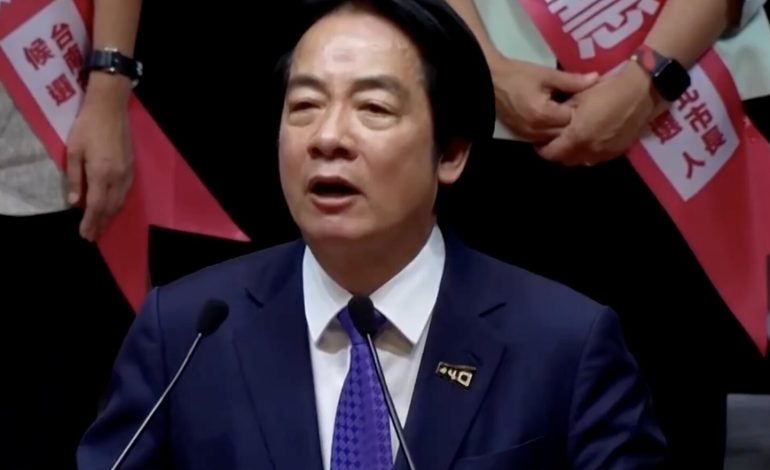
Screenshot taken from a video showing Lai Ching-te addressing his party, DPP.

New Delhi: Taiwan’s president, Lai Ching-te, has urged his ruling party to close ranks against what he called Beijing’s campaign of “red terror,” warning that the island’s democracy must never be allowed to slide back into becoming “China’s Taiwan.” Addressing the annual congress of the Democratic Progressive Party (DPP) in Taipei on Sunday, Lai – who also chairs the party – said Taiwan could not afford to lower its guard even in peacetime.
During his address, he pointed specifically to what he described as Beijing’s “legal warfare”, citing China’s newly enacted ethnic unity law, which gives Chinese authorities a legal pretext to pursue individuals beyond their own borders, including Taiwanese citizens Beijing regards as separatists. China has dismissed the criticism, though its judicial writ carries no legal force on Taiwanese soil.
Speaking in Taiwanese – also called Hokkien or Hoklo – rather than Mandarin, the language more commonly used in official settings, Lai told delegates: “I also expect comrades within the party to stand on the front lines, unite as one, and jointly oppose the threat posed by China’s red terror to Taiwanese society.” He added that citizens must “work together to protect our democratic and free way of life, and absolutely never allow democratic Taiwan to turn back and become China’s Taiwan.”
China’s Taiwan Affairs Office had not responded to the remarks at the time of writing. Beijing has consistently rejected Lai’s overtures for dialogue, branding him a “separatist”, and continues to regard the self-governed island as an inseparable part of Chinese territory – a claim Taipei firmly disputes.
Lai reiterated that Taiwan, whose formal name remains the Republic of China, already functions as a sovereign, independent state and is not subordinate to the People’s Republic of China in any respect. “Regardless of ethnic group, regardless of who came earlier or later, anyone who identifies with Taiwan is a master of the country,” he said, insisting that the island’s future rests solely with its 23 million residents.
The roots of the standoff trace back to 1949, when the defeated Republic of China administration retreated to Taiwan after losing the civil war to Mao Zedong’s communist forces, who went on to establish the People’s Republic on the mainland. Neither side has ever formally recognized the other’s legitimacy, and no peace treaty or armistice has been signed to formally close out that conflict – leaving the two sides technically still at war more than seven decades on.
Lai credited a decade of DPP governance with resisting what he termed “authoritarian expansion”, disinformation operations, military intimidation and sustained diplomatic pressure from Beijing. “Taiwan has shown the world that democracy is not a weakness; democracy is strength,” he said.
The president’s remarks come against a backdrop of steadily rising cross-strait tension, with Beijing having stepped up military exercises and grey-zone pressure around Taiwan in recent years, and Washington continuing to weigh its own strategic and arms-supply commitments to Taipei under the Taiwan Relations Act – a dynamic that regional capitals, including New Delhi, are watching closely given its implications for Indo-Pacific stability and freedom of navigation in the western Pacific.