
UAE deputy prime minister meets Jaishankar in Mumbai to discuss trade and regional security
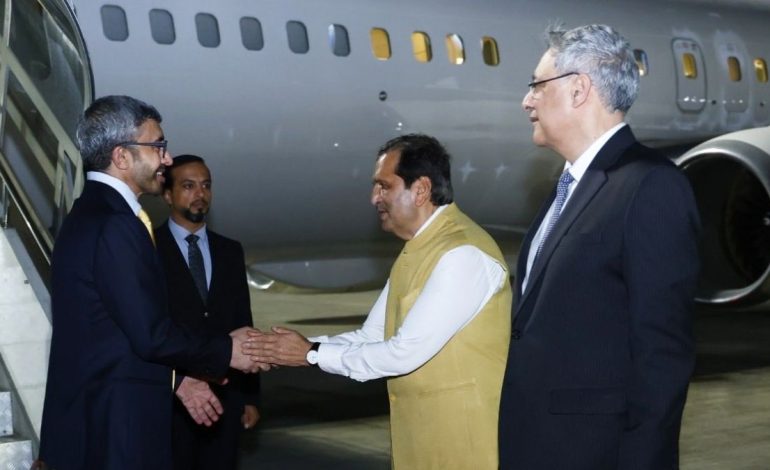
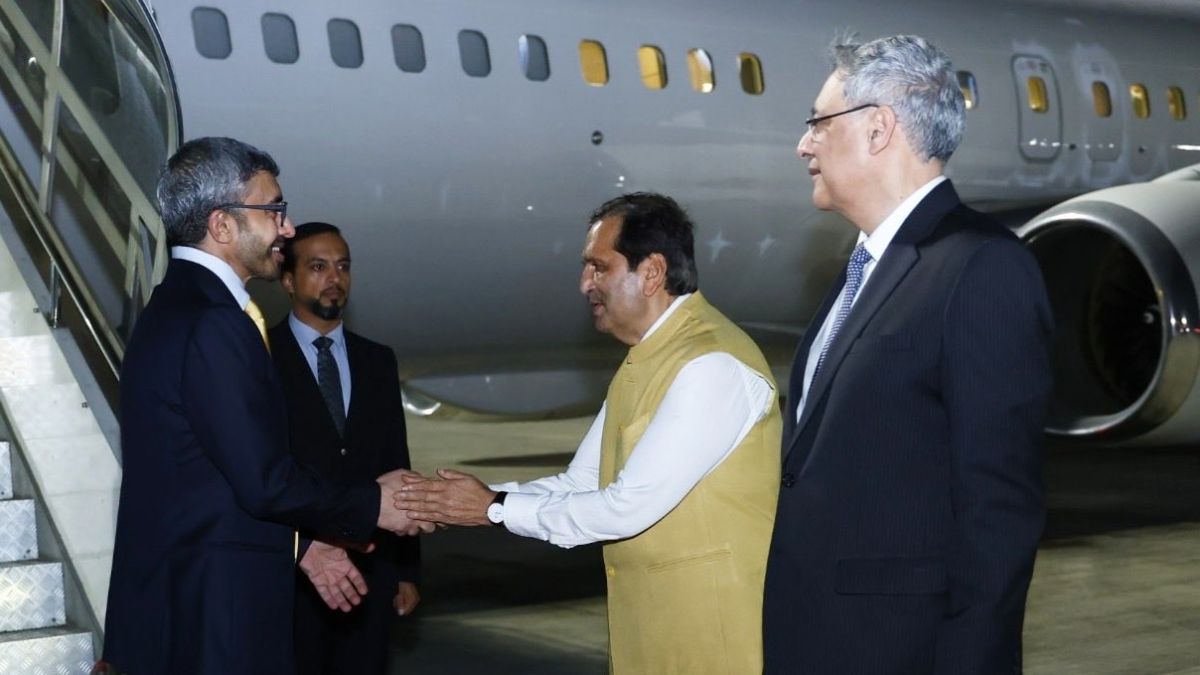
Sheikh Abdullah bin Zayed is received in Mumbai during his official visit to India. (image courtesy: X@MEAIndia)

New Delhi: The United Arab Emirates (UAE) deputy prime minister and foreign minister, Sheikh Abdullah bin Zayed Al Nahyan, arrived in Mumbai on Monday and met the external affairs minister, S Jaishankar, to advance bilateral cooperation. The engagement covered economic ties and international developments, with West Asia’s security situation also on the diplomatic agenda.
Announcing Sheikh Abdullah’s arrival, the Ministry of External Affairs (MEA) spokesperson, Randhir Jaiswal, wrote on X, “A warm welcome to HH Sheikh @ABZayed, Deputy prime minister and foreign minister of UAE, as he arrives in Mumbai on an official visit to India. He was received by Shri Mangalprabhat Lodha, minister, skill development department of the government of Maharashtra.”
Highlighting the significance of the visit, Jaiswal added, “This high-level visit reflects the close and regular engagement between India and the UAE, and will further strengthen our comprehensive strategic partnership.”
The UAE foreign ministry confirmed that the two ministers discussed economic, trade, investment, financial, cultural and energy cooperation, alongside regional and international developments. The discussions also covered efforts to safeguard peace and security, although no new agreements were announced in the ministry’s account of the meeting.
Welcoming his UAE counterpart, Jaishankar wrote on X, “Delighted to welcome DPM & FM UAE @ABZayed to Mumbai. Look forward to our talks.”
Before the visit, Jaiswal had said the two delegations would assess and take forward initiatives in energy, trade, investments, financial technology, defence and connectivity. These were the priorities announced in advance. The UAE’s account of the talks did not separately confirm whether defence, financial technology or connectivity projects were discussed.
Bilateral trade reached $101.25bn in the 2025-26 financial year, making the UAE India’s third-largest trading partner, according to the Indian embassy in Abu Dhabi. The two countries aim to raise trade to $200bn by 2032, building on the comprehensive economic partnership agreement signed in 2022.
Energy cooperation already has substantial contractual backing. In January, Adnoc Gas concluded a 10-year liquefied natural gas supply agreement with Hindustan Petroleum Corporation for 500,000 tonnes annually, worth between $2.5bn and $3bn. Emirati foreign direct investment into India totalled $25.59bn between April 2000 and March 2026, while both sides are working to connect their instant-payment systems and expand local-currency settlements.
West Asia and a rapid diplomatic follow-up
The MEA had said the delegations would also exchange views on West Asia and wider global and multilateral issues. The UAE foreign ministry subsequently confirmed discussions on regional and international developments and efforts to safeguard peace and security, without specifying individual conflicts or announcing joint measures.
Sheikh Abdullah’s arrival came three days after Jaishankar completed an official visit to the UAE from October 14 to 16. The ministers met in Abu Dhabi on October 14, discussing trade, investment and the regional situation.
On October 15, Jaishankar participated in a discussion titled “The Continental Corridors: Who Connects the Heartland?” at the second Raisina Middle East Dialogue in Abu Dhabi, organized on October 14 and 15 in collaboration with the Indian and UAE foreign ministries, highlighting the growing strategic importance of connectivity.
Jaishankar wrote on X, “A good discussion today on ‘The Continental Corridors: Who Connects the Heartland?’ at Raisina Dialogue Middle East. Made the following points: Competition has intensified, new chokepoints have emerged, and the willingness to leverage advantages has grown. Globalization cannot be reversed, but it must be navigated with greater resilience. IMEC is already shaping regional thinking on connectivity. As the global landscape evolves, India is building its own strengths and establishing trusted partnerships.”
The engagements highlight continuing diplomatic coordination between New Delhi and Abu Dhabi, with economic cooperation, connectivity and regional security remaining central to their comprehensive strategic partnership.