



Strong El Nino threatens India’s food prices, but huge grain stocks offer cushion: S&P
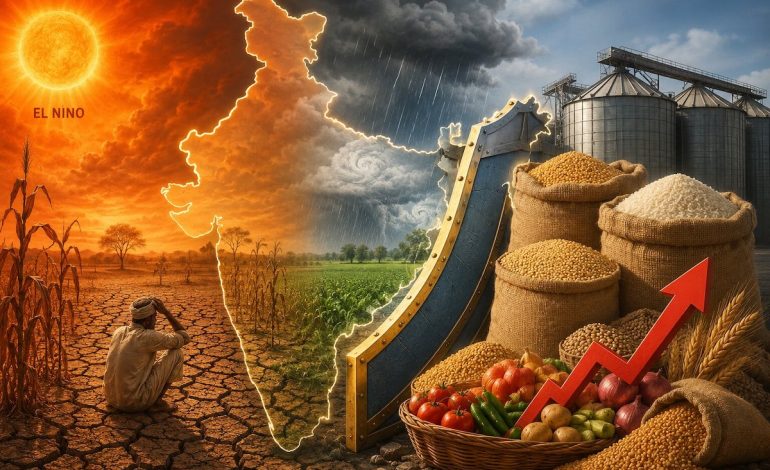
RNA Media illustration for representation.

New Delhi: A strengthening El Nino could drive up food prices and strain rainfall-dependent sectors across India in the coming months, although the country’s large grain reserves and government interventions should provide an important buffer, S&P Global Ratings has said. The ratings agency expects the broader economic impact across Asia-Pacific to remain manageable, but warned that countries where households spend heavily on food and agriculture remains economically important are more exposed to weather-driven price shocks.
India, Vietnam, Indonesia and the Philippines are among the economies facing heightened risks as El Nino alters rainfall patterns, potentially affecting crop output, water availability and electricity generation. S&P identified lower agricultural production, higher food inflation, reduced hydropower output and vegetation fires and haze as the principal channels through which the phenomenon could affect the region.
For India, the warning comes at a particularly sensitive point in the inflation cycle, with food prices already beginning to put pressure on household budgets after uneven rainfall disrupted agricultural output in several regions. A Reuters poll published on August 7 projected consumer inflation to have risen to 4.50 per cent in July from 4.38 per cent in June, which would mark a second successive month above the Reserve Bank of India’s 4 per cent medium-term target.
Yet India enters the potentially difficult weather phase with an unusually large foodgrain cushion. Central-pool stocks on July 1 were estimated at about 92.6 million tonnes of wheat and rice combined – around 52.3 million tonnes of wheat and 40.3 million tonnes of rice – leaving the government substantial room to release grain into the market if supplies tighten and prices accelerate.
S&P specifically pointed to those reserves as one of India’s strongest defences against an El Nino-induced food shock, along with closer coordination between authorities and farmers at the district level. The agency said improved import planning, market-management mechanisms, irrigation and water governance across the region could also soften the economic impact of prolonged dry conditions.
The World Meteorological Organization said on July 31 that a strong El Nino was developing and expected to intensify during August–October 2026, with significant changes in rainfall patterns and above-normal temperatures likely across much of the world. Its latest models indicate that the phenomenon could strengthen further towards the end of the year, while a positive Indian Ocean Dipole is also expected to influence weather around the Indian Ocean basin.
El Nino develops when surface waters in the central and eastern equatorial Pacific become unusually warm, altering atmospheric circulation and weather patterns far beyond the Pacific. Its effects vary between individual events, but South and Southeast Asia can experience weaker or erratically distributed rainfall, making agriculture, reservoirs and water-intensive industries particularly vulnerable.
India’s vulnerability is magnified by the importance of the southwest monsoon to agriculture and rural incomes, even though farming’s share in overall economic output has declined over the decades. A severe rainfall deficit can therefore travel quickly from farms to vegetable markets and household kitchens before feeding into broader inflation and, potentially, monetary-policy decisions.
As RNA Media had reported, the RBI has already put the weather risk on its policy radar. After keeping the repo rate unchanged at 5.25 per cent in its August review, the central bank retained a relatively reassuring inflation outlook but identified deficient and uneven monsoon rainfall under El Nino conditions as a risk to agriculture, rural demand and prices, while projecting average retail inflation of 5 per cent for 2026–27.
Food prices matter disproportionately for India because households devote more than 40 per cent of their spending to food, making weather-related supply disruptions much more visible in headline inflation than in many advanced economies. The immediate challenge for policymakers will consequently be not simply whether national rainfall is deficient, but where and when the shortfall occurs and whether it affects crops that have a large bearing on everyday food prices.
S&P said India is nevertheless better equipped to absorb such a shock than economies with thinner reserves and heavier dependence on food imports. Strategic grain releases, timely imports where required, crop diversification towards less water-intensive varieties and better reservoir and irrigation management could prevent localized production losses from turning into a broader price spiral.
The threat also extends beyond the farm sector. Prolonged weak rainfall could reduce reservoir levels, constrain water supplies to industry and cities and lower hydropower generation, adding another potential source of economic pressure if the current El Nino develops into the powerful event now anticipated by global forecasters.
India’s immediate advantage, therefore, lies less in escaping El Nino than in having the stocks and policy tools to manage its consequences. How effectively that cushion holds will depend on the intensity and duration of the weather event, the geographical distribution of the monsoon and the government’s ability to intervene before local shortages translate into sustained food inflation.