



Seven killed in Chamoli tunnel disaster. Why Himalayan excavation projects remain vulnerable?
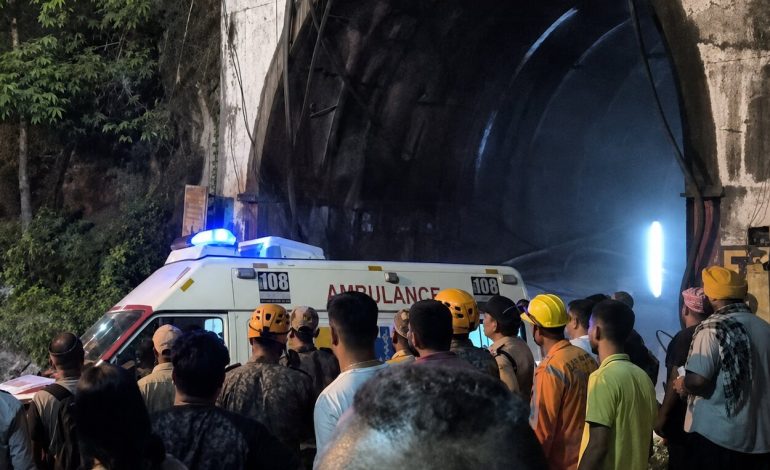
This screenshot from a widely circulated video on social media shows an ambulance coming out of the under-construction tunnel in Chamoli.

New Delhi: Seven workers were killed and 14 injured after water, mud and debris surged into an under-construction tunnel at the Vishnugad-Pipalkoti hydroelectric project in Uttarakhand’s Chamoli district on Thursday evening. One worker remained missing on Friday morning as rescue teams searched the flooded and debris-laden section of the tunnel.
The accident occurred at about 6.45pm on Thursday, near Mayapur in the Pipalkoti area, where 22 workers were on duty inside the tunnel being constructed by Hindustan Construction Company. Twenty-one workers had been accounted for by Friday morning, with the revised official count placing the toll at seven dead, 14 injured and one missing.
Officials said the workers heard a loud sound shortly before a powerful flow of water and debris entered the tunnel, blocking the passage and leaving several of them stranded. Early reports gave conflicting casualty figures as rescuers brought workers out in stages and hospitals updated their records through the night.
Nineteen workers were taken to the district hospital in Gopeshwar, where seven were declared dead and the survivors were examined for injuries. Ten were admitted, while one worker whose condition required specialist care was referred to the base hospital in Srinagar.
A large volume of water had accumulated inside the tunnel by the time emergency teams entered, while continued seepage from the sides complicated their movement. Heavy machinery and specialized equipment were deployed to remove debris, pump out water and reach the missing worker.
Personnel from the NDRF, SDRF, CISF, Indo-Tibetan Border Police, Uttarakhand Police, fire services and the Indian Army joined the operation. The district magistrate of Chamoli, Gaurav Kumar, supervised the response at the site as medical teams and ambulances were positioned nearby.
The chief minister of Uttarakhand, Pushkar Singh Dhami, directed the agencies to conduct the rescue operation on a war footing and said the state emergency operations centre was monitoring developments. Dhami also spoke to some of the injured workers and contacted the chief ministers of states from which several of the labourers came.
THDC India Limited’s executive director for projects, Kumar Sharad, said preliminary information indicated that a cavity had formed after the sudden water inflow. He said persistent rain had already prompted discussion about suspending work, but maintained that operations had been continuing with prescribed precautions.
That sequence has not yet been independently established, and the precise path through which the water and debris entered the tunnel will require a geological and engineering investigation. The inquiry will also have to determine whether warning signs were detected, whether drainage and dewatering systems were adequate, and whether work should have been stopped during prolonged rain.
The 444MW Vishnugad-Pipalkoti project is a run-of-the-river hydroelectric scheme on the Alaknanda, about 225 kilometres from Rishikesh. It includes a 65-metre diversion dam, a 13.4-kilometre headrace tunnel, a roughly three-kilometre tail-race tunnel and a large underground powerhouse complex.
The latest disaster came less than eight months after two industrial locomotives collided inside a tunnel at the same project during a shift change, injuring scores of workers. That accident was operationally different, but the two incidents will intensify scrutiny of worker safety, emergency access and risk management at the project.
Why under-construction Himalayan tunnels repeatedly turn dangerous
Tunnel accidents in the Himalayas do not arise from one common defect, and it would be premature to attribute the Chamoli disaster to negligence before the investigation is completed. The recurring pattern instead reflects a dangerous combination of complex geology, groundwater, extreme weather, incomplete structural support and, in some cases, shortcomings in investigation, monitoring or emergency preparation.
The Himalayas are comparatively young mountains that are still being compressed as the Indian tectonic plate pushes beneath the Eurasian plate. Their rock masses are folded, fractured and intersected by faults, thrusts and shear zones, meaning conditions can change abruptly within a few metres of excavation.
A section that appears to consist of competent rock may lead unexpectedly into crushed, weathered or clay-rich material incapable of supporting itself. Surveys conducted from the surface can identify broad geological structures, but they cannot always reveal every narrow fracture, concealed cavity, water-bearing seam or pocket of weak rock ahead of the tunnel face.
Peer-reviewed studies of Himalayan excavation projects show that failures are concentrated particularly around thrusts, shear zones and heavily weathered rock masses. High overburden can also generate intense pressure, producing rock bursts in strong formations and slow inward deformation, known as squeezing, in weaker rock.
Excavation itself alters the equilibrium that had held the rock mass together, transferring stresses towards the roof, walls and face of the opening. If fractured rock is not stabilized quickly with the correct combination of steel ribs, rock bolts, wire mesh, shotcrete and, where required, a permanent lining, localized failure can develop into a larger collapse.
This is why an under-construction tunnel is generally more exposed than a completed one: portions of the face remain open, permanent lining may be incomplete and drainage arrangements are still evolving. Heavy equipment, blasting or excavation can introduce vibration, while moving workers and material through a single access route makes evacuation difficult when that route is obstructed.
Water raises the danger considerably because it reduces friction along joints, softens susceptible rock and soil, increases pressure within fractures and carries loosened material into the excavation. A water-bearing fault or cavity breached by tunnelling can therefore release a sudden, high-energy inflow even when the tunnel had previously appeared dry.
The risk increases during the monsoon, when prolonged rainfall saturates slopes and raises groundwater levels, while swollen streams can exploit fissures created by landslides or erosion. Uttarakhand’s steep valleys funnel water and debris rapidly, and portals, access adits and shallow tunnel sections can become exposed to slope failure or drainage entering from above.
Sikkim faces a similar but not identical combination of hazards, including exceptionally heavy rainfall, steep river valleys, fractured rock and high seismicity in the eastern Himalayas. The October 2023 glacial lake outburst flood in the Teesta basin also demonstrated how an extreme upstream event can rapidly damage hydropower infrastructure across a river system.
Not every Himalayan tunnel disaster is caused by a collapse or water inflow. At the under-construction Teesta Stage-VI hydroelectric project in Sikkim on July 20, NHPC said [pdf] a suspected burst of methane embedded or trapped in rock caused an explosion, dense smoke and toxic gases inside the headrace tunnel; the precise cause was left to an investigation.
That disaster nevertheless highlighted another underground risk that geological investigations must consider: hazardous gases can migrate through fractures or accumulate in poorly ventilated spaces. Continuous gas detection, forced ventilation, ignition control and properly equipped refuge and rescue arrangements are therefore as important as structural support in potentially gas-bearing ground.
The 2023 collapse of the Silkyara-Barkot road tunnel in Uttarkashi, which trapped 41 workers for 17 days, exposed weaknesses of a different kind. A government investigation [pdf] reportedly found deficiencies in geological assessment, tunnel alignment, coordination and the response to repeated minor collapses, while recommending stronger project-specific safety and evacuation procedures.
The Silkyara episode demonstrated why a detailed project report cannot be treated as a fixed description of what engineers will encounter underground. Geological mapping must continue at the excavation face, supported by probe drilling ahead of the tunnel, groundwater measurements and instruments that detect deformation, stress changes and movement in temporary supports.
Construction methods and support designs must then be modified as the observed ground changes, rather than being applied mechanically across the entire alignment. In weak or water-charged zones, engineers may need shorter excavation advances, pre-grouting, forepoling, drainage holes, heavier steel supports or immediate closure of the structural ring.
The Vishnugad-Pipalkoti project underwent studies of landslide, seismic and structural risks before construction, and the World Bank’s inspection panel said in 2014 that the decision to use a tunnel-boring machine for much of the excavation would reduce vibration-related risks. The latest accident, however, underlines that sound planning must be accompanied by continuous verification because geological and hydrological conditions become clearer only as excavation advances.
Safety also depends on decisions made during construction, particularly when exceptional rain, increasing seepage, falling debris, cracking sounds or abnormal instrument readings are reported. Work-stoppage thresholds must be explicit and enforceable, with authority resting with qualified safety and geological personnel rather than being influenced by production targets.
Reliable communications, worker accountability, alarm systems, emergency lighting, protected refuge areas and an independent escape route can determine whether an engineering failure becomes a mass-casualty event. Rescue plans must be designed around credible site-specific scenarios – collapse, flooding, fire, gas release and loss of ventilation – and regularly tested with the actual workforce.
Tunnelling is indispensable for roads, railways and hydroelectric projects in mountainous India, and difficult geology does not make such construction inherently unmanageable. It does, however, leave little tolerance for incomplete investigation, delayed support, weak monitoring or emergency systems that exist only on paper.