



Payments law amendment bill introduced in Parliament, may open door to UPI merchant fees on large transactions
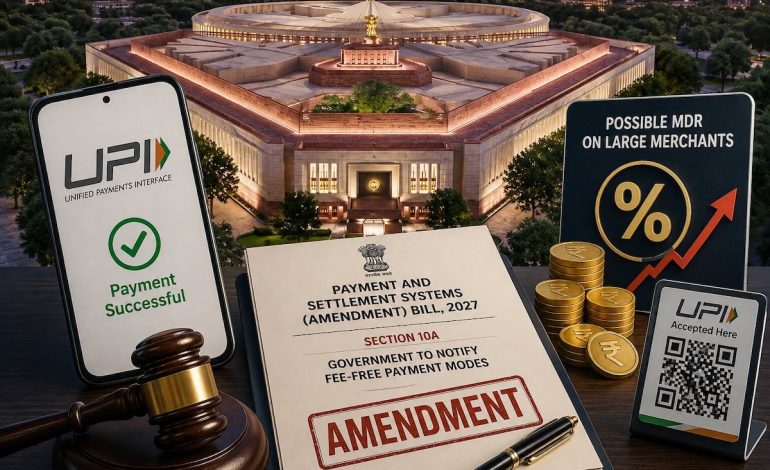
RNA Media illustration for representation.

New Delhi: The finance ministry has introduced the Payment and Settlement Systems (Amendment) Bill, 2027, in Parliament. This move could eventually allow merchant discount rate charges on UPI transactions for large businesses even as the government retains full authority over which payment modes stay free and which may attract fees.
The bill itself specifies no fee, no rate and no timeline, and the existing prohibition on charging for UPI remains untouched for now, with the Centre gaining the power to decide the matter through notification rather than fresh legislation.
At the heart of the amendment is Section 10A of the Payment and Settlement Systems Act, 2007, which currently bars banks and payment system providers from charging fees, directly or indirectly, on modes of payment listed under Section 269SU of the Income-tax Act, 1961, a provision that specifically forbids any charge, whether direct or indirect, on UPI transactions. Under the proposed change, that reference to the tax law is struck out altogether.
Instead, the list of protected, fee-free payment instruments will be whatever the central government chooses to notify by gazette, without having to return to Parliament each time.
This is a meaningful procedural shift rather than an announcement of charges. Two provisions have kept UPI free of cost over the past few years: Section 269SU, which requires businesses with a turnover above ₹50 crore to accept payments through modes prescribed by the Central Board of Direct Taxes, and Section 10A, which bars banks from charging on those same modes. Once the amendment takes effect, a future notification could simply choose to exclude a category such as peer-to-merchant UPI payments at large merchants, making a charge on those transactions possible for the first time since 2020.
A source familiar with the matter told Business Standard that the finance ministry would, after this change, be in a position to design an MDR structure – for large merchants, say – purely through executive notification, calling it the first concrete step towards a possible levy on UPI, while stressing that no decision on the shape or size of any charge has yet been taken.
The zero-MDR regime on UPI and RuPay debit cards has been in place since January 2020, introduced specifically to accelerate adoption of digital payments across the country. The Payments Council of India has for some time argued that this free-for-all model is not commercially sustainable at scale, and its chairman, Vishwas Patel, wrote to the Prime Minister’s Office in March 2025 proposing a nominal MDR of around 30 basis points on UPI and RuPay transactions at large merchants, while keeping smaller businesses shielded from any charge.
Comparisons with other large digital economies have featured prominently in the industry’s pitch. Pine Labs chief executive Amrish Rau noted on X that Brazil’s Pix and China’s real-time payment systems have always carried merchant charges of 30 to 40 basis points, yet both have crossed 90 per cent penetration among users and merchants, against roughly 35 to 40 per cent in India, citing figures from the Reserve Bank of India and the National Payments Corporation of India.
UPI, he added, now processes close to 23 billion interoperable transactions every month, making it the largest real-time payment system anywhere in the world. He warned, however, that six years of near-zero monetization had begun to slow the pace of expansion.
A parliamentary standing committee had separately flagged the zero-MDR structure as financially unsustainable for the wider UPI ecosystem, while projecting that the platform could still add 600 million users and handle between 100 billion and 150 billion transactions a month in the years ahead.
Markets react
Fintech stocks moved higher on Monday, ahead of the bill’s formal introduction. Pine Labs climbed 9.68 per cent to ₹152.45 a share, Paytm gained 2.63 per cent to ₹1,376, AvenuesAI rose 11.02 per cent to ₹17.63 and MobiKwik added 4.66 per cent to close at ₹214.55 Analysts also see a potential UPI MDR as a positive for PhonePe and Razorpay, both of which are working towards initial public offerings .
The government’s own incentive outlay for UPI, meanwhile, has been trimmed for the current year. The budget has allocated ₹2,000 crore to promote low-value peer-to-merchant transactions through UPI and RuPay debit cards, about 8.9 per cent lower than the final FY26 figure of roughly ₹2,196 crore, though well above the FY26 budget estimate of ₹437 crore The highest annual payout under the scheme so far was ₹3,631 crore in FY24, and the industry estimates that operating and expanding the payments infrastructure now costs at least ₹10,000 crore a year.
For context, the finance ministry had earlier dismissed similar reports as speculation, insisting on social media that no MDR would be imposed on UPI and describing such claims as baseless. Whether Tuesday’s bill marks a genuine change of position or simply a technical realignment of statutory language will depend on how – and whether – the notification power is eventually exercised.