




Parliament clears Bankers’ Books Evidence Bill, brings digital bank records firmly into legal evidence framework
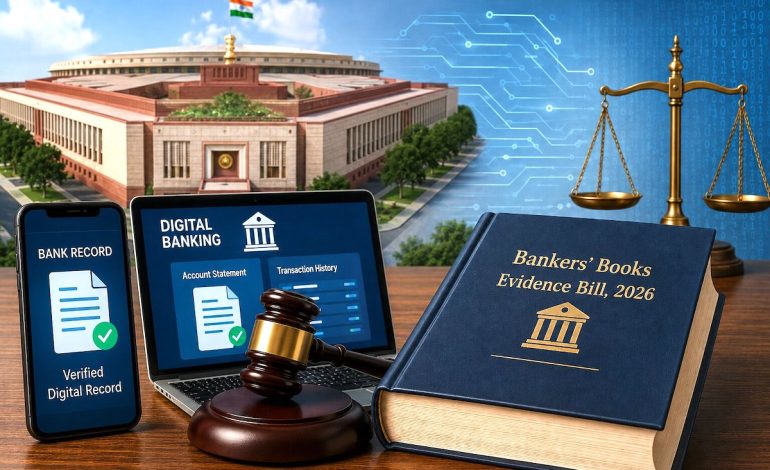
RNA Media illustration for representation.

New Delhi: Parliament has passed the Bankers’ Books Evidence Bill, 2026, which explicitly recognizes electronic and digital banking records as admissible evidence in legal proceedings and seeks to replace a 135-year-old colonial-era law. The Rajya Sabha approved the legislation on Monday, five days after it was passed by the Lok Sabha.
The bill will repeal and replace the Bankers’ Books Evidence Act, 1891, after receiving presidential assent, updating a legal framework created when banking records were maintained predominantly in physical ledgers. Although the existing law already permits certified copies of bankers’ books to be admitted as evidence without requiring the originals, the new legislation expressly accommodates records generated and maintained through modern digital banking systems.
The legislation was introduced in the Lok Sabha on August 3 by the finance minister, Nirmala Sitharaman, and passed by the House on August 5. The government has said the changes are intended to create a technology-neutral framework capable of keeping pace with the rapid digitization of India’s banking and financial system.
Under the bill, an electronic or digital copy of a bank record may be admitted as evidence if it is a true copy of the relevant entry or information and accurately represents, or has been appropriately derived from, the underlying record. It must also meet safeguards designed to establish that the information has not been subjected to unauthorized alteration or system tampering that could compromise its accuracy or integrity.
The measure largely retains the evidentiary principles of the 1891 Act while adapting them to banking conducted through computers, electronic databases and other digital systems. In practical terms, courts will be able to rely on properly certified digital bank records without requiring banks to produce the original record merely because it exists electronically rather than on paper.
The bill also preserves protections available to bank officials when their institution is not itself a party to a legal proceeding. An officer ordinarily cannot be compelled either to produce bankers’ books or appear as a witness merely to prove transactions and accounts recorded in them unless a court or judge finds a “special cause” for doing so.
For the first time, the legislation sets out circumstances that may constitute such a special cause, including doubts over the accuracy or genuineness of a record, disruption of the normal record-keeping process or failure by a bank to comply with a court order concerning inspection of its books. The provision is intended to balance judicial access to relevant evidence with safeguards against unnecessary demands on banks and their employees.
The legislation will initially apply to entities engaged in banking as well as post office savings banks and money order offices, continuing the coverage provided under the existing framework. It also empowers the central government to extend the provisions to other entities or classes of entities operating in the financial sector through notification, with specified conditions, exceptions or modifications.
The Rajya Sabha passed the bill by voice vote after opposition members walked out during proceedings, while its passage in the Lok Sabha had also taken place without substantive debate amid protests and disruptions. Sitharaman criticized the opposition’s absence from the discussion, arguing that legislation modernizing banking procedures was an area where members could have offered constructive suggestions.
The overhaul comes more than a century after the original legislation was enacted on October 1, 1891, when the expression “bankers’ books” principally referred to ledgers and other physical accounting records. By expressly recognizing electronic evidence and establishing tests for its authenticity and integrity, the 2026 bill seeks to bring the evidentiary framework closer to the way banking transactions and records are now created, stored and retrieved.