Jaishankar in Thimpu: India hands over 54 Indian EVs to Bhutan as New Delhi ups green partnership with Thimpu
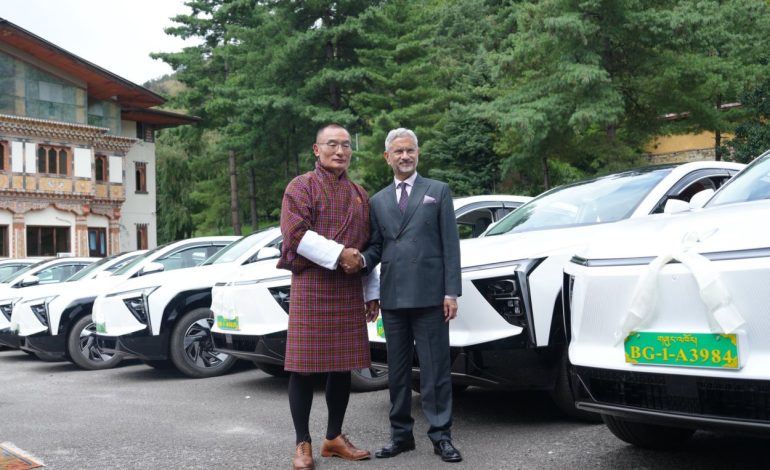
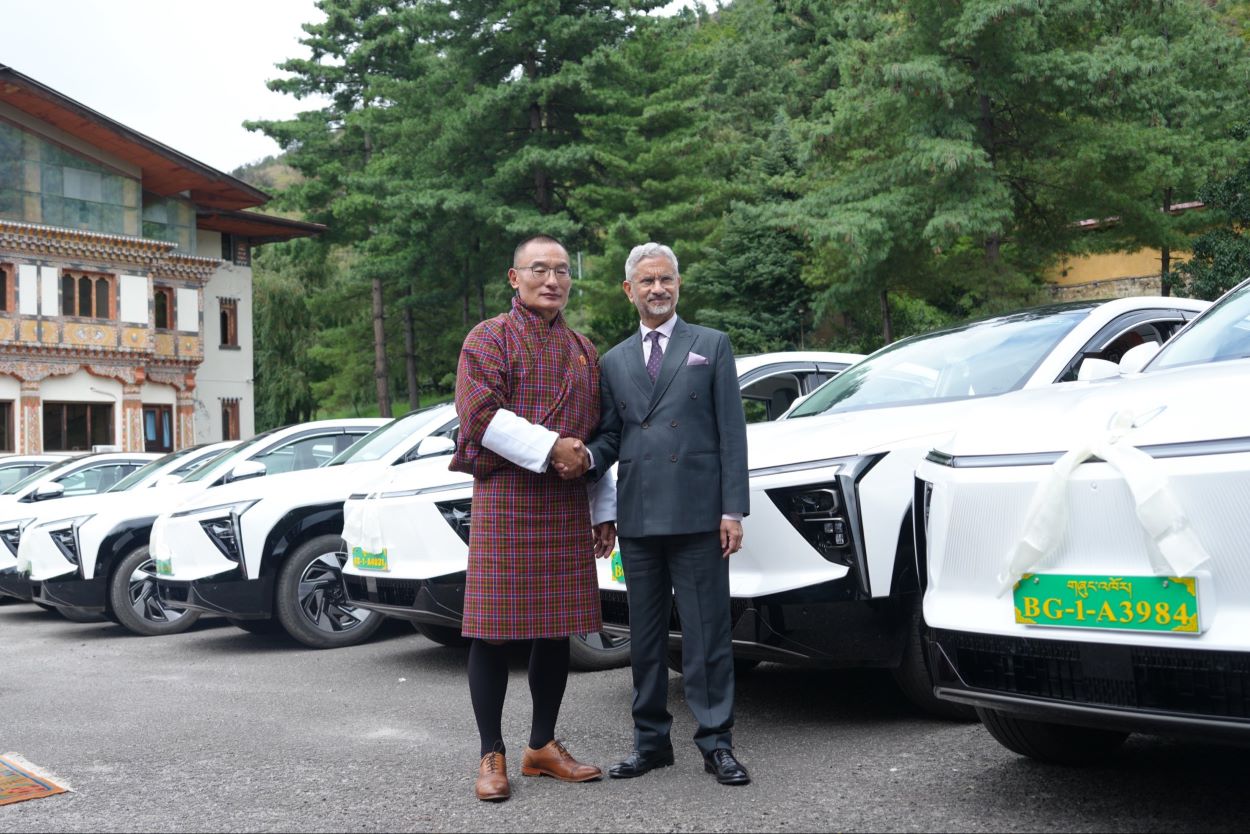
S JaBhutan PM Tshering Tobgay shake hands during the handing over of the Indian EVs to Bhutan in Thimpu. (Photo: X/@DrSJaishankar)

New Delhi: India has handed over 54 “Made in India” electric vehicles to Bhutan as New Delhi expands its support for the Himalayan kingdom’s transition towards electric mobility and lower-emission transport. The external affairs minister, S Jaishankar, presented the vehicles to Bhutan’s prime minister, Tshering Tobgay, in Thimphu on Thursday, describing the initiative as part of India’s support for Bhutan’s advances in e-mobility and sustainable transport.
The vehicles, identified by Bhutanese national broadcaster BBS as Mahindra electric vehicles, are intended for official use by Bhutanese government executives. Their procurement forms part of India’s Project Tied Assistance for Bhutan’s 13th Five-Year Plan, under which Nu 900 million has been allocated for vehicle procurement and a further 45 electric buses are planned.
The latest handover also builds on an earlier transfer of 45 electric vehicles in July, indicating that the two countries are moving towards a more systematic expansion of electric mobility rather than treating the initiative as a stand-alone diplomatic gesture. For Bhutan, the programme links government transport with its wider effort to develop cleaner and more sustainable mobility options.
Jaishankar’s meeting with Tobgay provided the political setting for the handover, with the Indian minister conveying the greetings of the prime minister, Narendra Modi, and reiterating New Delhi’s commitment to Bhutan’s development and prosperity. He said he valued the Bhutanese prime minister’s sentiments on the two countries’ distinctive relationship of friendship and cooperation.
The EV initiative is significant in the context of Bhutan’s broader development model, which places considerable emphasis on environmental sustainability. The country generates most of its electricity from hydropower, giving electric transport the potential to make use of a domestic renewable-energy resource while reducing dependence on petrol and diesel for road transport.
The initiative also gives an industrial dimension to India’s development partnership with Bhutan. The use of Indian-built vehicles connects New Delhi’s development assistance with Indian manufacturing capabilities, while giving Bhutan access to electric mobility technology through a bilateral framework rather than relying solely on commercial procurement.
The vehicle handover was one element of a wider set of initiatives announced during Jaishankar’s visit. He and the Bhutanese foreign minister, Lyonpo DN Dhungyel, reviewed cooperation covering development partnership, energy, trade, connectivity, culture and people-to-people ties, reflecting the breadth of the relationship beyond the immediate EV programme.
The visit also produced several concrete development outcomes. Jaishankar and Dhungyel inaugurated the 65-bed Gyaltsuen Jetsun Pema Mother and Child Hospital in Mongar, while they also laid the foundation stone for the 500-kW Lunana Hydropower Project in Gasa and inaugurated the 80-metre Jaganathan Bridge in Samdrup Jongkhar.
The hydropower project is particularly relevant to the evolution of India-Bhutan energy cooperation, which has been a central pillar of bilateral economic relations for decades. The Lunana project is intended to extend electricity access to some of Bhutan’s last unelectrified settlements, illustrating how the partnership is increasingly combining large-scale energy cooperation with projects designed to reach remote communities.
The EV programme therefore fits into a broader pattern in which India’s assistance to Bhutan is being extended from traditional infrastructure and hydropower into newer areas such as clean transportation and digital connectivity. On the same visit, the two sides launched the second phase of the Unified Payments Interface, while also exchanging a memorandum of understanding on the Nehru-Wangchuk Scholarship for Bhutanese students pursuing higher education in India.
For New Delhi, the electric vehicles also demonstrate how bilateral development cooperation can support Bhutan’s economic and environmental priorities while creating a visible role for Indian technology and manufacturing. For Thimphu, the programme offers a practical route to expanding electric mobility within a development partnership that already encompasses energy, infrastructure, healthcare, education and digital payments.
The 54-vehicle handover is consequently best understood as one component of a wider effort to modernize the India-Bhutan partnership. What makes the initiative notable is not simply the number of vehicles, but the way clean transport, Indian manufacturing and Bhutan’s development priorities are being brought together within the two countries’ established framework of cooperation.