


India to build world’s largest museum display space in Delhi at ₹3,230 crore, surpassing Louvre and British Museum
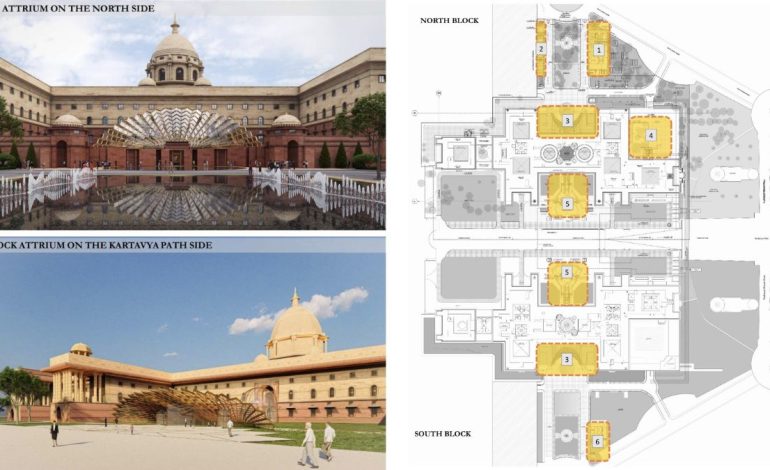
Proposed peacock atriums for the Yuge Yugeen Bharat National Museum. (Photo: X/@AmanKayamHai_)

New Delhi: The government has approved a ₹3,230 crore project to transform New Delhi’s historic North Block and South Block into the Yuge Yugeen Bharat Museum, which is planned to have the world’s largest museum display area, surpassing renowned institutions such as the Louvre in Paris and the British Museum in London. The ambitious cultural project, approved on Wednesday, will convert the former headquarters of several key Union ministries into a vast public institution showcasing nearly 10,000 years of Indian civilization, with completion scheduled for March 2031.
The Cabinet Committee on Economic Affairs, chaired by the prime minister, Narendra Modi, cleared the proposal following its appraisal by the Public Investment Board on July 27 this year. The museum will be developed in phases between the financial years 2026–27 and 2030–31, with its first gallery, dedicated to the theme of “Adornment”, expected to open in North Block during the latter part of 2027.
Spread across approximately 178,509 square metres of built-up space, the museum will have more than 100,000 square metres of exhibition area, making it the largest in the world by the government’s proposed display-space comparison. According to the official Cabinet briefing, this would exceed the Louvre’s 73,000 square metres, the British Museum’s 70,000 square metres and Russia’s State Hermitage Museum’s 66,800 square metres.
The museum is intended to present India’s historical development through interconnected exhibitions covering archaeology, scientific achievements, artistic traditions, literature, religious practices, architecture and cultural exchanges. Planned galleries include “Architecture and Cityscapes”, “Mathematics and Astronomy”, “Languages and Scripts”, “Faith and Spirituality”, and “Bharat Connects – Trade and Ideas”.
The project involves an enormous collection-management exercise, with approximately 1.8 million objects already identified from the National Museum, other museums under the culture ministry, 52 Archaeological Survey of India site museums, state institutions and private collections. However, identifying these objects does not necessarily mean that all will be exhibited simultaneously, as their eventual selection, conservation, storage and display will require extensive curatorial planning.
Beyond conventional exhibitions, the complex will incorporate digital installations, interactive displays and immersive technologies designed to make historical material accessible to different audiences. The government expects the museum to accommodate approximately one crore visitors annually, potentially establishing Delhi as a major international destination for cultural tourism.
From centres of government to cultural landmark
The transformation represents a significant change in the function of two of India’s most recognizable administrative buildings, which formed the institutional heart of the country’s central government for nearly a century. Their conversion follows the relocation of government offices under the wider Central Vista redevelopment programme, allowing the historic structures to be repurposed without demolishing their principal architectural features.
Designed during the British colonial period as part of New Delhi’s imperial administrative complex, the North and South Blocks subsequently became important centres of governance after independence in 1947. The museum project will therefore preserve buildings associated with both colonial administration and independent India’s political history, giving them a new role as public cultural spaces.
The government has adopted an adaptive-reuse approach, under which existing heritage buildings are modified for contemporary purposes rather than replaced. This will involve carefully integrating exhibition galleries, conservation laboratories, storage facilities, visitor infrastructure and modern building systems into structures whose architectural character must be protected.
International expertise is also involved in planning the institution. Under a technical cooperation agreement signed on December 19, 2024, the National Museum engaged France Museums Développement to provide assistance with feasibility assessments, museum planning and the adaptation of the historic buildings.
The project was originally announced by Modi on May 18, 2023, but its final financial and implementation framework emerged only after subsequent technical assessments. The Cabinet’s latest approval provides a defined budget and timetable for an initiative that forms an important component of the government’s broader cultural and urban redevelopment agenda.
Economic potential and challenges
The museum is expected to generate income through admission charges, guided tours, digital experiences, restaurants, retail outlets and the rental of spaces for cultural and educational events. According to a Times of India report, the ministry has proposed annual revenue of approximately ₹163 crore, with suggested admission charges of ₹100 for Indian visitors and ₹1,000 for foreign tourists, although these rates should not yet be treated as finalized.
The project’s significance, however, extends beyond visitor numbers and commercial returns. Its success will depend on the quality of historical interpretation, professional conservation standards, accessibility and the ability to represent India’s diverse cultural traditions without reducing its complex history to a single narrative.
The scale also presents considerable logistical challenges, particularly in relocating and conserving artefacts, protecting heritage structures and managing large crowds within a historically sensitive government precinct. Ensuring that collections remain accessible to scholars and that exhibition decisions follow credible academic standards will be important to the museum’s international standing.
For India, the larger objective is to establish a cultural institution capable of competing with the world’s leading museums while strengthening its international cultural presence. If completed as planned, Yuge Yugeen Bharat will not merely transform the architectural identity of Raisina Hill but also significantly change how India’s civilizational history is presented to domestic and international audiences.