India tells UN Pakistan’s military is exploiting natural resources, cites Munir’s box of minerals
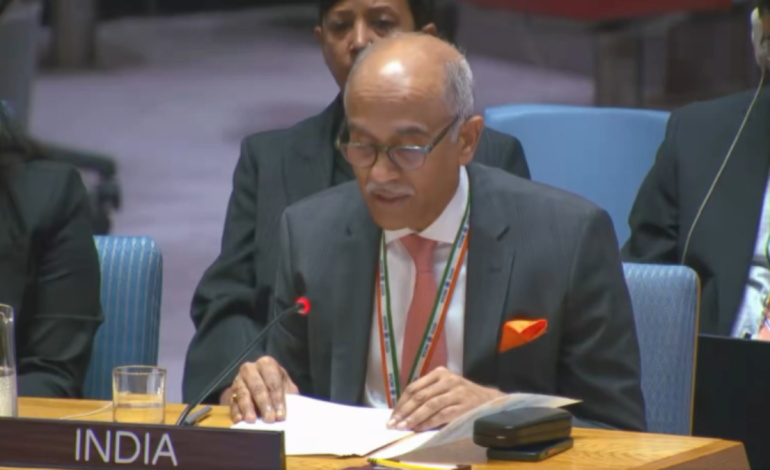
India accuses Pakistani army of exploiting natural resources at UN. (Image courtesy: X/@AmbHarishP)

New Delhi: India has accused Pakistan’s military establishment of exploiting the country’s natural resources for its own benefit, with its permanent representative to the United Nations, P Harish, citing an incident in which the Pakistani army chief, Field Marshal Asim Munir, displayed a wooden box filled with mineral stones to foreign leaders.
Speaking at an Arria-formula meeting on natural resources and conflict convened by Liberia on Wednesday, Harish alleged that the military’s involvement in resource exploitation was also believed to be behind the recent dismissal of a provincial government in Pakistan and the imposition of a state of emergency.
Responding to comments by the Pakistani delegation on the Indus Waters Treaty, Harish said India’s position on the agreement remained clear and consistent.
“Mr. Chair, it was not our intention to bring other issues into this forum, but my delegation is compelled to respond to the comment made by the delegation of Pakistan that has chosen to misuse today’s discussion to peddle its propaganda. Our position on the Indus Waters Treaty remains clear and consistent and has been articulated at multiple forums,” he said.
He added that the Pakistani army chief, Field Marshal Asim Munir, was seen in September 2025 displaying a wooden box of mineral stones to foreign leaders. He said it was “a clear indication of their Army’s role in this exploitation, which is also believed to be behind the recent dismissal of a provincial government in Pakistan and imposition of a state of emergency there”.
The reference was to an incident in September 2025 involving Munir and a wooden box containing mineral samples displayed to foreign leaders. Harish cited the episode to question the Pakistani military’s role in the country’s mineral resources sector.
India criticizes military’s role in resource exploitation
Harish argued that Pakistan’s natural resources should be used for the benefit of its population and not the interests of its military leadership. He also accused the Pakistan Army of fomenting conflict with neighbouring countries, saying the consequences were affecting Pakistan itself.
“Pakistanis would be served well if its real rulers, its military, used the country’s natural resources for the benefit of their population rather than self-aggrandisement,” he said. Harish said the Pakistan Army’s role in fomenting conflict with its neighbours was “boomeranging” back on Pakistan, and that the country would be better served if it stopped.
The remarks were made as part of India’s response to the Pakistani delegation during the UN discussion. The alleged connection between resource exploitation and the dismissal of a provincial government was presented by Harish and should not be treated as an independently established finding.
India calls for sustainable resource governance
Beyond its criticism of Pakistan, Harish outlined India’s broader position on natural resource governance, arguing that natural wealth should contribute to development and prosperity and not to conflict.
He highlighted the importance of voluntary, consensus-based and nationally led cooperation, pointing to the Kimberley Process as an example of an international mechanism designed to prevent conflict diamonds from entering legitimate trade. India holds the chair of the Kimberley Process in 2026.
Harish also referred to India’s district mineral foundations, which channel contributions from mining companies towards the welfare and development of communities affected by mining. The framework is intended to ensure that people living in resource-rich areas also benefit from mineral extraction.
He emphasized the importance of local participation in resource governance and of ensuring that the benefits of natural resources reach affected communities, including women and young people.
India underlines respective roles of UN bodies
Harish also called for the United Nations’ principal organs to operate within their respective mandates. He argued that the Security Council should focus on international peace and security, while broader questions of sustainable development and resource governance should be addressed by the General Assembly, the Economic and Social Council and other relevant bodies.
Concluding his remarks, Harish reiterated India’s willingness to contribute to international cooperation on resource governance.
“India stands ready to share its experience and to work with all partners towards practical consensus-based approaches that enable natural resources to drive sustainable development and lasting peace,” he said.
The meeting examined the relationship between natural resources and conflict, including how the illicit exploitation and trafficking of resources can finance armed groups and prolong instability. India’s intervention focused on national ownership, responsible resource governance and ensuring that natural wealth contributes to sustainable development.