


India and China revive Himalayan border trade after six-year freeze
RNA illustration for representation.

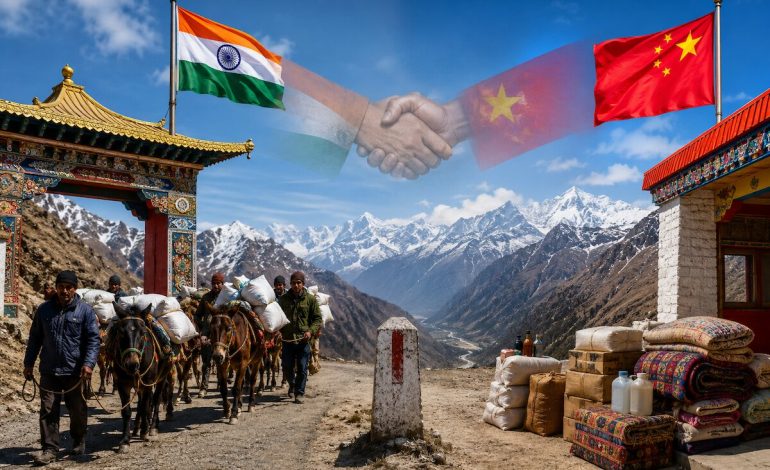
New Delhi: Border trade between India and China resumed on Saturday through two Himalayan passes – Nathu-la in Sikkim and Shipki-la in Himachal Pradesh – ending a suspension that had lasted since the Covid-19 pandemic struck in 2020. The revival follows months of quiet diplomatic engagement between New Delhi and Beijing and comes as both capitals seek to steady a relationship still shadowed by the 2020 Galwan valley clash.
At Shipki-la, in Himachal Pradesh’s high-altitude Kinnaur district, 16 local traders set off for Tibet carrying goods on 14 mules, according to Hishey Negi, president of the Kinnaur Indo-China Trade Association. They were flagged off by the state’s revenue and horticulture minister, Jagat Singh Negi, who presented the traders with traditional khataks, or ceremonial scarves, before their departure.
The exchange operates on a barter system, and the traders are expected to return after 72 hours of trading in the Tibetan region. Negi also inaugurated the newly built Chhuppan Trade Mart at Namgya, constructed at a cost of ₹1.70 crore, and said the resumption would strengthen the local economy and create employment for border youth.
The Kinnaur deputy commissioner, Amit Kumar Sharma, thanked the Army and the Indo-Tibetan Border Police for their cooperation in facilitating the reopening. Officials said the state government would also take up traders’ demands to widen the list of permitted goods with the ministry of external affairs.
Nathu-la reconnects Sikkim to an old silk route
In Sikkim, trade resumed through Nathu-la under standard operating procedures agreed between the two governments, with the season set to run from May to November each year. An official quoted by Moneycontrol described the reopening as significant for Sikkim, saying it would revive economic activity and benefit registered traders using the historic route.
Nathu-la has a longer and more turbulent history. Trade through the pass was suspended for 44 years after the 1962 war before reopening in July 2006, only to be halted again in 2020, along with the Kailash Manasarovar pilgrimage that also crosses the same route.
Geopolitics and commerce
The volumes involved in Himalayan border trade have always been modest, but the symbolism is not. The two countries had been discussing a resumption since at least mid-2025, a period that coincided with global trade turbulence following tariff measures imposed by the United States, which pushed both Asian economies to explore ways of easing bilateral friction.
That diplomatic groundwork included a visit to Beijing by the external affairs minister, S Jaishankar, in July 2025, followed by talks in New Delhi involving the Chinese foreign minister, Wang Yi. Beijing’s foreign ministry had said the two sides reached a consensus on cross-border exchanges and cooperation, including the resumption of border trade, setting the stage for Saturday’s reopening.
The move also fits a broader pattern of incremental normalization since the Galwan clash, which includes the resumption of direct flights between the two countries and renewed talks on de-escalation along the line of actual control. Analysts will be watching whether the reopening of these two passes is followed by the revival of a third route, Lipulekh in Uttarakhand, which has remained closed since 2020 along with the Manasarovar pilgrimage it once served.