


Sri Lanka court sentences country’s ex-police chief, former defence secretary to death over 2019 Easter bombings
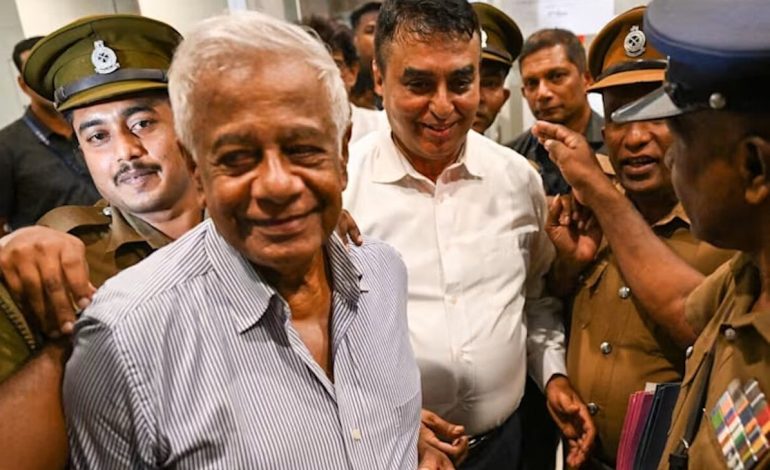
Sri Lanka’s former police chief Pujith Jayasundara (in civvies with grey hair) escorted out of the courthouse after being sentenced to death. (Photo: X/@TabzLIVE)

New Delhi: A special Sri Lankan court has sentenced the country’s former police chief and its former defence secretary to death for criminal negligence in failing to prevent the Easter Sunday bombings of April 21, 2019, which killed 279 people and wounded more than 500 others. The verdict, delivered on Friday, ends a seven-year legal battle that survived an earlier acquittal and a Supreme Court-ordered retrial.
The Colombo Permanent High Court Trial-at-Bar found the former inspector general of police, Pujith Jayasundara, and the former secretary to the ministry of defence, Hemasiri Fernando, guilty on 854 of the 855 charges brought against them, including criminal negligence, dereliction of duty and aiding and abetting deaths. Two of the three judges on the bench, Priyantha Liyanage and Thilakaratne Bandara, delivered the majority verdict, while the third judge, Viraj Weerasuriya, dissented, ruling that the prosecution had not proved its case beyond reasonable doubt.
Jayasundara and Fernando were first acquitted by the same court in February 2022, without either man being called to present a defence. The state appealed, and the Supreme Court ruled that the acquittal was contrary to law and ordered the case reheard, setting up the retrial that concluded with Friday’s sentencing.
India’s warnings went unheeded
Court proceedings established that an Indian intelligence agency had alerted Sri Lankan authorities on April 4, 2019 to a possible suicide attack, but the warning was not acted upon. A parliamentary committee that separately investigated the bombings found that police and intelligence officials had failed to act on repeated warnings before the attacks.
The episode remains a sore point in Colombo’s own reckoning with the failures of April 2019, given how specific the foreign tip-off is now known to have been.
The coordinated bombings struck three tourist hotels and three churches – two Catholic and one Protestant. The attacks killed 279 people, including at least 42 foreign nationals, and wounded hundreds more. Sri Lankan authorities attributed the bombings to a local group with links to the Islamic State (ISIS); none of those believed to have carried out the attacks directly survived, and separate trials continue for others accused of involvement in the plot.
Sentence unlikely to be carried out
A death sentence in Sri Lanka has, in practice, long meant life imprisonment. The country has not carried out an execution since 1976 and maintains an unofficial moratorium on capital punishment. The president of Sri Lanka, Anura Kumara Dissanayake, supports keeping that moratorium in place. Government figures placed before parliament in February 2026 showed at least 800 people on death row nationwide, with sentences usually commuted to life imprisonment.
The lawyer for the two men, Chaminda Athukorale, said on Sunday that they would appeal the ruling within two weeks. He argued that the dissenting judge’s opinion set out why neither man had a motive to kill or any link to the actual perpetrators of the bombings.
The convictions come after an earlier civil case had already ordered Fernando and Jayasundara to jointly pay 125 million Sri Lankan rupees (about $372,000) in damages to survivors of the attacks. Sri Lanka’s Catholic Church, whose congregations bore much of the loss of life, has long maintained that those identified so far are not the masterminds behind the bombings and that a wider conspiracy has never been fully investigated.
The verdict is among the few instances anywhere in South Asia in which senior security officials have been held personally liable, in a criminal court, for an intelligence failure of this scale – a distinction that will now be tested on appeal before the country’s supreme court.