
Death toll in Pakistan-occupied Kashmir unrest nears 90 as media curbs tighten

New Delhi: Pakistan-occupied Kashmir (POK) is entering its third month of unrest, with an independent rights monitor now placing the verified civilian death toll at 89. As RNA Media had reported, Islamabad has simultaneously moved to restrict foreign media access to the region, making it harder for the outside world to verify what is actually happening on the ground.
The Jammu Kashmir Human Rights Observatory (JKHRO), which has tracked casualties since the latest wave of protests began on June 7, updated its figures this week to cover the period from July 27 to August 5. It added three fresh deaths in Muzaffarabad – Mir Fayyaz, Raja Iqbal Khan and Raja Ahsan – taking the confirmed toll to 89, with a further four unverified cases pushing the total number of reported fatalities to 93, according to a POK-based media outlet Kashmir Times.
Of the 89 verified deaths, 45 have occurred since July 27 alone, with 37 linked to violence in Rawalakot, three in Mirpur, four in Muzaffarabad and one in Bhimber. JKHRO says verification work is continuing and the numbers could still change as more evidence emerges from the field.
Rawalakot sit-ins continue
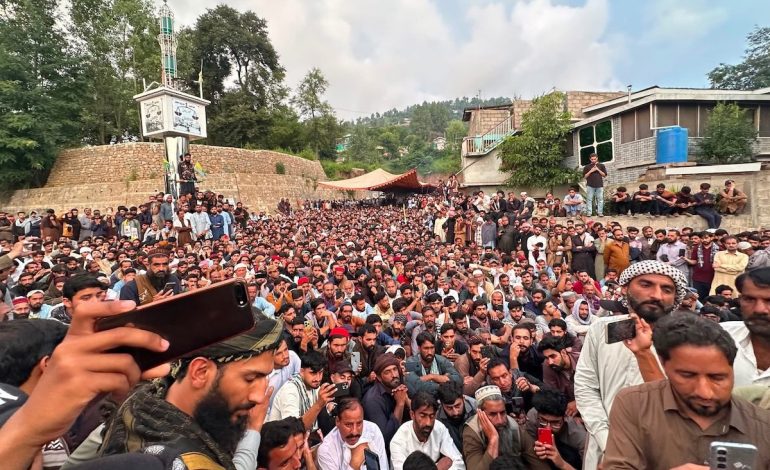
A sit-in in Rawalakot, organized by the now-banned Joint Awami Action Committee (JAAC), has continued for days without fresh violence, according to local reports. Thousands have gathered at the site, where speakers have kept up pressure on the government over demands to abolish 12 seats in the regional legislature reserved for refugees from Indian-administered Jammu and Kashmir.
The region’s legal community has stepped into the standoff. At a joint meeting hosted by the district bar association in Mirpur, lawyers declared they could not remain silent spectators and called on the federal government and POK administration to hold unconditional talks with JAAC representatives. They insist any dialogue be grounded in mutual respect rather than pressure or force.
The bars also offered to mediate and demanded the release of detained protesters, activists and lawyers, along with an end to the use of force and other coercive measures against demonstrators.
BBC report disputed
The BBC became the first international broadcaster to gain access to Rawalakot, reporting dozens of deaths over the preceding two months and describing a local clinic that had treated 50 to 60 critically injured patients since late July. One doctor at the facility told the broadcaster he had personally handled 15 to 20 gunshot wounds.
The POK administration rejected the report outright. The region’s information secretary, Muhammad Rashid Hanif, called it biased and said its figures had not been verified by any government institution, the police or the civil administration. Hanif said seven security personnel had been killed and more than 45 injured, laying blame on armed elements within JAAC and denying that security forces had used snipers, fired indiscriminately or withheld bodies from families.
Separately, the region’s police chief, Liaqat Ali Malik, told Al Jazeera he had lost seven men, with more than 200 officers injured in recent weeks, and accused critics of ignoring the use of weapons by violent elements among the protesters.
Foreign media gagged
As RNA Media had reported earlier, the dispute over casualty figures has since hardened into formal policy. Under new Foreign Media Facilitation Guidelines issued this month, foreign correspondents, Pakistani nationals working for international outlets, and freelancers must now obtain a no-objection certificate before reporting anywhere outside Islamabad, Karachi and Lahore. Foreign journalists already inside Pakistan-occupied Kashmir have reportedly been ordered to leave immediately.
The rules followed public criticism from Islamabad of international coverage of the unrest, with officials accusing broadcasters including the BBC and Al Jazeera of bias. Al Jazeera’s website reportedly became inaccessible inside Pakistan shortly after its correspondent filed a dispatch from Muzaffarabad, an episode the information ministry described as yellow journalism without announcing any formal ban.
Press freedom advocates have warned that the new framework, which allows accreditation to be suspended over reporting deemed contrary to national security, public order or state ideology, gives authorities wide latitude to silence unwelcome coverage. The editor of Dawn, Zaffar Abbas, called the restrictions unprecedented in more than 40 years of journalism, while the Pakistan Federal Union of Journalists has urged the government to withdraw the guidelines altogether.
The Committee to Protect Journalists said two independent Pakistani journalists were detained on August 1 and taken to an undisclosed location, and that several others had been summoned to court under laws criminalizing the spread of false information. As a direct consequence, sustained, independently verified reporting from inside Pakistan-occupied Kashmir – long a difficult region to cover given restricted access and patchy connectivity – has become considerably harder to obtain, leaving casualty figures, official denials and eyewitness accounts largely impossible to reconcile from outside.
Disputed polls deepen crisis
The unrest has played out alongside staggered assembly elections due to conclude on August 10. Amnesty International said on July 28 that at least 40 people had been killed, including 34 protesters and six security personnel, and called for a transparent investigation into the deaths.
Markets, banks and petrol stations in Muzaffarabad were shut ahead of polling day, with JAAC and protesters boycotting the vote entirely. One resident, describing the mood on the ground, said people had come out for their rights and were being shot at directly. The Pakistan Peoples Party has alleged widespread rigging, a charge the chief election commissioner has rejected, arguing that losses suffered by the ruling Pakistan Muslim League-Nawaz in some constituencies were themselves proof the process was fair.
Elected candidate faces UK rape probe
The political crisis has taken a further turn with revelations about one of the election’s winners. Rukhsar Ahmed, a former Pakistani state minister elected to the POK assembly from Mirpur on a PML-N ticket, was arrested by Greater Manchester Police in July 2024 on suspicion of raping and trafficking vulnerable girls in Manchester’s Rusholme area during the 1990s, and remains on police bail. Ahmed, 62, was due to answer bail at a Manchester police station last month but did not attend, reportedly citing illness, while continuing to campaign in POK.
He has not been charged, and the allegations remain under active investigation.
As RNA Media had reported earlier, India has dismissed the POK elections as a complete farce, alleging that the region is witnessing violence, intimidation, communication blackouts and repression. New Delhi called the polls a “humiliation” for Islamabad. Members of the Kashmiri diaspora have staged protests in the UK, including in Bradford, in solidarity with demonstrators in Pakistan-occupied Kashmir.