


Border infrastructure remains critical to future warfare, says Rajnath Singh at BRO conclave
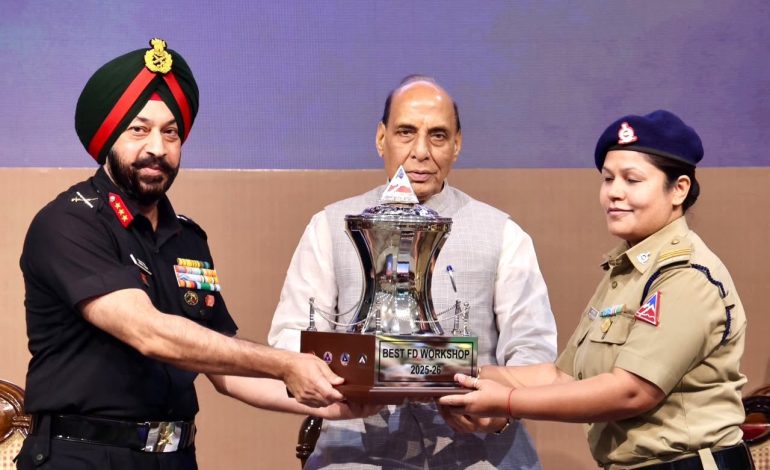
Rajnath Singh (C) along with Lt Gen Harpal Singh (L) presenting the BRO’s Best Field Workshop award to a lady BRO officer. (Photo: X/@rajnathsingh)

New Delhi: Border infrastructure will remain indispensable to national security even as the military inducts increasingly sophisticated weapons and platforms, the defence minister, Rajnath Singh, said on Tuesday. Singh said this while addressing the Border Roads Organisation’s “Strategic Infrastructure Conclave” here in the national capital.
Singh told delegates that while the outcome of modern warfare is shaped largely by military prowess, precision capabilities and advanced technology, the roads, tunnels, airfields and ports that connect the hinterland to the frontline remain central to sustaining any military operation. He noted that the route leading soldiers to the border is often the first front of a conflict, framing the organization’s engineers and workers as guardians of national security in their own right.
Six decades of expansion
The defence minister credited the BRO with evolving over six and a half decades from a basic road-construction agency into one of the world’s more capable strategic infrastructure organizations, pointing to the Atal Tunnel in Himachal Pradesh, the Umling La pass in Ladakh – among the highest motorable roads in the world – and the Sela Tunnel in Arunachal Pradesh as evidence of that transformation.
He singled out tunnelling technology as an area where the organization has moved from urban metro-style construction to mountain highway development, and said the pace at which BRO builds in some of the world’s most difficult terrain reflects a combination of institutional resolve and modern engineering.
Singh also linked the organization’s work to the government’s Vibrant Village Programme, under which villages along the border – previously regarded as the last settlements in the country – are being developed as the first line of habitation instead, part of a wider push to ensure no remote community feels disconnected from the mainstream.
Digital platforms and publications launched
At the event, Singh presented performance awards to several BRO projects and launched two digital platforms, one for project management and the other for recruitment, as part of the organization’s continuing digital transformation. He also released three publications – “Path Pradarshak”, “Oonchi Sadken” and “Path Vikas” – documenting the organization’s engineering achievements and future plans, and unveiled a BRO anthem.
Speaking separately, the BRO director general, Lieutenant General Harpal Singh, said strategic capability today is judged less by what is built and more by how intelligently it is planned, how quickly it is executed, and how sustainably it is maintained. He said the organization is increasingly relying on digital planning tools, AI-enabled systems, mechanization and closer collaboration with industry and academic institutions to modernize its operations.
Budget and scale
The conclave comes against a backdrop of steadily rising government investment in border infrastructure. The BRO’s capital allocation was increased to approximately ₹7,394 crore for 2026-27, following a record expenditure of ₹16,690 crore in 2024-25 – the organization’s highest ever. In December 2025, Singh had inaugurated 125 BRO projects worth close to ₹5,000 crore in a single day, spanning Ladakh, Jammu & Kashmir, Arunachal Pradesh, Sikkim, Himachal Pradesh, Uttarakhand, Rajasthan, West Bengal and Mizoram, the largest such launch in the organization’s history.
Since its formation in 1960, the BRO has built more than 64,000 kilometres of roads, over 1,100 bridges, seven tunnels and 22 airfields across India’s border regions, besides undertaking connectivity projects in Bhutan, Myanmar, Afghanistan and Tajikistan.
The conclave, which began on Wednesday, brought together senior military leadership, policymakers, infrastructure experts, BRO officers, industry representatives and technology partners to discuss the full lifecycle of strategic infrastructure – from planning and design through execution and maintenance. Sessions were built around the theme of enhancing capability through technology, innovation and execution, with an accompanying industry interaction segment where infrastructure firms and equipment manufacturers showcased solutions suited to the organization’s high-altitude and remote operating conditions.
Singh urged industry to innovate, academia to strengthen research, engineers to develop practical solutions and administrators to implement them on the ground, describing infrastructure development as a collective national effort rather than the government’s responsibility alone.