
At SCO summit, Modi says terrorism cannot be a ‘strategic asset’, demands end to double standards
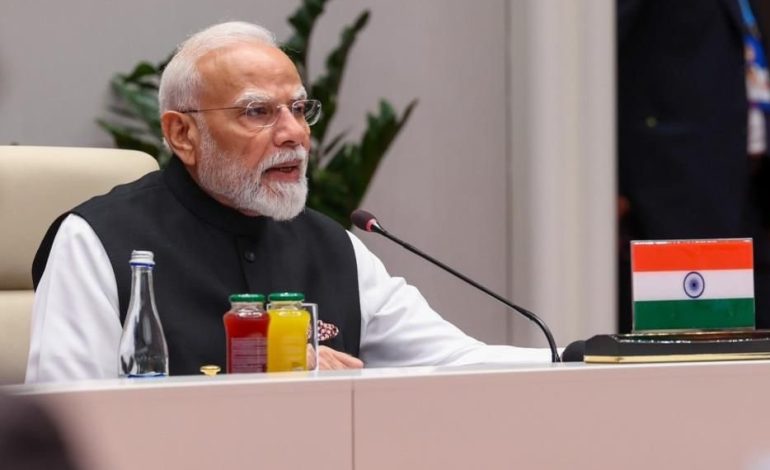
PM Narendra Modi addressing SCO leaders at Bishkek, on September 1, 2026. (Photo: X/@narendramodi)

New Delhi: The prime minister, Narendra Modi, on Tuesday urged Shanghai Cooperation Organisation members to dismantle the networks that finance, recruit, radicalize and shelter terrorists, warning that selective responses had weakened the international fight against the threat. Addressing the 26th SCO Summit in Bishkek with the prime minister of Pakistan, Shehbaz Sharif, in attendance, Modi described terrorism as a grave challenge to humanity that demanded consistent and collective action.
Modi argued that counterterrorism efforts could not remain confined to a cycle of attacks and retaliatory measures, as eliminating individual perpetrators would leave the broader support structure intact. Countries that employ terrorism as an instrument of state policy or provide protection to violent groups must be told that “terrorism cannot be a strategic asset for anyone,” he said.
The prime minister did not identify any country, but the presence of Sharif gave his remarks an unmistakable diplomatic context because India has consistently accused Pakistan-based organizations and their patrons of directing cross-border terrorism against it. Islamabad denies supporting terrorism and maintains that it has itself suffered heavily from extremist violence.
Modi’s intervention also highlighted the difficulty the SCO has faced in reconciling the competing security narratives of India and Pakistan, despite counterterrorism being one of the organization’s foundational priorities. An SCO defence ministers’ meeting in Qingdao in June 2025 ended without a joint statement after India objected to a draft that omitted the Pahalgam terrorist attack while referring to violence in Pakistan’s Balochistan province.
The dispute was partly resolved at the September 2025 leaders’ summit in Tianjin, where the SCO declaration condemned the Pahalgam attack and called for those responsible to be brought to justice. The episode nevertheless exposed how disagreements between member states can impede a grouping that formally treats terrorism, separatism and extremism as common regional threats.
The SCO already has a permanent regional anti-terrorist structure, headquartered in Tashkent, which coordinates cooperation among member states against terrorist and extremist organizations. Modi called for this and related mechanisms dealing with organized crime, information security and narcotics to become channels for practical coordination and timely action rather than remain largely consultative platforms.
He also identified drug trafficking as a growing danger to young people and regional stability, pointing to the overlap between narcotics networks, organized crime and terrorist financing. The emphasis expanded India’s security argument beyond attacks themselves to the illicit financial and logistical systems that allow armed groups to survive.
Modi linked the prospect of a secure Eurasian region to peace and stability in Afghanistan, saying India would continue its development and humanitarian assistance for the Afghan people. New Delhi has maintained contact with the Taliban authorities and supplied humanitarian aid without formally recognizing their government, while continuing to press for an inclusive political order and safeguards against Afghan territory being used by terrorist groups.
Turning to conflicts beyond the SCO region, Modi said wars could not be contained within national frontiers because their consequences disrupted energy security, maritime commerce and international supply chains. Countries of the Global South carried a disproportionate share of those costs, he said, reiterating India’s position that conflicts must be settled through dialogue and diplomacy rather than on the battlefield.
Connectivity formed the second pillar of Modi’s formulation of the SCO, alongside security and opportunity, with India supporting corridors that connect markets, facilitate trade and create new avenues for development. He added, however, that such projects must respect national sovereignty and territorial integrity – language reflecting India’s longstanding opposition to the China-Pakistan Economic Corridor because sections of it pass through Pakistan-occupied Kashmir.
Under the opportunity component, Modi said the value of regional cooperation should be measured by tangible outcomes, including employment for young people, wider markets for entrepreneurs, technological support for farmers and improvements in everyday life. He cited Indian initiatives such as the SCO start-up forum, young authors’ conclave and young scientists’ forum as attempts to extend cooperation beyond governments and security agencies.
The Bishkek summit marked the SCO’s 25th anniversary and brought together leaders from its 10 member states, including China, Russia, India, Pakistan and Iran. Earlier, as RNA Media reported earlier, Modi briefly shook hands with the Chinese president, Xi Jinping, signalling a further thaw in the relationship between New Delhi and Beijing following the May 2000 Galwan valley clash. India has been a full member since 2017 and continues to use the forum to deepen engagement with Central Asia, while pressing for greater clarity on terrorism and sovereignty within a grouping whose members often hold sharply different strategic interests.