
Gwadar’s War Dividend: Why Pakistan’s Latest Port Surge Is Built to Fade
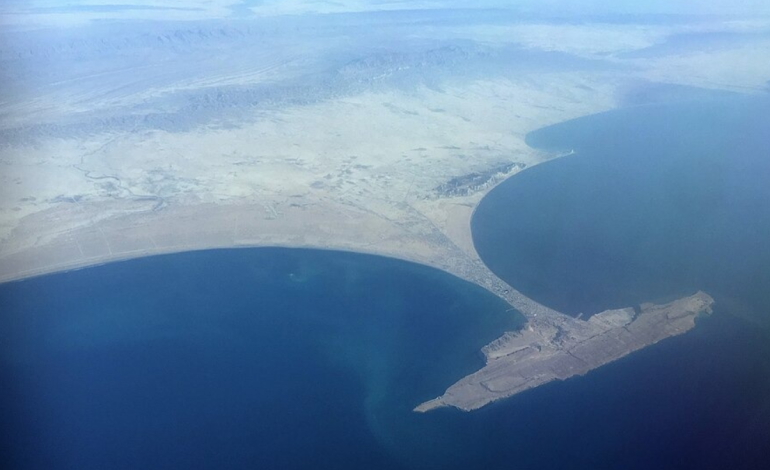
Gwadar strategic reality. Image courtesy: Wikimedia

The recent spike in activity at Gwadar Port is being projected in Pakistan as a long-awaited strategic breakthrough. That interpretation is not just premature—it is analytically flawed. The surge is not the product of Gwadar’s intrinsic strength, but a direct consequence of the ongoing Iran war and the near collapse of maritime traffic through the Strait of Hormuz. In other words, Gwadar is not rising because it has become indispensable; it is rising because the region’s primary trade artery is temporarily dysfunctional.
The scale of disruption in Hormuz is unprecedented. Shipping traffic, which normally averages around 100 vessels per day, has collapsed dramatically due to the conflict, with just 154 vessels recorded crossing in the entire month of March — roughly 5 per day, or about 5% of the pre-war average.
This is not a marginal fluctuation; it is a systemic shock. The Iran war, which began in February 2026, triggered a dual blockade dynamic: Iranian restrictions on passage combined with a U.S. naval blockade targeting Iranian ports. The result has been a near paralysis of one of the world’s most critical maritime chokepoints, through which roughly 20% of global oil trade normally flows.
It is within this extraordinary disruption that Gwadar’s current “success” must be understood.
Shipping companies are not choosing Gwadar because it is efficient, secure, or commercially superior. They are using it because they have fewer options. When Hormuz becomes risky, congested, or effectively closed, cargo must be diverted temporarily to alternative nodes. Gwadar is benefiting from this diversion, not from a structural shift in global trade patterns. That distinction is critical because diversion traffic is inherently reversible. Once the crisis subsides, the traffic will revert.
Pakistan’s attempt to frame this moment as a strategic validation is, therefore, misleading. Ports do not become major hubs because of geopolitical emergencies; they become hubs because they offer reliability across time. Gwadar has never demonstrated that capacity. Even during periods of relative calm, its throughput has remained minimal, its infrastructure underdeveloped, and its integration with hinterland supply chains incomplete. One month of elevated activity, driven by war conditions, does not erase years of underperformance.
In fact, Pakistan’s own actions reveal how contingent this surge really is. Islamabad has moved quickly to exploit the Iran war by opening overland transit routes for goods destined for Iran, effectively turning Gwadar and other ports into logistical workarounds for a sanctioned and blockaded economy. This is not evidence of Gwadar’s strength; it is evidence of opportunism. Pakistan is inserting itself into a crisis-driven supply chain distortion, hoping to extract short-term gains while presenting it as long-term relevance.
But such opportunism carries its own risks. By aligning Gwadar’s current utility so closely with the Iran conflict, Pakistan is tying the port’s fortunes to an inherently unstable geopolitical environment. The moment tensions de-escalate, whether through ceasefire stabilization, negotiated maritime security arrangements, or reduced enforcement of blockades – the rationale for rerouting cargo through Gwadar will weaken. Shipping firms, which are fundamentally risk-averse, will return to established, predictable routes that offer better infrastructure, deeper capacity, and lower security premiums.
This is where the illusion collapses. Gwadar is not competing with a disrupted Hormuz; it is competing with normalized maritime geography. And in that competition, it remains structurally disadvantaged. It lacks the depth, connectivity, and ecosystem of established regional ports.
More importantly, it remains embedded in Balochistan, a region marked by persistent insurgency and political instability. These are not temporary variables; they are enduring constraints that no short-term traffic spike can offset.
The broader lesson is straightforward. Gwadar’s rise today is a function of war, not of capability. It is benefiting from what can be described as a “conflict dividend”, a temporary influx of activity generated by the breakdown of normal trade routes. But conflict dividends are, by definition, unsustainable.
They disappear when stability returns. Pakistan, however, appears determined to misread this moment. By presenting Gwadar as a rising hub rather than a temporary substitute, it risks overcommitting politically and economically to a narrative that cannot be sustained. This is a familiar pattern: inflate success during crisis, ignore structural weaknesses, and hope perception substitutes for reality. It rarely ends well.
Gwadar’s current activity is real, but its implications are being exaggerated. The port is not emerging as a new centre of gravity in regional trade. It is functioning as a contingency outlet during an extraordinary geopolitical disruption. When the Iran war subsides and the Strait of Hormuz reopens to normal traffic flows, Gwadar will face the same test it has always failed: proving that it can attract and sustain trade in the absence of crisis.
Until then, its rise remains what it truly is—a temporary phenomenon, born out of war, and destined to fade with it.