




War, vanishing aid and El Nino push millions towards starvation; UN flags 16 global hunger hotspots
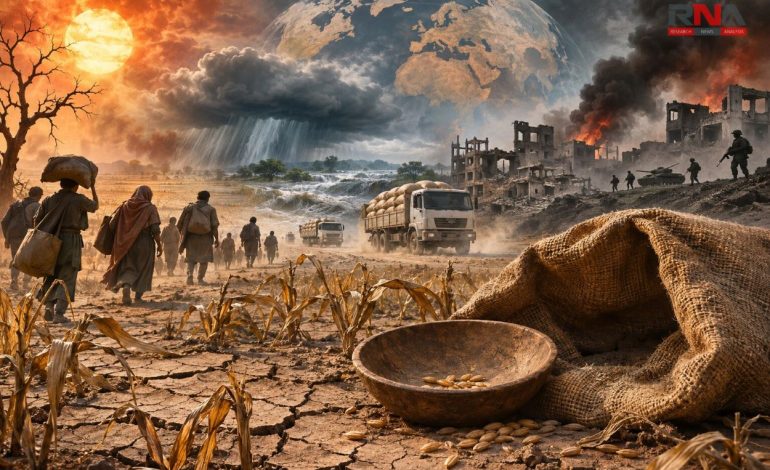
RNA Media illustration for representation.

New Delhi: Millions of people across Africa, West Asia and other vulnerable regions face a worsening food crisis over the next six months as armed conflicts, soaring energy prices, dwindling humanitarian assistance and extreme weather threaten their survival. Two United Nations agencies warned on Friday that Sudan, South Sudan, Yemen, Somalia and northern Nigeria face the gravest threats, with famine looming over parts of Africa.
The warning came in the latest joint Hunger Hotspots report released by the Food and Agriculture Organization (FAO) and the World Food Programme (WFP) on Friday. Covering the period from December this year to May 2027, the assessment identifies 16 countries and geographical regions where acute food insecurity is expected to deteriorate significantly, compared with 13 in June.
Armed violence remains a principal cause of food insecurity in 12 of the 16 hotspots, while the economic repercussions of the conflict in West Asia are being felt far beyond the region. Rising fuel, transportation and agricultural production costs are making essential food supplies increasingly unaffordable for populations already struggling with poverty and displacement.
Compounding the crisis is a sharp contraction in international humanitarian funding. Financial assistance for food security and nutrition across the five worst-affected hotspots declined by 62 per cent between 2022 and 2025, falling from $5.1 billion to $2 billion.
Sudan faces mounting famine threat
Sudan, where a civil war between the Sudanese Armed Forces and the paramilitary Rapid Support Forces has raged since April 2023, remains among the most disturbing humanitarian emergencies. Nearly 19.5 million people, representing around 41 per cent of the country’s population, were experiencing crisis-level food insecurity or worse in the latest nationwide assessment.
The UN agencies warned that famine could occur in 13 areas across North Darfur and South Kordofan through January 2027 under a reasonably foreseeable worst-case scenario. Acute malnutrition in two camps sheltering displaced civilians in South Darfur has already crossed the threshold associated with famine, although that alone does not constitute a formal famine classification.
The conflict has severely disrupted agricultural production, commercial supply networks and humanitarian operations. According to the Associated Press, the prices of sorghum, a staple grain in Sudan, and diesel have more than doubled over the past year.
Yemen caught between war and maritime insecurity
In Yemen, renewed fighting since July has threatened to reverse the limited humanitarian gains made during an earlier period of relative calm. The country has been embroiled in conflict since 2014, when the Iran-backed Houthis seized the capital, Sanaa, prompting a Saudi-led military intervention the following year.
As RNA Media reported earlier, recent Houthi advances towards Aden have heightened concerns over the humanitarian situation. More than 360,000 people have been displaced since early August, according to UN figures released earlier this week.
Yemen’s heavy dependence on imported food and fuel makes it particularly vulnerable to maritime disruptions. Insecurity around the Red Sea and the Bab al-Mandab strait, coupled with higher shipping and insurance costs, threatens to make basic commodities even more expensive.
Meanwhile, international food and nutrition assistance to Yemen declined by 79 per cent between 2022 and 2025, leaving humanitarian organizations with considerably fewer resources to address rising demand.
El Nino opens new fronts in global hunger crisis
The emerging El Nino weather phenomenon, characterized by unusually warm surface waters in the equatorial Pacific Ocean, is expected to intensify food insecurity across several continents. Its effects could range from prolonged drought and crop failures in some regions to destructive flooding in others.
Southern Africa, the Central American Dry Corridor and northeastern Uganda have been added to the hunger hotspots list largely because of weather-related risks. Chad has also been included, principally because of the humanitarian and economic consequences of the conflict in neighbouring Sudan.
In southern Africa, Zimbabwe, Malawi and Mozambique together could see around 7.4 million people experiencing high levels of acute food insecurity through March 2027. In Central America, unusually dry conditions during the first agricultural season of 2026 resulted in extensive crop losses, threatening rural livelihoods and household food reserves.
The FAO and WFP have drawn up a joint anticipatory action programme intended to protect nine million people across 22 countries from the consequences of El Nino.
Gaza remains vulnerable despite ceasefire
Afghanistan, the Democratic Republic of the Congo, Haiti and Palestine have been placed in the second-highest risk category. Although food availability in the Gaza Strip has improved following the October 2025 ceasefire, the UN agencies cautioned that the recovery remains fragile.
The destruction of civilian infrastructure, limited livelihood opportunities and continued dependence on humanitarian supplies leave Gaza vulnerable to renewed food shortages. Conditions in the West Bank are also expected to deteriorate.
When does a hunger crisis become a famine?
Under the internationally recognized Integrated Food Security Phase Classification (IPC), famine is the most severe manifestation of acute food insecurity. Its classification requires extreme food deprivation among at least 20 per cent of households, acute malnutrition reaching specified thresholds among children and exceptionally high hunger-related mortality.
However, humanitarian agencies emphasize that intervention must begin well before these thresholds are reached. By the time famine is formally established, widespread starvation and preventable deaths are already occurring.
Humanitarian crisis with geopolitical consequences
At a UN briefing on Friday, officials identified disruptions to commercial routes through the Strait of Hormuz, the Red Sea and the Black Sea as contributing to rising agricultural and commodity prices. These developments illustrate how geographically distinct conflicts can collectively undermine food security across the developing world.
Beyond the immediate humanitarian emergency, prolonged food shortages risk accelerating cross-border migration, aggravating political instability and intensifying competition over scarce resources. The UN agencies have called for greater diplomatic intervention, predictable humanitarian funding, unhindered access to affected populations and timely agricultural assistance.
Their assessment makes clear that famine is not an inevitable consequence of war or adverse weather. Whether the worsening hunger crisis develops into a much larger humanitarian catastrophe will depend substantially on the international community’s response over the coming months.