
Trump administration restores Pacific Command name, raises questions over Indo-Pacific strategy
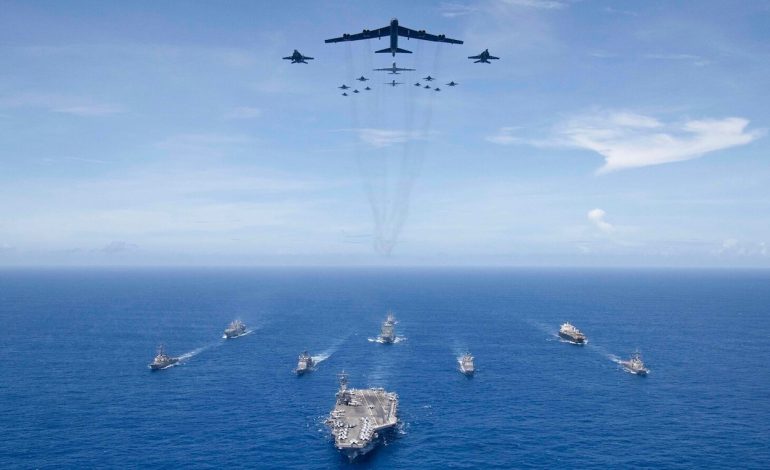
A US Indo-Pacific Command carrier battle group led by USS Ronald Reagan and a US Air Force B-52 strategic bomber, in 2020. (Photo for representation via US Navy)

New Delhi: The United States has reversed an eight-year-old decision that symbolically placed India at the centre of Washington’s strategic outlook towards Asia. The administration of the US president, Donald Trump, restored the name of the United States Indo-Pacific Command (USINDOPACOM) to the United States Pacific Command (USPACOM).
In an announcement on Tuesday, the US Department of War said the command would revert to its historic designation, arguing that the move honours the command’s legacy dating back to January 1, 1947. The department described USPACOM as the oldest and largest US unified combatant command and said the restoration would reinforce institutional heritage, military tradition, and the command’s longstanding partnerships across the Pacific region.
The Pentagon stressed that the change was purely nominal. It said the command’s area of responsibility would remain unchanged, stretching from the western coast of the US to India’s western boundary. The command’s mission, force posture, alliances, and commitment to maintaining what Washington describes as a “free and open” region would also remain intact.
The decision nevertheless carries strategic significance because the original renaming from Pacific Command to Indo-Pacific Command in May 2018 by the first Trump administration was not merely administrative but a formal acknowledgement of the growing strategic importance of the Indian Ocean and India’s rising role in US’s regional planning. The move aligned with Washington’s broader “Free and Open Indo-Pacific” strategy and reflected a geopolitical shift driven largely by China’s expanding military and economic influence.
At the time, the renaming was widely interpreted as a signal that the US no longer viewed the Pacific and Indian Oceans as separate theatres but as a single interconnected strategic space. For India, it represented one of the clearest institutional recognitions by Washington of New Delhi’s growing importance in regional security architecture.
The latest reversal therefore raises a broader question: does the return to USPACOM represent a substantive shift in American strategy or merely a symbolic recalibration by the Trump administration?
More than a name change
Officially, Washington is presenting the move as a restoration of historical identity rather than a strategic adjustment. However, names matter in geopolitics because they often reflect how governments conceptualize regions and prioritize partnerships.
Several factors may explain the decision.
First, the Trump administration has consistently shown a preference for restoring historical nomenclature and institutions associated with earlier eras of American power. Reinstating USPACOM fits that pattern and allows the administration to emphasize continuity with the command’s Cold War legacy.
Second, the administration may believe that the term “Indo-Pacific” has become associated with a specific strategic doctrine developed across multiple administrations, including those of Barack Obama and Joe Biden. Returning to Pacific Command could be an attempt to reframe American regional strategy under a different political banner without necessarily changing underlying policies.
Third, the move may reflect a desire to simplify military branding. Despite widespread adoption of the term “Indo-Pacific” across diplomatic and strategic circles, many American military officers and veterans continue to associate the command with its decades-long Pacific Command identity.
Importantly, none of these explanations necessarily imply a reduced American commitment to Asia or a retreat from competition with China. The command’s operational responsibilities, force deployments, and alliance structures remain unchanged.
Indeed, if Washington intended to reduce its regional footprint, a mere name change would be among the least consequential ways of doing so.
Is Washington junking the Indo-Pacific concept?
The short answer is no. The “pivot to Asia” – later refined into the Indo-Pacific strategy – is rooted in structural geopolitical realities rather than terminology. The rise of China as a military, economic, and technological competitor remains the central driver of American strategy in Asia.
Successive US administrations, despite significant political differences, have broadly agreed on one point: the Indo-Pacific region is the primary theatre of long-term strategic competition in the 21st century.
The original Obama-era “rebalance to Asia” focused on redirecting diplomatic, military, and economic attention towards Asia-Pacific. During Trump’s first term, that framework evolved into the “Free and Open Indo-Pacific” concept, placing greater emphasis on strategic competition with China and elevating India’s role. The Biden administration subsequently retained and expanded many of those elements.
That continuity suggests that the underlying strategy enjoys bipartisan support in Washington.
Moreover, the institutions underpinning the Indo-Pacific concept remain firmly in place. Defence cooperation agreements between India and the United States continue to operate. Military exercises such as Malabar remain active. Intelligence-sharing mechanisms have expanded over the past decade. American force posture adjustments across the western Pacific and Indian Ocean also remain intact.
The strategic logic that drove the adoption of the Indo-Pacific concept has not disappeared. China’s growing naval presence in the Indian Ocean, its expanding overseas military footprint, and its increasing influence across maritime Asia continue to bind the Pacific and Indian Oceans into a single strategic theatre.
For that reason, reverting to USPACOM is unlikely to signal a return to the older Asia-Pacific framework that largely treated India as a peripheral actor.
A message to India?
The restoration of the Pacific Command name will inevitably be scrutinized in New Delhi because India was the biggest symbolic beneficiary of the 2018 renaming.
Yet the command’s area of responsibility remains unchanged. India remains within the same strategic geography managed by the command. No operational boundaries have been altered. No alliance structures have been modified. No defence agreements have been rescinded.
This suggests that the move is not directed specifically at India.
Rather, it appears to be part of a broader effort by the Trump administration to reshape institutional branding while emphasizing historical continuity. The administration itself has gone out of its way to state that the command’s western boundary remains India’s western border – an unusual detail that appears designed precisely to reassure partners that geography and missions are unchanged.
If Washington intended to downgrade India’s strategic importance, it would likely do so through policy decisions, force reallocations, defence cooperation reductions, or diplomatic signals rather than through nomenclature alone.
That said, symbolism matters in international relations. The removal of “Indo” from the command’s title inevitably weakens a powerful political signal that had highlighted India’s central role in regional strategy.
What does it mean for India and Quad?
For India, the practical implications appear limited, at least for now, because the trajectory of India-US defence ties has been driven by converging interests rather than symbolic gestures. Bilateral military cooperation has expanded steadily over the past two decades under governments of different political persuasions in both countries.
That cooperation is anchored in shared concerns about maritime security, regional stability, technological collaboration, and China’s growing military capabilities. The Quad – comprising India, United States, Japan, and Australia – also derives its relevance from strategic realities rather than command nomenclature.
The grouping has evolved beyond its original security focus into areas including critical technologies, supply-chain resilience, maritime domain awareness, cybersecurity, and infrastructure cooperation. None of those initiatives depends on whether the American command overseeing the region is called Indo-Pacific Command or Pacific Command.
However, New Delhi will likely watch closely for any follow-on policy changes. If the renaming is accompanied by broader shifts in regional priorities, alliance management, or force posture, analysts may eventually interpret it as part of a larger strategic recalibration. At present, there is little evidence of such a shift.
The more likely interpretation is that the administration is separating strategic substance from institutional branding. The name may have changed, but the strategic challenges that gave rise to the Indo-Pacific concept remain largely unchanged.
Although the restoration of the Pacific Command name is politically and symbolically significant, it does not yet amount to a strategic reversal. The United States remains deeply engaged in Asia, continues to view China as its principal long-term competitor, and retains the same military geography that includes India within its regional command structure.
For India, the development warrants attention but not alarm. The real test will not be the command’s title but whether future American policies, military deployments, and diplomatic initiatives continue to treat the Indian and Pacific Oceans as a single strategic space. So far, the evidence suggests they do.